Mississippi Science L.4.2
Standard Cluster
Students will demonstrate an understanding of life cycles, including familiar plants and animals (e.g., reptiles, amphibians, or birds). Compare and contrast life cycles of familiar plants and animals. Develop and use models to explain the unique and diverse life cycles of organisms other than humans (e.g., flowering plants, frogs, or butterflies) including commonalities (e.g., birth, growth, reproduction, or death).
2026 Mississippi College- and Career-Readiness Standards for Science · Reproduction and Heredity
Cluster contents
Standards in This Cluster
L.4.2 is a cluster heading. These are the individual standards under it.
Teacher's field guide
What This Cluster Means
What Students Need to Do
- Students put the stages of a flowering plant and an animal in order. They draw models showing how adults produce offspring, then compare what is shared and what is different.
What Mastery Looks Like
- A student can label a frog’s egg, tadpole, froglet, and adult stages, and a bean plant’s seed, seedling, flowering plant, and new seeds. Their arrows show adults producing a new generation, not returning to their own first stage.
Common Misconceptions
- Some students think a tadpole is a different animal from a frog, or that a chrysalis is a butterfly egg. Others draw the adult changing back into an egg instead of producing offspring.
How to Assess It
- On an exit ticket, have students draw and label a frog and bean plant life cycle. Ask them to name one change both share and one difference.
Lesson moves
Ways to Teach It
Give pairs frog and bean plant stage cards to order, then use yarn arrows to show adults producing new offspring.
Have students write two sentences answering, “How is a seed like a frog egg, and how is it different?”
Play a relay where teams order butterfly stage cards, then point to the stage that produces new eggs.
Open a bean pod, count its seeds, and sketch how one seed can grow into a plant that makes more pods.
Free download
Printable L.4.2 Worksheet
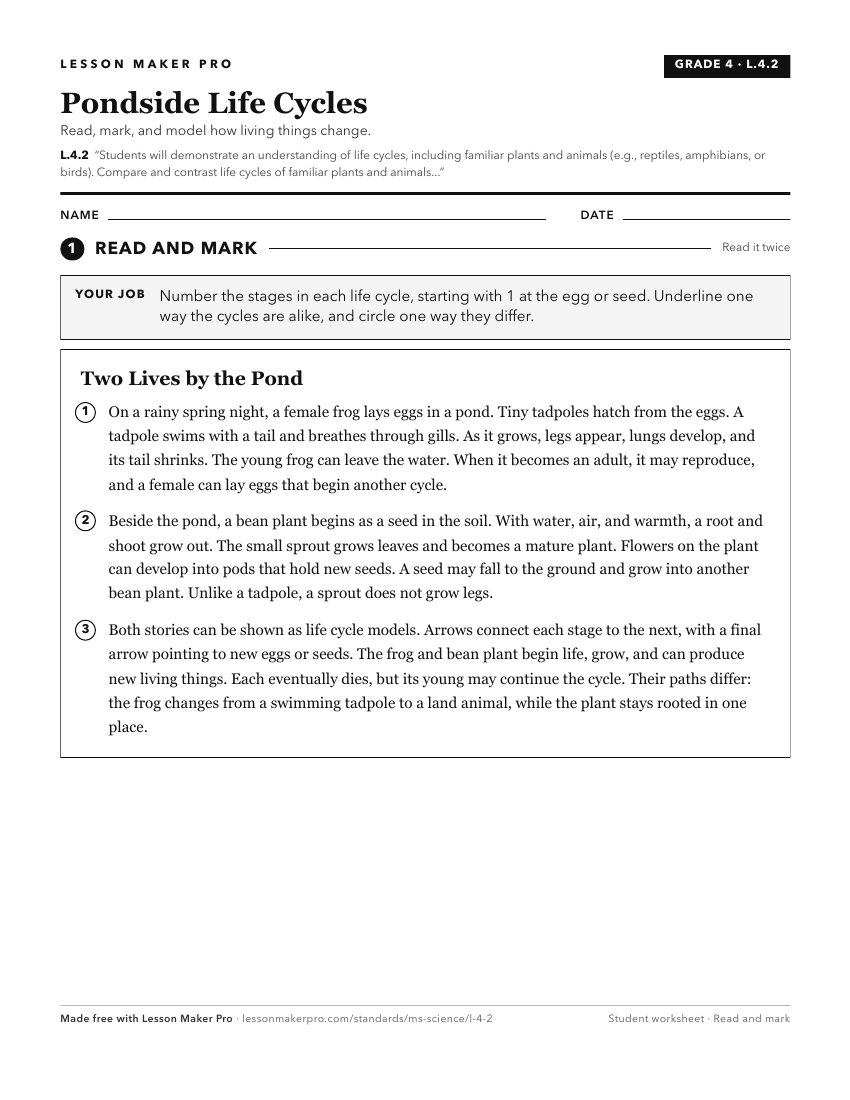
A ready-to-print activity worksheet aligned to L.4.2, with an answer key for the teacher on its own page. No account needed.
PDF, US Letter, prints cleanly in black and white.
Download the worksheetKeep exploring
Related Standards
- L.K.1A
Students will demonstrate an understanding of living and non-living things.
- L.K.2
Students will demonstrate an understanding of how living things change in form as they go through the general stages of a life cycle.
- L.1.2
Students will demonstrate an understanding of how living things change in form as they go through the general stages of a life cycle
- L.2.2
Students will demonstrate an understanding of how living things change in form as they go through the general stages of a life cycle.
Turn this cluster into a lesson
Grade, subject, topic, and the complete cluster are prefilled. Create one free, no account needed.
Also for this cluster:Make a WorksheetMake a QuizMake a Sub Lesson