Mississippi Science L.K.2
Standard Cluster
Students will demonstrate an understanding of how living things change in form as they go through the general stages of a life cycle. Use informational text or other media to make observations about plants as they change during the life cycle (e.g., germination, growth, reproduction, and death) and use models (e.g., drawing, writing, dramatization, or technology) to communicate findings. Construct explanations using observations to describe and model the life cycle (birth, growth, adulthood, death) of a familiar mammal (e.g., dog, squirrel, rabbit, deer). With teacher guidance, conduct a structured investigation to observe and measure (comparison of lengths) the changes in various individuals of a single plant species from seed germination to adult plants. Record observations using drawing or writing. Use observations to explain that young plants and animals are similar but not exactly like their parents (i.e., puppies look similar, but not exactly like their parents).
2026 Mississippi College- and Career-Readiness Standards for Science · Reproduction and Heredity
Cluster contents
Standards in This Cluster
L.K.2 is a cluster heading. These are the individual standards under it.
- L.K.2.1
Use informational text or other media to make observations about plants as they change during the life cycle (e.g., germination, growth, reproduction, and death...
- L.K.2.2
Construct explanations using observations to describe and model the life cycle (birth, growth, adulthood, death) of a familiar mammal (e.g., dog, squirrel, rabb...
- L.K.2.3
With teacher guidance, conduct a structured investigation to observe and measure (comparison of lengths) the changes in various individuals of a single plant sp...
Teacher's field guide
What This Cluster Means
What Students Need to Do
- Children use pictures and real plants to see how a seed sprouts, grows, makes seeds, and dies. They draw a dog's life from birth to death and compare a puppy with its parent. They measure and draw several bean plants of the same kind as they grow.
What Mastery Looks Like
- A child puts bean plant pictures in order and points to pods as the source of new seeds. They draw a puppy growing into an adult dog and explain that its life ends. They record plant lengths with cubes and name one way a puppy looks like its parent and one way it differs.
Common Misconceptions
- Children may think a seed is not living because it does not move. They may place a pod before a sprout or think a plant dies as soon as it makes seeds. Some think puppies look exactly like their parents or that all bean plants grow the same amount.
How to Assess It
- Give each child pictures of a bean seed, sprout, plant with pods, and dried plant. Ask them to put the pictures in order and point to where new seeds come from.
Lesson moves
Ways to Teach It
Plant three sprouted bean seeds in labeled cups, measure each shoot with cubes, and start a weekly picture-and-cube-count chart.
Show a photo of a puppy beside its parent; ask, 'Which parts look alike, and which look different?' Record two observations.
Give groups bean seed, sprout, flowering plant, pod, and dried plant cards to order, then ask where the next seed comes from.
Open a green bean pod from the grocery store, count its seeds, and ask how those seeds could become new plants.
Free download
Printable L.K.2 Worksheet
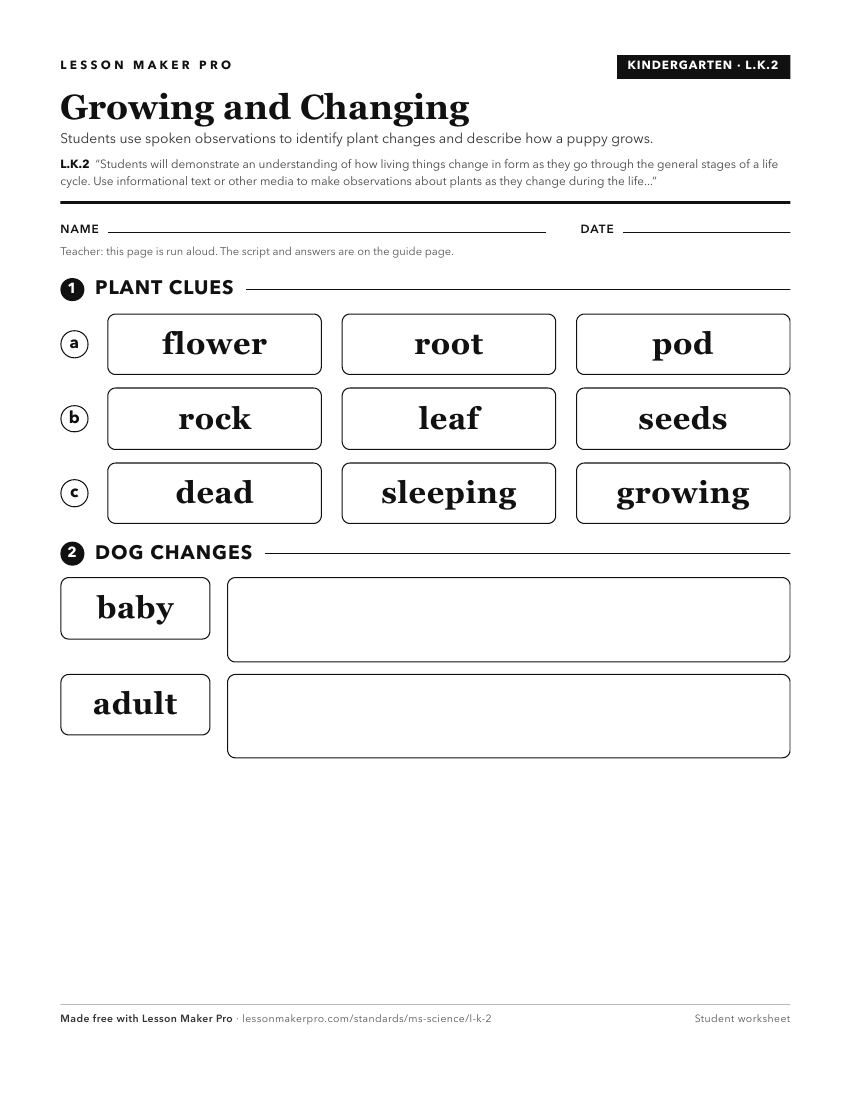
A ready-to-print activity worksheet aligned to L.K.2, with an answer key for the teacher on its own page. No account needed.
PDF, US Letter, prints cleanly in black and white.
Download the worksheetKeep exploring
Related Standards
- L.4.2
Students will demonstrate an understanding of life cycles, including familiar plants and animals (e.g., reptiles, amphibians, or birds).
- L.K.1A
Students will demonstrate an understanding of living and non-living things.
- L.1.2
Students will demonstrate an understanding of how living things change in form as they go through the general stages of a life cycle
- L.2.2
The 2nd Grade version of this standard.
Turn this cluster into a lesson
Grade, subject, topic, and the complete cluster are prefilled. Create one free, no account needed.
Also for this cluster:Make a WorksheetMake a QuizMake a Sub Lesson