Mississippi Science FB.6.1
The Standard
- FB.6
- Students will understand the interdependence of living organisms and their environment.
Compare and contrast biotic and abiotic factors.
2026 Mississippi College- and Career-Readiness Standards for Science · Ecological Principals
Teacher's field guide
What This Standard Means
What Students Need to Do
- Students identify living, once-living, and nonliving parts of an ecosystem. They compare their roles and explain how a change in water or light affects organisms.
What Mastery Looks Like
- A student identifies grass, fungi, and a fallen leaf as living or once living, and rocks and sunlight as nonliving. They explain how less rain can reduce grass growth and leave grasshoppers with less food.
Common Misconceptions
- Students may call plants nonliving because they do not move. They may think a fallen leaf was never living because it is dead. They may treat soil as wholly nonliving, overlooking worms and microbes.
How to Assess It
- Exit ticket: Classify algae, fish, sunlight, and water in a pond as living or nonliving. Explain one way sunlight affects algae.
Lesson moves
Ways to Teach It
Give pairs a potted plant, fallen leaf, pebble, and cup of water to sort; ask them to explain each choice.
Ask students to write two sentences explaining what might happen to algae and fish if a pond gets less sunlight.
Play a card sort with mushroom, rock, earthworm, rain, dead leaf, and bacteria; require a reason for every placement.
Use a local weather report to predict how a dry week might change grass growth and insect numbers in the schoolyard.
Free download
Printable FB.6.1 Worksheet
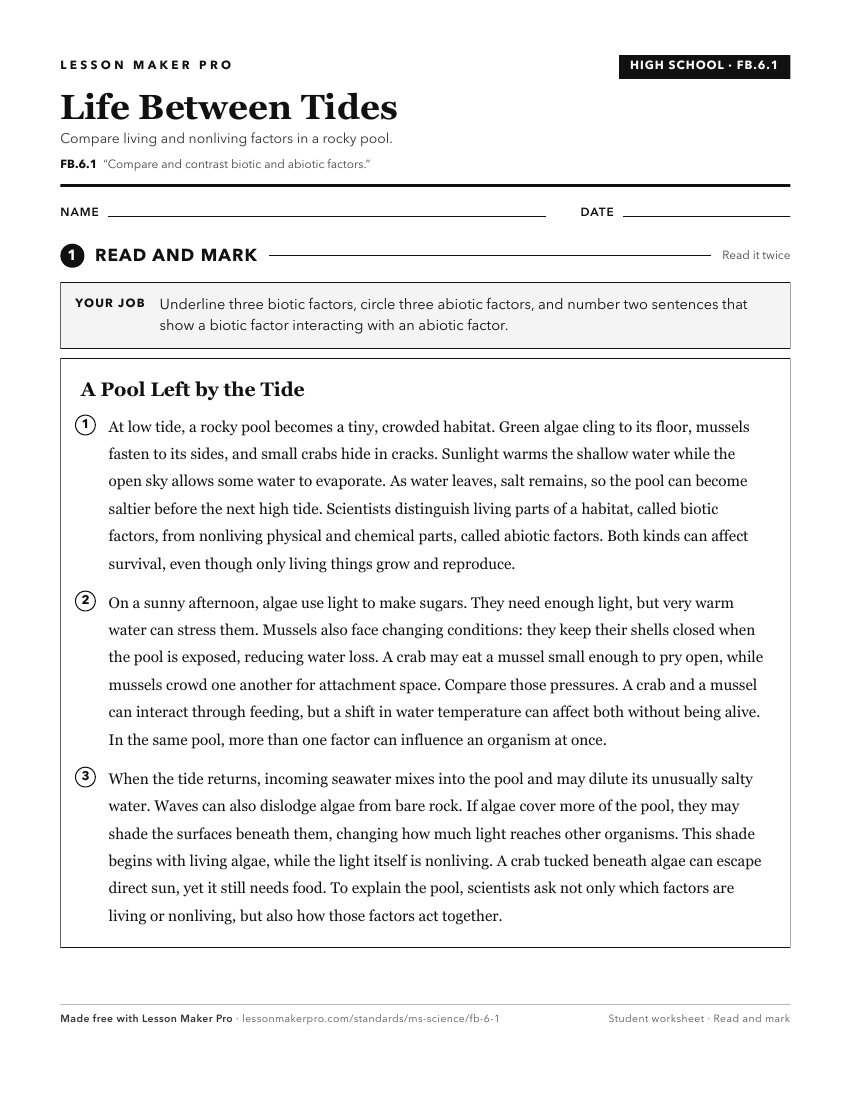
A ready-to-print activity worksheet aligned to FB.6.1, with an answer key for the teacher on its own page. No account needed.
PDF, US Letter, prints cleanly in black and white.
Download the worksheetKeep exploring
Related Standards
- MAQ.4.1
Compare and contrast the unique biotic and abiotic characteristics of the following selected aquatic ecosystems: intertidal zone, wetlands/estuaries, coral reef...
- L.6.3.1
Use scientific reasoning to explain differences between biotic and abiotic factors that demonstrate what living organisms need to survive.
- ENV.1.1
Identify, investigate, and evaluate the interactions of the abiotic and biotic factors that determine the types of organisms that live in major biomes.
- L.4.2.1
Compare and contrast life cycles of familiar plants and animals.
Turn this exact standard into a lesson
Grade, subject, topic, and the complete standard are prefilled. Create one free, no account needed.
Also for this standard:Make a WorksheetMake a QuizMake a Sub Lesson