Mississippi Science BIO.1A.1
The Standard
- BIO.1A
- Students will demonstrate an understanding of the characteristics of life and biological organization.
Develop criteria to differentiate between living and non-living things.
2026 Mississippi College- and Career-Readiness Standards for Science · Cells as a System
Teacher's field guide
What This Standard Means
What Students Need to Do
- Students use evidence such as cells, energy use, and response to surroundings to decide whether something is alive. They explain why one trait, like growing, is not enough to decide.
What Mastery Looks Like
- A student can classify a dry seed, a flame, and a salt crystal using more than one trait. They can explain why a dormant seed is alive and a flame is not, even though a flame grows.
Common Misconceptions
- Students may call fire alive because it grows and uses fuel. They may call a dormant seed dead because it does not move, or assume every living individual must be able to reproduce.
How to Assess It
- Exit ticket: Is a dry bean seed alive? Is a candle flame alive? Give two reasons for each answer, and explain why growth alone does not settle the question.
Lesson moves
Ways to Teach It
Examine a fresh Elodea leaf and table salt under a microscope, then sketch the structures visible in each sample.
Ask, "A candle flame grows and uses fuel. Is it alive?" Have students defend an answer using cells and two other traits.
Give pairs cards showing a seed, flame, mushroom, crystal, and toy robot; have them sort the cards and defend one disputed choice.
Mix dry yeast with warm sugar water in a clear cup, check for bubbles after 15 minutes, and connect fermentation to bread rising.
Free download
Printable BIO.1A.1 Worksheet
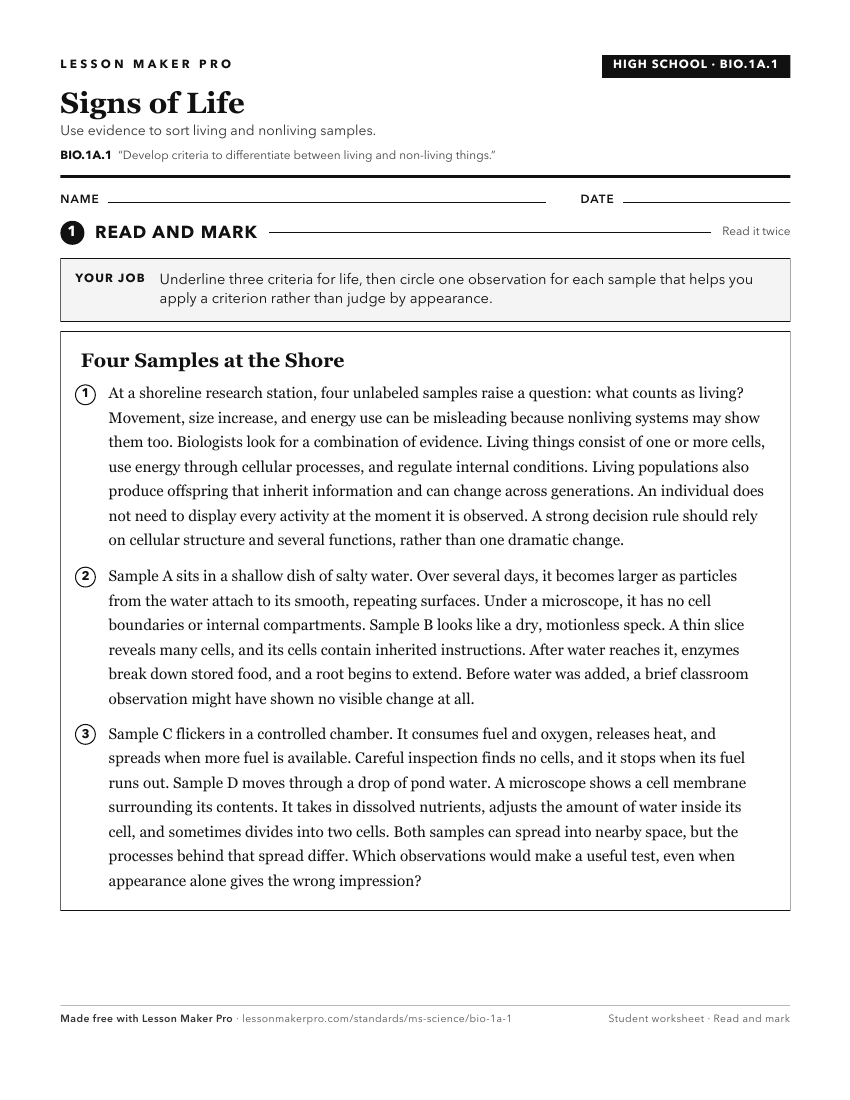
A ready-to-print activity worksheet aligned to BIO.1A.1, with an answer key for the teacher on its own page. No account needed.
PDF, US Letter, prints cleanly in black and white.
Download the worksheetKeep exploring
Related Standards
- L.6.3.1
Use scientific reasoning to explain differences between biotic and abiotic factors that demonstrate what living organisms need to survive.
- L.K.1A.1
With teacher guidance, conduct an investigation of living organisms and non-living objects in various real-world environments to define characteristics of livin...
- L.K.1A
Students will demonstrate an understanding of living and non-living things.
- L.6.1.1
Use argument supported by evidence in order to distinguish between living and non-living things, including viruses and bacteria.
Turn this exact standard into a lesson
Grade, subject, topic, and the complete standard are prefilled. Create one free, no account needed.
Also for this standard:Make a WorksheetMake a QuizMake a Sub Lesson