Mississippi Science L.6.1.1
The Standard
- L.6.1
- Students will demonstrate an understanding that living things range from simple to complex organisms, are organized hierarchically, and function as whole living systems.
Use argument supported by evidence in order to distinguish between living and non-living things, including viruses and bacteria.
2026 Mississippi College- and Career-Readiness Standards for Science · Hierarchical Organization
Teacher's field guide
What This Standard Means
What Students Need to Do
- Students compare cell structure, energy use, and reproduction to decide whether something is living. They support their decisions with evidence, especially when comparing bacteria and viruses.
What Mastery Looks Like
- A student identifies bacteria as living because they are cells that use energy and can divide. The student explains that viruses are usually classified as nonliving because they lack cells and need a host to make copies.
Common Misconceptions
- Some students think all germs are living, so they group viruses with bacteria. Others call a seed nonliving because it is not visibly growing, or call fire living because it spreads.
How to Assess It
- Exit ticket: A bacterium is a cell that uses nutrients and divides. A virus has genetic material but needs a host cell to make copies. Which is living, and which is usually called nonliving? Give one piece of evidence for each answer.
Lesson moves
Ways to Teach It
Have pairs sort picture and fact cards for a seed, rock, bacterium, and virus into living and nonliving piles, recording evidence.
Ask, 'A virus has genes but needs a host cell to make copies. What evidence supports calling it nonliving?'
Play evidence match: teams pair picture cards with cell, energy, and reproduction clues, then defend one classification against a challenge.
Show a yogurt label marked 'live cultures' and a disinfectant label listing bacteria and viruses, then ask which target has cells.
Free download
Printable L.6.1.1 Worksheet
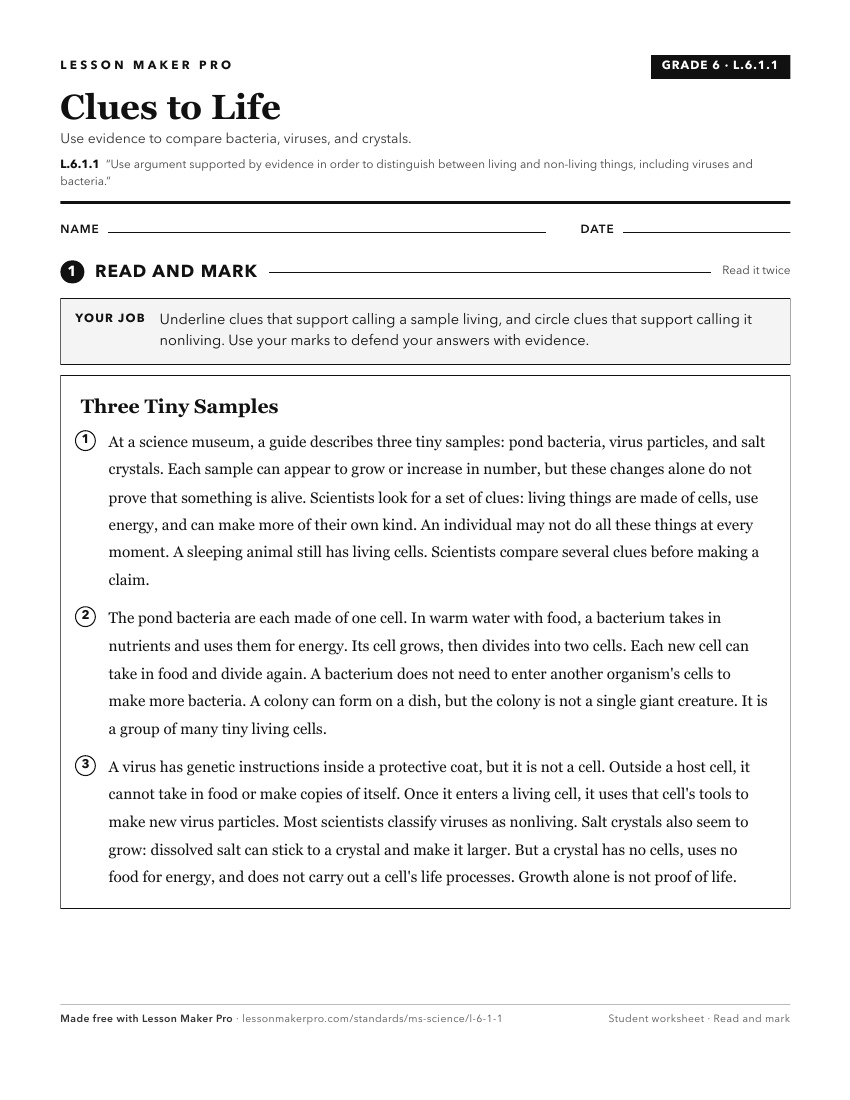
A ready-to-print activity worksheet aligned to L.6.1.1, with an answer key for the teacher on its own page. No account needed.
PDF, US Letter, prints cleanly in black and white.
Download the worksheetKeep exploring
Related Standards
- FB.6.6
Engage in scientific argument from evidence to distinguish organisms that exist in symbiotic (mutualism, parasitism, commensalism) or co-evolutionary (predator-...
- L.6.4.5
Engage in scientific arguments to support claims that bacteria (Archaebacteria and Eubacteria) and viruses can be both helpful and harmful to other organisms an...
- BIO.1A.1
Develop criteria to differentiate between living and non-living things.
- BIO.1A.4
Use evidence from current scientific literature to support whether a virus is living or non-living
Turn this exact standard into a lesson
Grade, subject, topic, and the complete standard are prefilled. Create one free, no account needed.
Also for this standard:Make a WorksheetMake a QuizMake a Sub Lesson