Mississippi Science L.6.4.5
The Standard
- L.6.4
- Students will demonstrate an understanding of classification tools and models such as dichotomous keys to classify representative organisms based on the characteristics of the kingdoms: Archaebacteria, Eubacteria, Protists, Fungi, Plants, and Animals.
Engage in scientific arguments to support claims that bacteria (Archaebacteria and Eubacteria) and viruses can be both helpful and harmful to other organisms and the environment.
2026 Mississippi College- and Career-Readiness Standards for Science · Adaptations and Diversity
Teacher's field guide
What This Standard Means
What Students Need to Do
- Students make claims about how bacteria, archaea, and viruses can help or harm organisms and the environment. They use examples as evidence and explain how each example supports a claim.
What Mastery Looks Like
- A student can explain how yogurt bacteria help, E. coli in water harms, and viruses that kill harmful bacteria can help people. They can also explain how cow-gut archaea aid digestion but release methane, and use flu as an example of a harmful virus.
Common Misconceptions
- Students may call viruses bacteria or assume all bacteria cause illness. They may miss that cow-gut archaea can have both helpful and harmful effects, or assume a virus that kills bacteria must also harm people.
How to Assess It
- Exit ticket: Write one claim about bacteria or archaea and one about viruses. Support each with a helpful and a harmful example from yogurt cultures, E. coli in water, cow-gut archaea, flu, and viruses that kill harmful bacteria.
Lesson moves
Ways to Teach It
Have pairs sort cards for yogurt bacteria, E. coli, cow-gut archaea, flu, and bacteria-killing viruses into helpful, harmful, or both.
Ask: “Can a virus harm one organism but help another?” Have students defend an answer using a card about bacteria-killing viruses.
Play an evidence match game: teams pair claim cards with short facts about decomposers, food poisoning, flu, and bacteria-killing viruses.
Read a yogurt label for live cultures, then compare it with a printed boil-water notice about E. coli contamination.
Free download
Printable L.6.4.5 Worksheet
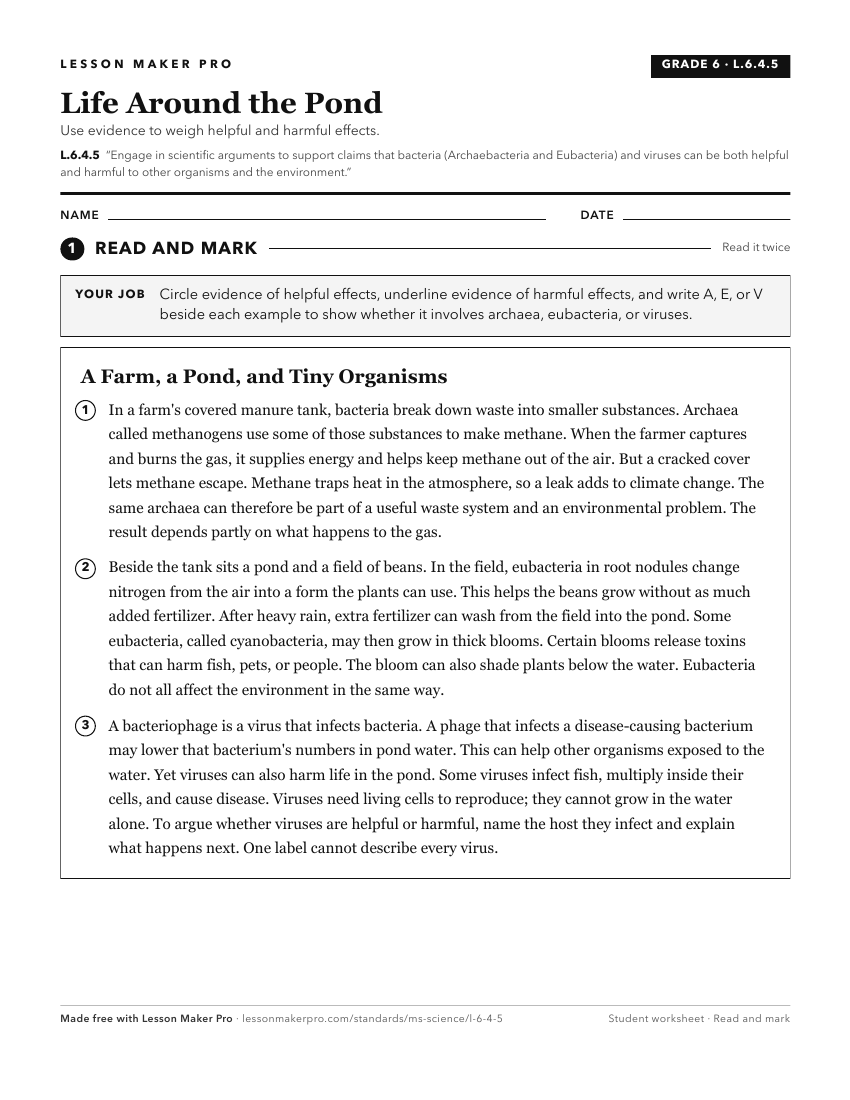
A ready-to-print activity worksheet aligned to L.6.4.5, with an answer key for the teacher on its own page. No account needed.
PDF, US Letter, prints cleanly in black and white.
Download the worksheetKeep exploring
Related Standards
- FB.6.6
Engage in scientific argument from evidence to distinguish organisms that exist in symbiotic (mutualism, parasitism, commensalism) or co-evolutionary (predator-...
- L.8.2C.2
Construct scientific arguments from evidence to support claims about the potentially harmful, beneficial, or neutral effects of genetic mutations on organisms.
- L.6.1.1
Use argument supported by evidence in order to distinguish between living and non-living things, including viruses and bacteria.
- ENV.1.10
Enrichment: Engage in scientific argument from evidence the benefits versus harm of genetically modified organisms.
Turn this exact standard into a lesson
Grade, subject, topic, and the complete standard are prefilled. Create one free, no account needed.
Also for this standard:Make a WorksheetMake a QuizMake a Sub Lesson