Mississippi Science ENV.2.5
The Standard
- ENV.2
- Students will relate the impact of human activities on the environment, conservation activities, and efforts to maintain and restore ecosystems.
Research various resources related to water quality and pollution (e.g., nonfictional text, EPA’s Surf Your Watershed, MDEQ publications) and communicate the possible effects on the environment and human health.
2026 Mississippi College- and Career-Readiness Standards for Science · Natural Resources Use and Conservation
Teacher's field guide
What This Standard Means
What Students Need to Do
- Students use water quality reports and other reliable sources to identify a pollutant, where it may come from, and how it reaches water. They explain possible effects on aquatic life and human health using evidence from those sources.
What Mastery Looks Like
- A student can use a nitrate test result to explain how runoff may lead to algae growth and lower oxygen for fish. They can describe the risk to infants if nitrate reaches drinking water, without claiming a stream test proves tap water is unsafe.
Common Misconceptions
- Students may assume clear water is safe or that pollution in a stream always reaches household taps. They may treat one test result as proof of where the pollution came from.
How to Assess It
- Exit ticket: A stream report shows high nitrate downstream of farms. Explain one possible effect on fish and one possible health risk if the water enters a drinking supply.
Lesson moves
Ways to Teach It
Build a sloped tray watershed with paper farms, sprinkle cocoa on one slope, pour water, and watch runoff reach a model stream.
Compare a local water report with an EPA pollutant fact sheet, then write two sentences separating measured pollution from possible health effects.
Sort cards labeled fertilizer, runoff, nitrate, algae, low oxygen, and fish deaths into a cause-and-effect chain, then explain each link.
Find a public water utility's annual water report, circle one measured contaminant, and compare its level with the listed limit.
Free download
Printable ENV.2.5 Worksheet
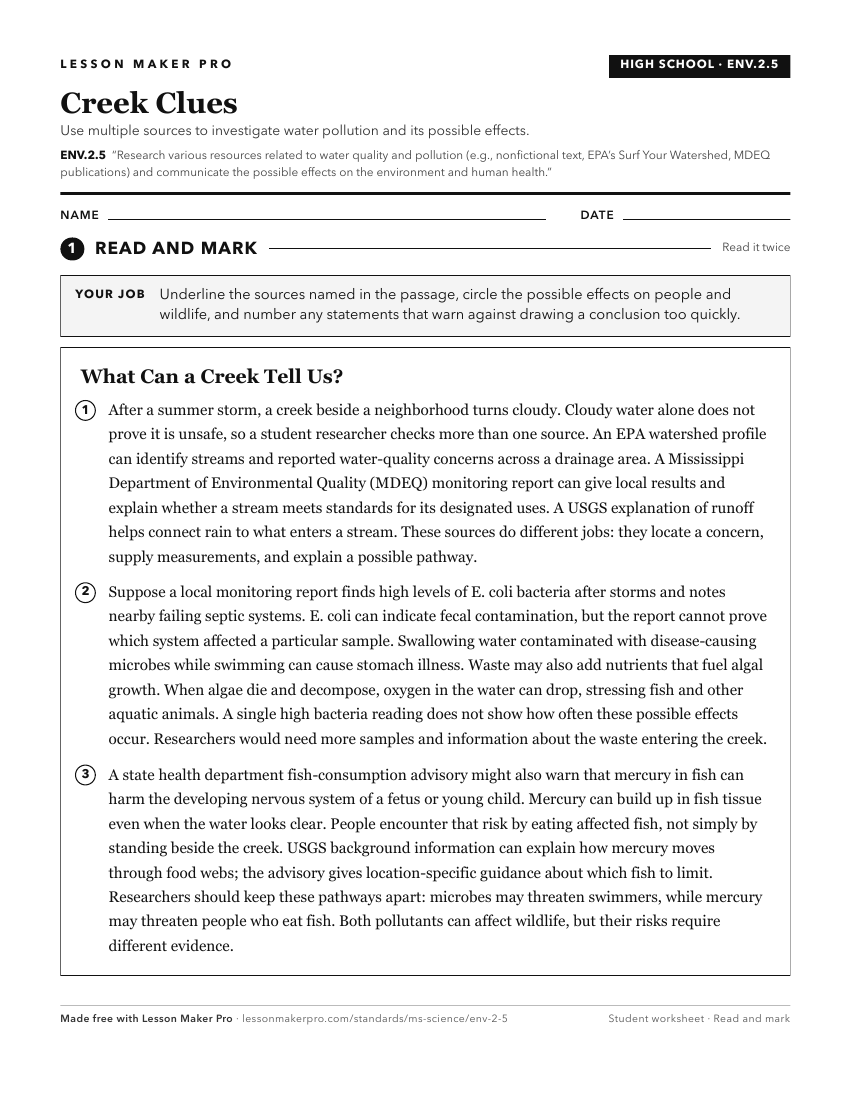
A ready-to-print activity worksheet aligned to ENV.2.5, with an answer key for the teacher on its own page. No account needed.
PDF, US Letter, prints cleanly in black and white.
Download the worksheetKeep exploring
Related Standards
- ENV.4.4
Enrichment: Explore online resources related to air pollution to determine air quality in a geographic area and communicate the possible effects on the environm...
- MAQ.4.4
Research, analyze, and communicate the effects of urbanization and continued expansion by humans on the aquatic ecosystems’ biodiversity (e.g., land use changes...
- E.1.10.1
Obtain and evaluate informational texts and other media to generate and answer questions about water sources and human uses of clean water.
- MAQ.4.7
Research, analyze, and communicate which and in what capacity local, state, and federal regulatory agencies are involved in different aquatic ecosystems, includ...
Turn this exact standard into a lesson
Grade, subject, topic, and the complete standard are prefilled. Create one free, no account needed.
Also for this standard:Make a WorksheetMake a QuizMake a Sub Lesson