Mississippi Science MAQ.4.7
The Standard
- MAQ.4
- Students will examine characteristics of specific aquatic ecosystems and the effects of human and natural phenomena on those ecosystems.
Research, analyze, and communicate which and in what capacity local, state, and federal regulatory agencies are involved in different aquatic ecosystems, including current environmental policies already in place (e.g., the Clean Water Act and the Endangered Species Act). Research should include, but is not limited to, how humans can preserve animal diversity using habitat creation and conservation, research, legislation, medical and breeding programs, and management of genetic diversity at local and global levels.
2026 Mississippi College- and Career-Readiness Standards for Science · Flora and Fauna
Teacher's field guide
What This Standard Means
What Students Need to Do
- Students use agency websites and current laws to find who handles runoff, permits, and protected species in streams and coastal waters. They compare habitat repair, research, veterinary care, and breeding as ways to protect aquatic animals locally and worldwide.
What Mastery Looks Like
- Students match city stormwater staff, MDEQ, EPA, and NOAA Fisheries to their jobs in a stream or coastal case. They link the Clean Water Act to water pollution and the Endangered Species Act to listed wildlife. They explain why breeding from unrelated parents helps a small population.
Common Misconceptions
- Students may assume EPA issues every water permit, when state offices often issue permits under federal rules. They may think releasing more hatchery fish always helps, even when the fish come from a few related parents.
How to Assess It
- Exit ticket: Fertilizer washes from a town drain into a stream with a federally protected fish. Name a local, state, and federal office, give each a job, cite one relevant law, and suggest one way to protect the fish's genetic diversity.
Lesson moves
Ways to Teach It
Place agency and law cards on a paper watershed map, then use string to connect each card to runoff, permits, or protected fish.
Ask: Why might releasing 100 hatchery fish from two parents harm a wild population, even if fish numbers rise?
Match city stormwater, MDEQ, EPA, and NOAA Fisheries cards to cases about drains, water permits, federal oversight, and protected marine fish.
Find a nearby stream on MDEQ's impaired waters map, then check your town's website to see who handles its storm drains.
Free download
Printable MAQ.4.7 Worksheet
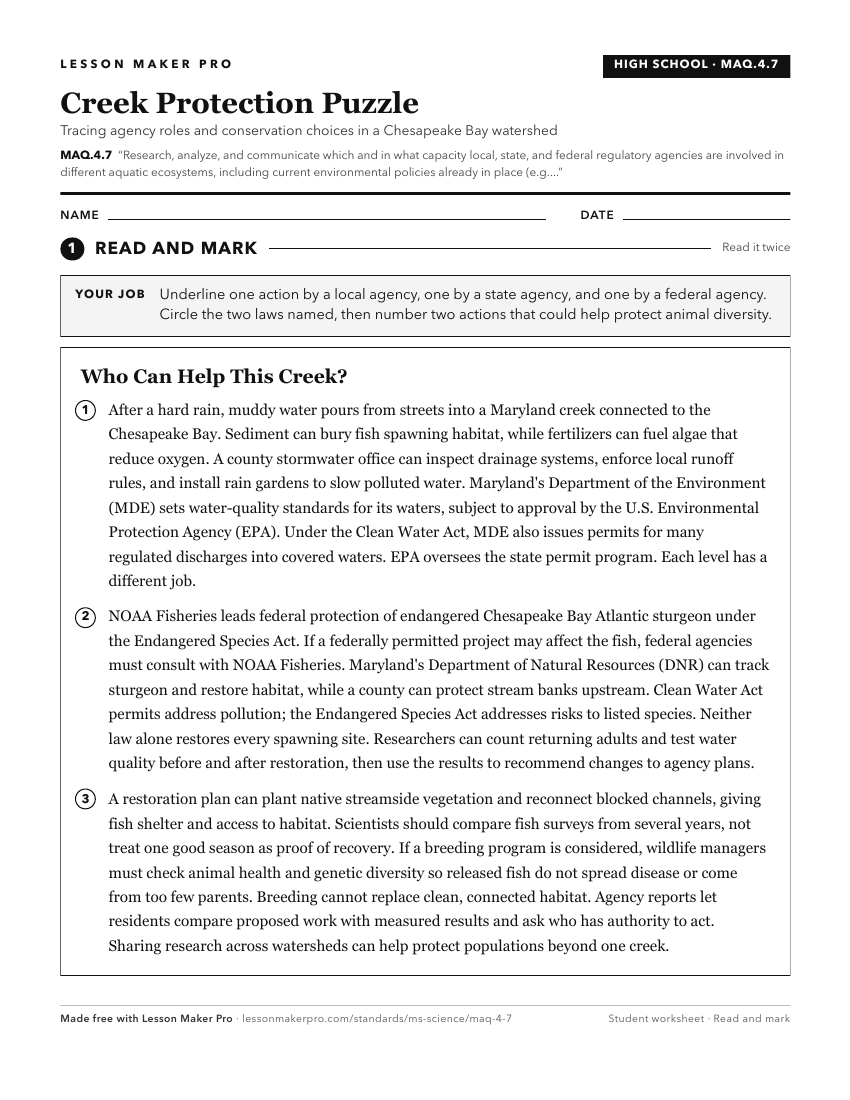
A ready-to-print activity worksheet aligned to MAQ.4.7, with an answer key for the teacher on its own page. No account needed.
PDF, US Letter, prints cleanly in black and white.
Download the worksheetKeep exploring
Related Standards
- ZOO.7.6
Research, analyze, and communicate the effects of urbanization and continued expansion by humans on the biodiversity of fish species (e.g., overfishing, and inv...
- MAQ.4.4
Research, analyze, and communicate the effects of urbanization and continued expansion by humans on the aquatic ecosystems’ biodiversity (e.g., land use changes...
- MAQ.4.6
Research, analyze, and communicate the effects of natural phenomena (e.g., hurricanes, floods, drought, and sea-level rise) on the aquatic ecosystems.
- MAQ.4.8
Enrichment: Choose an environmental issue that currently exists in one of the aquatic ecosystems and use an engineering design process to propose and develop a ...
Turn this exact standard into a lesson
Grade, subject, topic, and the complete standard are prefilled. Create one free, no account needed.
Also for this standard:Make a WorksheetMake a QuizMake a Sub Lesson