Mississippi Science MAQ.4.4
The Standard
- MAQ.4
- Students will examine characteristics of specific aquatic ecosystems and the effects of human and natural phenomena on those ecosystems.
Research, analyze, and communicate the effects of urbanization and continued expansion by humans on the aquatic ecosystems’ biodiversity (e.g., land use changes, erosion and sedimentation, over-fishing, invasive/exotic species, and pollution).
2026 Mississippi College- and Career-Readiness Standards for Science · Flora and Fauna
Teacher's field guide
What This Standard Means
What Students Need to Do
- Students find maps and surveys that show how human activity near water has changed. They link changes such as sediment runoff, overfishing, or introduced species to shifts in aquatic life. They report a claim supported by evidence.
What Mastery Looks Like
- A student compares species counts before and after shoreline development and identifies which species declined. They explain a possible path from construction to habitat loss, cite the survey numbers, and name another cause worth checking.
Common Misconceptions
- Students may treat murky water as proof that pollution killed fish without checking other causes. They may mistake more individual fish for greater biodiversity when fewer species remain. Some assume an introduced species helps biodiversity without checking whether it displaces native species.
How to Assess It
- Exit ticket: Creek surveys found 12 fish species before bank construction and 7 afterward, while muddy runoff increased. Explain one possible path from construction to the drop, cite both counts, and name another cause to check.
Lesson moves
Ways to Teach It
Pour equal cups of water onto a grass-covered soil tray and a bare soil tray, then compare sediment in the runoff jars.
Give pairs a construction notice and two fish surveys; ask which species changed and whether construction alone explains the change.
Give groups cards labeled dredging, sediment, seagrass loss, and fish decline; have them build and defend a cause-and-effect chain.
Open a satellite map of a nearby creek; mark roads and rooftops, then sketch where rainwater could carry pollutants into it.
Free download
Printable MAQ.4.4 Worksheet
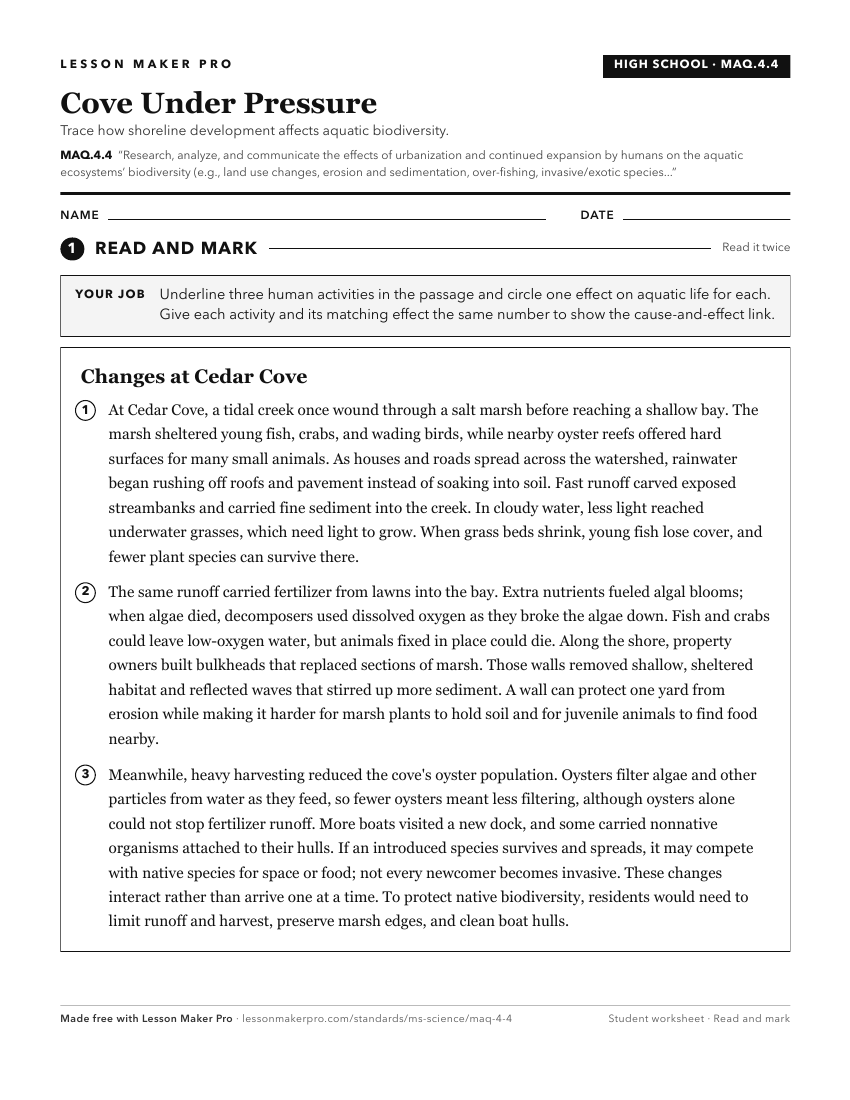
A ready-to-print activity worksheet aligned to MAQ.4.4, with an answer key for the teacher on its own page. No account needed.
PDF, US Letter, prints cleanly in black and white.
Download the worksheetKeep exploring
Related Standards
- ZOO.7.6
Research, analyze, and communicate the effects of urbanization and continued expansion by humans on the biodiversity of fish species (e.g., overfishing, and inv...
- MAQ.4.6
Research, analyze, and communicate the effects of natural phenomena (e.g., hurricanes, floods, drought, and sea-level rise) on the aquatic ecosystems.
- ZOO.10.6
Explain how human impacts have changed the environment of aquatic and terrestrial organisms (e.g., habitat destruction, urbanization, and climate change).
- MAQ.4.7
Research, analyze, and communicate which and in what capacity local, state, and federal regulatory agencies are involved in different aquatic ecosystems, includ...
Turn this exact standard into a lesson
Grade, subject, topic, and the complete standard are prefilled. Create one free, no account needed.
Also for this standard:Make a WorksheetMake a QuizMake a Sub Lesson