Mississippi Science E.K.10
Standard Cluster
Students will demonstrate an understanding of how humans use Earth’s resources. Participate in a teacher-led activity to gather, organize, and record recyclable materials data on a chart or table using technology. Communicate results. With teacher guidance, develop questions to conduct a structured investigation to determine ways to conserve Earth's resources (i.e., reduce, reuse, and recycle) and communicate results. Create a product from reused materials that will meet a human need (e.g., pencil holder, musical instrument, bird feeder). Use an engineering design process to define the problem, design, construct, evaluate, and improve the product. *
2026 Mississippi College- and Career-Readiness Standards for Science · Earth’s Resources
Cluster contents
Standards in This Cluster
E.K.10 is a cluster heading. These are the individual standards under it.
- E.K.10.1
Participate in a teacher-led activity to gather, organize, and record recyclable materials data on a chart or table using technology. Communicate results.
- E.K.10.2
With teacher guidance, develop questions to conduct a structured investigation to determine ways to conserve Earth's resources (i.e., reduce, reuse, and recycle...
- E.K.10.3
Create a product from reused materials that will meet a human need (e.g., pencil holder, musical instrument, bird feeder). Use an engineering design process to ...
Teacher's field guide
What This Cluster Means
What Students Need to Do
- Children sort and count items that can be recycled. They put the counts on a class tablet chart and tell what the numbers show. With help, they test a way to save materials, then build, try, and improve something useful made from used materials.
What Mastery Looks Like
- A child can point to the largest count on the chart and tell what the class found when it tried to save paper. They can show how their reused item helps someone and name a change they made after testing it.
Common Misconceptions
- Children may put food-soiled paper in the recycling bin because it is paper. They may call using the same bottle again recycling rather than reusing. They may think a pencil holder is finished even if it tips over.
How to Assess It
- Show a tablet chart with 6 paper pieces and 3 plastic bottles, then set out a reused-carton pencil holder that tips over. Ask, "Which did we collect more of, and what would you change to make the holder stand up?"
Lesson moves
Ways to Teach It
Give pairs empty cartons, tape, and pencils to build a pencil holder, test whether it stands, then change one part.
Ask, "Can we save paper by drawing on both sides?" Compare sheet counts for two drawings on separate sheets and one double-sided sheet.
Sort clean paper, cardboard, and plastic bottles into labeled bins, enter counts on a tablet chart, then tell a partner which bin has more.
Show photos of snack wrappers and drink bottles, then ask children which items they could bring less of, reuse, or recycle.
Free download
Printable E.K.10 Worksheet
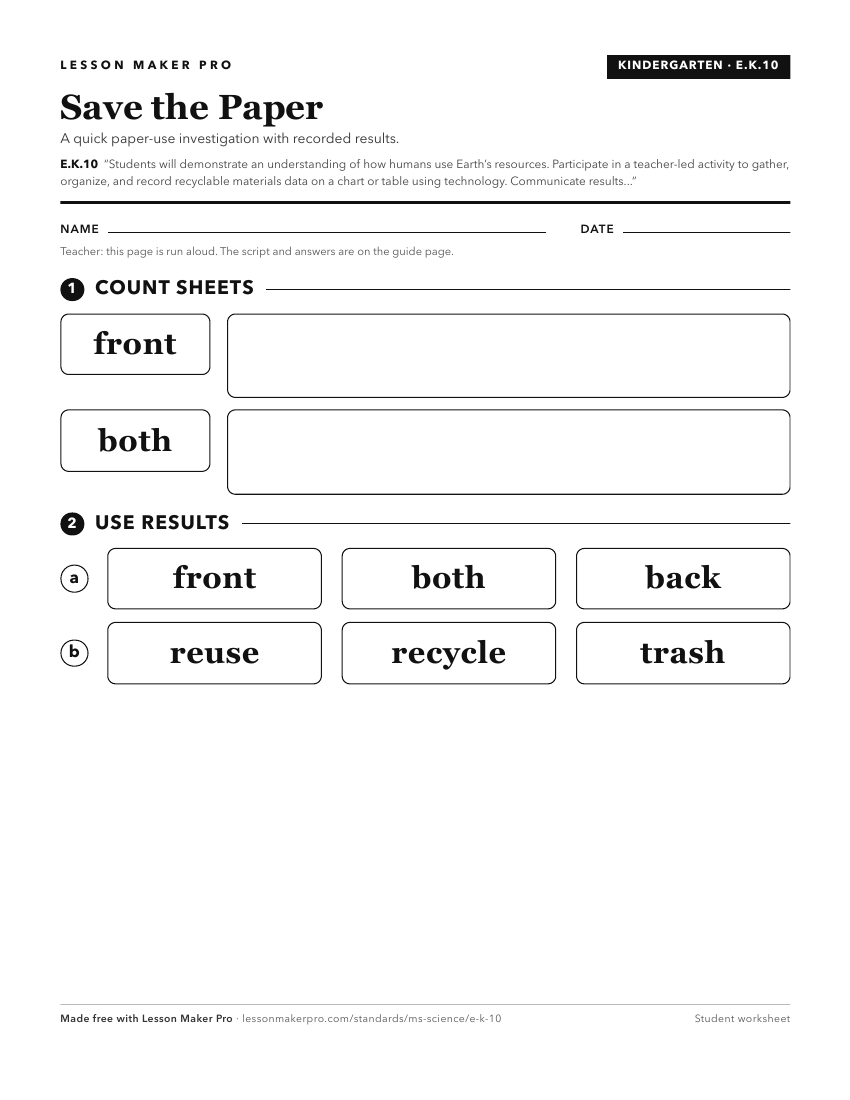
A ready-to-print activity worksheet aligned to E.K.10, with an answer key for the teacher on its own page. No account needed.
PDF, US Letter, prints cleanly in black and white.
Download the worksheetKeep exploring
Related Standards
- ENV.4
Students will demonstrate an understanding of the interdependence of human sustainability and the environment.
- E.2.10
The 2nd Grade version of this standard.
- E.5.10
Students will demonstrate an understanding of the effects of human interaction with Earth and how Earth’s natural resources can be protected and conserved.
- ESS.4
Students will develop an understanding of Earth’s resources and the impact of human activities.
Turn this cluster into a lesson
Grade, subject, topic, and the complete cluster are prefilled. Create one free, no account needed.
Also for this cluster:Make a WorksheetMake a QuizMake a Sub Lesson