Mississippi Science ENV.4.1
The Standard
- ENV.4
- Students will demonstrate an understanding of the interdependence of human sustainability and the environment.
Identify human impact and develop a solution for protection of the atmosphere, considering pollutants (e.g., acid rain, air pollution, smog, ozone layer, or increased levels of greenhouse gases) and the impacts of pollutants on human health (e.g., asthma, COPD, emphysema, and cancer).
2026 Mississippi College- and Career-Readiness Standards for Science · Human Sustainability
Teacher's field guide
What This Standard Means
What Students Need to Do
- Students trace how a human activity adds a pollutant to the air and how that pollutant can affect health. They use evidence to propose a way to reduce it and explain how they would check whether the change worked.
What Mastery Looks Like
- A student can explain that idling diesel buses release fine particles that can worsen asthma and COPD. They can propose a no-idling rule and compare bus idling times before and after it begins.
Common Misconceptions
- Students may confuse protective ozone high in the atmosphere with ground-level ozone in smog. They may assume every air pollutant causes the same illness or that planting trees cancels out vehicle exhaust.
How to Assess It
- Exit ticket: “Diesel buses idle outside school for 20 minutes each afternoon. Name one pollutant they release, one possible health effect, one change the school could make, and one way to check whether it helped.”
Lesson moves
Ways to Teach It
Pairs arrange cards labeled bus idling, fine particles, airway irritation, and asthma symptoms, then place a no-idling sign where it acts.
Ask students to write why ground-level ozone can worsen asthma while the ozone layer protects people from harmful sunlight.
Give teams source, pollutant, health effect, and solution cards; score each accurate chain they build.
Have students tally idling cars at dismissal for five minutes, then draft a two-sentence note proposing a no-idling sign.
Free download
Printable ENV.4.1 Worksheet
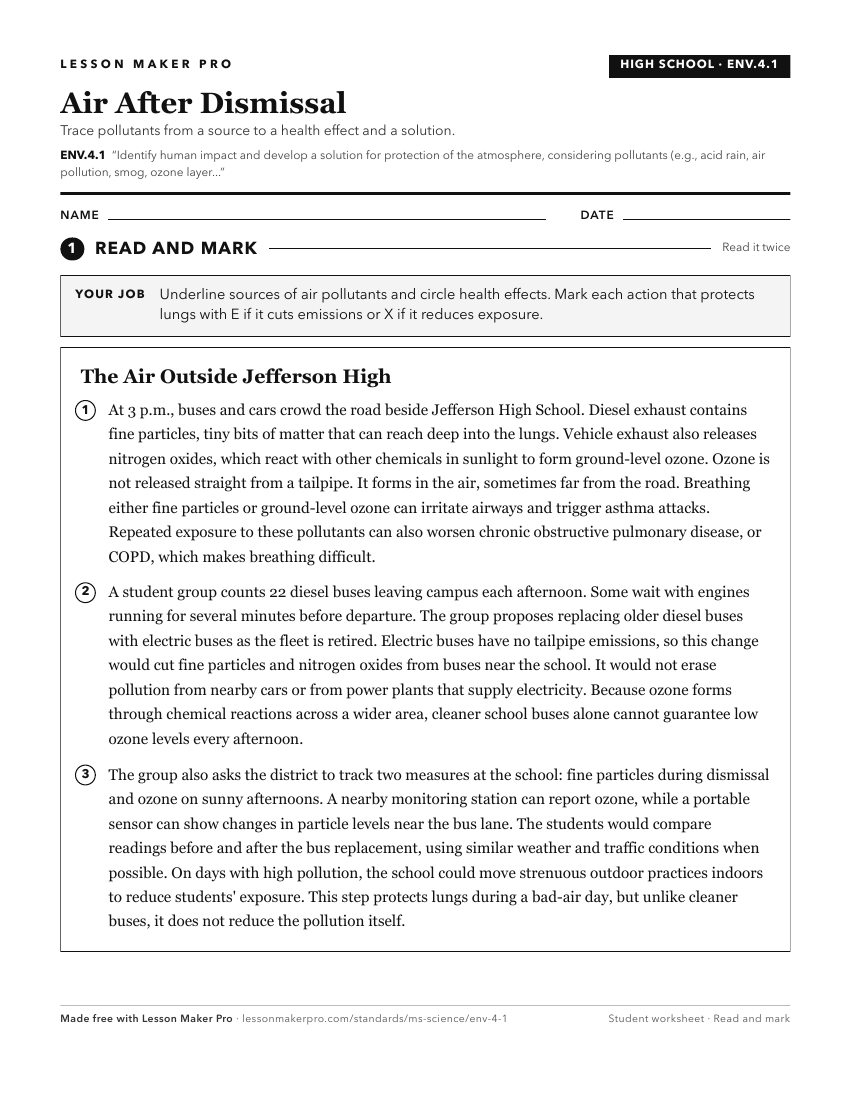
A ready-to-print activity worksheet aligned to ENV.4.1, with an answer key for the teacher on its own page. No account needed.
PDF, US Letter, prints cleanly in black and white.
Download the worksheetKeep exploring
Related Standards
- HAP.12.6
Research and discuss new environmental causes of respiratory distress (e.g., e-cigarettes, environmental pollutants, and changes in inhaled gas composition).
- ENV.4.4
Enrichment: Explore online resources related to air pollution to determine air quality in a geographic area and communicate the possible effects on the environm...
- E.8.10.2
Create and defend a proposal for reducing the environmental effects humans have on Earth (e.g., population increases, consumer demands, chemical pollution, defo...
- ENV.4.3
Enrichment: Research and analyze case studies to determine the impact of human-related and natural environmental changes on human health and communicate possibl...
Turn this exact standard into a lesson
Grade, subject, topic, and the complete standard are prefilled. Create one free, no account needed.
Also for this standard:Make a WorksheetMake a QuizMake a Sub Lesson