Mississippi Science ENV.1.5
The Standard
- ENV.1
- Students will investigate the interdependence of diverse living organisms and their interactions with the components of the biosphere.
Develop and use models to diagram the flow of nitrogen, carbon, and phosphorus through the environment.
2026 Mississippi College- and Career-Readiness Standards for Science · Biosphere and Biodiversity
Teacher's field guide
What This Standard Means
What Students Need to Do
- Students make separate diagrams for carbon, nitrogen, and phosphorus. They show where each is stored and label arrows with the processes that move it. They use the diagrams to trace each element through living and nonliving places.
What Mastery Looks Like
- A student shows carbon moving from air into plants by photosynthesis and back by respiration. They show nitrogen moving from air into soil through fixation, then into plants. They trace phosphorus from rock to soil by weathering, then into plants, without adding an atmospheric step.
Common Misconceptions
- Students may show plants taking nitrogen gas straight from the air instead of taking usable nitrogen from soil. They may add an atmospheric step to the phosphorus cycle. They may label the return of every element to soil as respiration instead of decomposition.
How to Assess It
- Exit ticket: Draw three mini-models tracing carbon from air to a plant and back, nitrogen from air through soil into a plant, and phosphorus from rock through soil into a plant. Label each arrow with a process.
Lesson moves
Ways to Teach It
Give groups cards labeled air, rock, soil, plants, animals, and microbes; build three pathways with string arrows and label each transfer process.
Ask: Why does phosphorus enter plants from weathered rock, while carbon enters from air? Support your answer with two labeled arrows.
Play arrow match: Pairs match fixation, photosynthesis, and weathering cards to arrows between air, soil, plants, and rock.
Show a photo of an algae bloom near farmland; have students trace fertilizer nitrogen and phosphorus from fields through runoff into water and algae.
Free download
Printable ENV.1.5 Worksheet
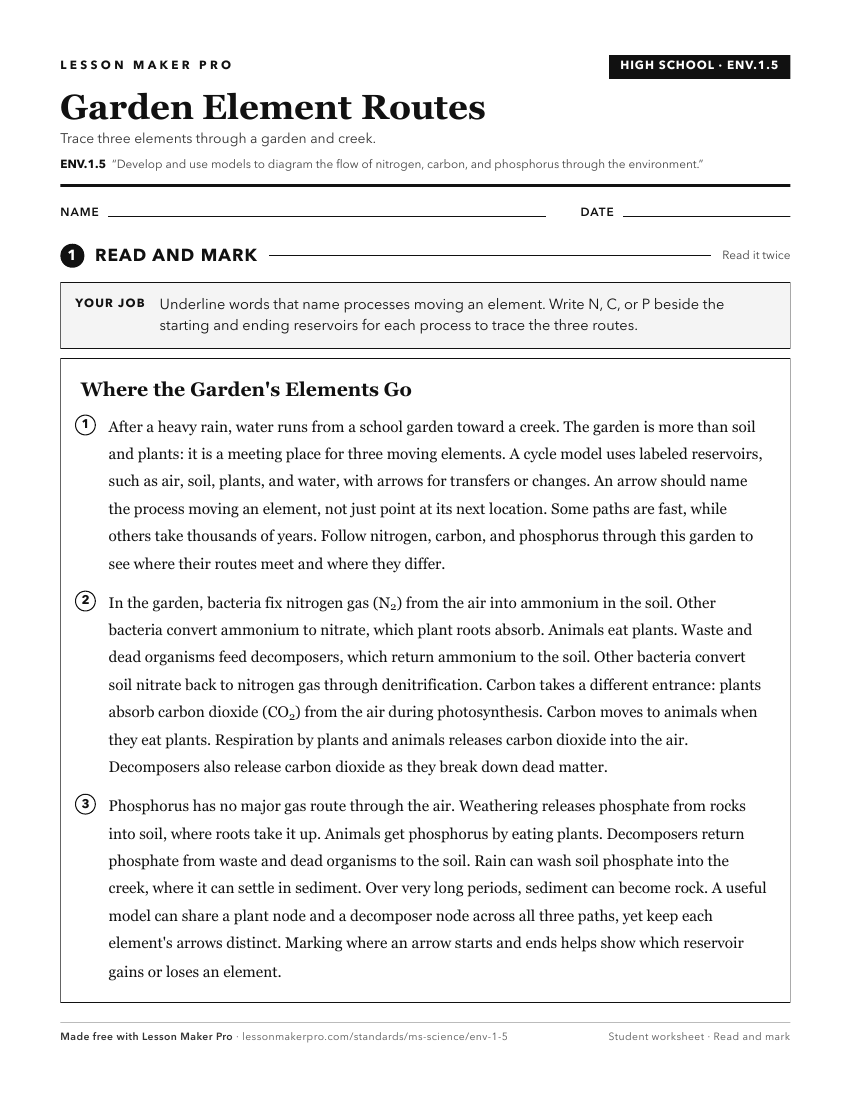
A ready-to-print activity worksheet aligned to ENV.1.5, with an answer key for the teacher on its own page. No account needed.
PDF, US Letter, prints cleanly in black and white.
Download the worksheetKeep exploring
Related Standards
- BIO.5.4
Develop and use models to describe the flow of energy and amount of biomass through food chains, food webs, and food pyramids.
- FB.6.5
Use models to analyze the flow of energy through food chains, webs, and pyramids.
- BIO.5.2
Analyze models of the cycling of matter (e.g., carbon, nitrogen, phosphorus, and water) between abiotic and biotic factors in an ecosystem and evaluate the abil...
- FB.6.2
Use models to analyze the cycling of matter in an ecosystem (e.g., water, carbon dioxide/oxygen, nitrogen).
Turn this exact standard into a lesson
Grade, subject, topic, and the complete standard are prefilled. Create one free, no account needed.
Also for this standard:Make a WorksheetMake a QuizMake a Sub Lesson