Mississippi Science ENV.1.8
The Standard
- ENV.1
- Students will investigate the interdependence of diverse living organisms and their interactions with the components of the biosphere.
Utilize data to communicate changes within a given population and the environmental factors that may have impacted these changes (e.g., weather patterns, natural disasters)
2026 Mississippi College- and Career-Readiness Standards for Science · Biosphere and Biodiversity
Teacher's field guide
What This Standard Means
What Students Need to Do
- Students use counts from several dates to describe how a population changed. They compare those counts with weather or disaster records and use numbers to explain a possible connection.
What Mastery Looks Like
- A student can make a labeled graph and identify when the largest change happened. They can cite population and environmental data while making clear that a matching pattern does not prove a cause.
Common Misconceptions
- Students may call one low count a decline without checking earlier counts. They may assume drought caused a decline just because both happened at the same time, or miss that fewer animals were counted because fewer sites were surveyed.
How to Assess It
- Give students frog counts of 40, 38, 22, and 19 and rainfall totals of 80, 75, 40, and 35 cm across four years. Ask for two sentences that cite the population change and explain how rainfall might be related.
Lesson moves
Ways to Teach It
Give pairs counters and four year-labeled frog-count cards (40, 38, 22, 19); have them build bars and mark the largest drop.
Show deer counts before and after a wildfire, then ask, 'Did deer die, move away, or become harder to count?'
Deal teams year-labeled frog-count and rainfall cards; have them race to write a claim with two numbers and one uncertainty.
Compare a state wildlife agency's deer count chart with NOAA rainfall totals for matching years; have students write one possible connection.
Free download
Printable ENV.1.8 Worksheet
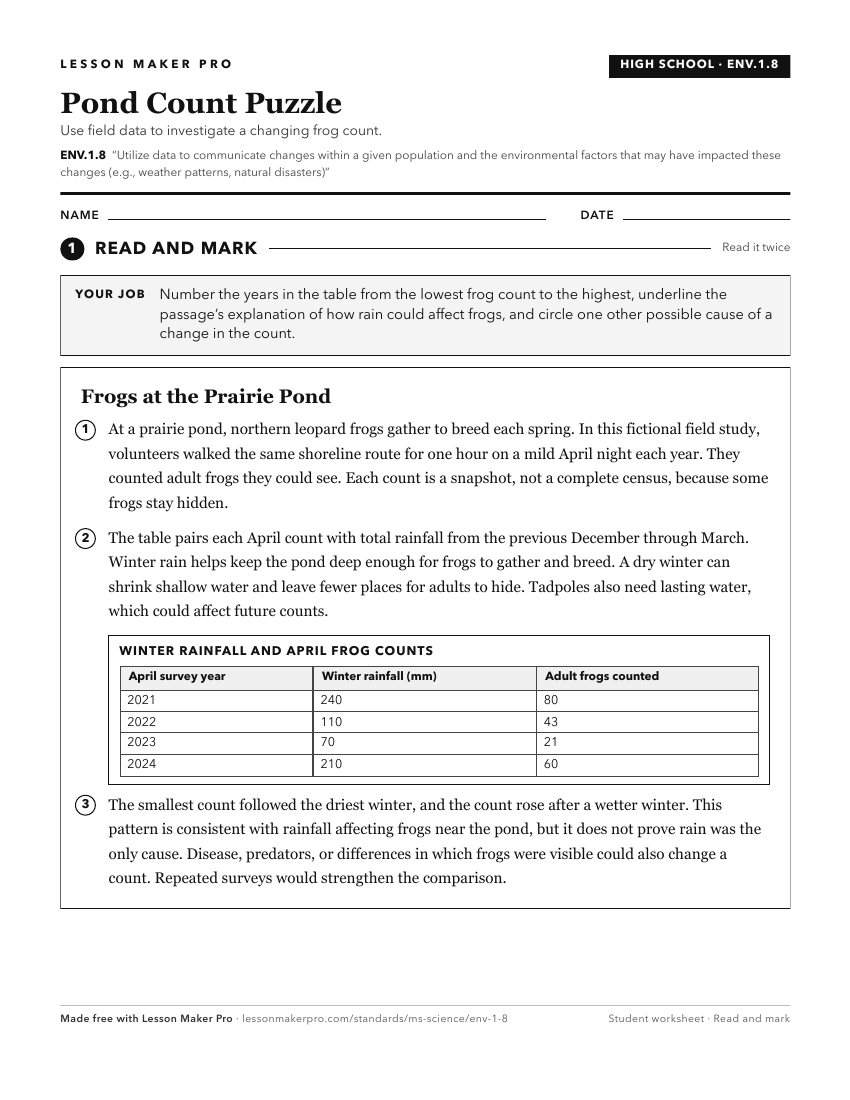
A ready-to-print activity worksheet aligned to ENV.1.8, with an answer key for the teacher on its own page. No account needed.
PDF, US Letter, prints cleanly in black and white.
Download the worksheetKeep exploring
Related Standards
- MAQ.4.6
Research, analyze, and communicate the effects of natural phenomena (e.g., hurricanes, floods, drought, and sea-level rise) on the aquatic ecosystems.
- L.2.3A.1
Evaluate and communicate findings from informational text or other media to describe how animals change and respond to rapid or slow changes in their environmen...
- E.4.9B.1
Analyze and interpret data (e.g., temperature, precipitation, wind speed/direction, relative humidity, or cloud types) to predict changes in weather over time.
- ENV.4.2
Evaluate data and other information to explain how key natural resources (e.g., water sources, fertile soils, concentrations of minerals, and fossil fuels), nat...
Turn this exact standard into a lesson
Grade, subject, topic, and the complete standard are prefilled. Create one free, no account needed.
Also for this standard:Make a WorksheetMake a QuizMake a Sub Lesson