Mississippi Science BIO.4.1
The Standard
- BIO.4
- Students will analyze and interpret evidence to explain the unity and diversity of life.
Use models to differentiate between organic and chemical evolution, illustrating the steps leading to aerobic heterotrophs and photosynthetic autotrophs.
2026 Mississippi College- and Career-Readiness Standards for Science · Adaptations and Evolution
Teacher's field guide
What This Standard Means
What Students Need to Do
- Students model a proposed path from nonliving chemicals to early cells, photosynthetic cells, and oxygen-using cells. They separate chemical evolution before life from organic evolution in living populations. They show how oxygen from photosynthesis allowed aerobic heterotrophs to evolve.
What Mastery Looks Like
- A student can order inorganic substances, organic molecules, protocells, early anaerobic cells, oxygen-producing photosynthetic cells, oxygen buildup, and aerobic heterotrophs. They mark where living cells first appear and explain why aerobic cells come later.
Common Misconceptions
- Students may think chemical evolution means chemical reactions inside living cells, rather than changes before life began. They may place aerobic cells before oxygen-producing cells or assume an individual cell changed into a new kind of organism.
How to Assess It
- On an exit ticket, have students order seven boxes: inorganic substances, organic molecules, protocells, anaerobic cells, oxygen-producing photosynthetic cells, oxygen buildup, and aerobic heterotrophs. Ask them to mark where organic evolution begins and explain why aerobic heterotrophs come last.
Lesson moves
Ways to Teach It
Give pairs molecule cards, clay protocells, and blue oxygen counters; have them build a timeline that adds oxygen after photosynthetic cells.
Ask, 'Can a molecule evolve the same way a population does?' Have students answer using inheritance and early Earth chemistry.
Play timeline swap: display aerobic heterotrophs before photosynthetic cells, then have teams fix the order and explain the oxygen clue.
Show a pond oxygen graph from dawn to afternoon; students circle the oxygen rise and explain how algae support oxygen-using fish.
Free download
Printable BIO.4.1 Worksheet
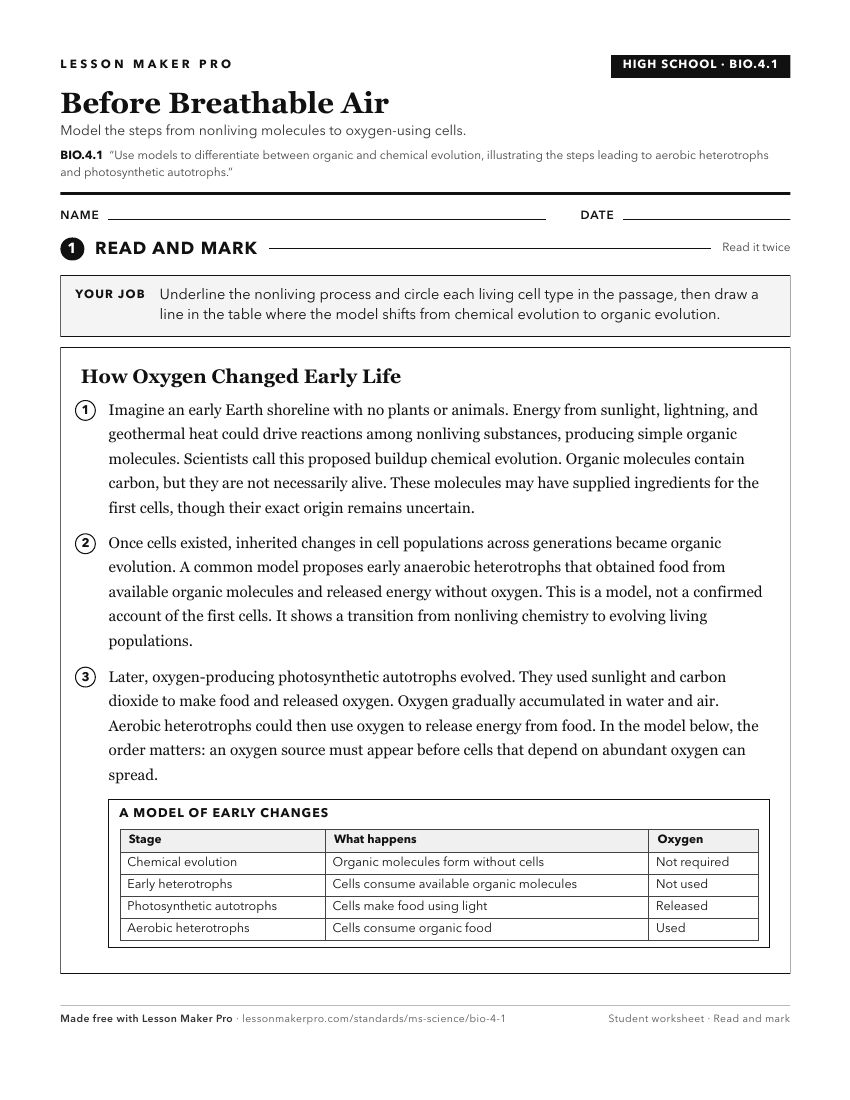
A ready-to-print activity worksheet aligned to BIO.4.1, with an answer key for the teacher on its own page. No account needed.
PDF, US Letter, prints cleanly in black and white.
Download the worksheetKeep exploring
Related Standards
- L.4.2.2
Develop and use models to explain the unique and diverse life cycles of organisms other than humans (e.g., flowering plants, frogs, or butterflies) including co...
- BIO.2.2
Develop models of the major reactants and products of photosynthesis to demonstrate the transformation of light energy into stored chemical energy in cells. Emp...
- L.7.3.3
Use models to describe how food molecules (carbohydrates, lipids, proteins) are processed through chemical reactions using oxygen (aerobic) to form new molecule...
- FB.6.2
Use models to analyze the cycling of matter in an ecosystem (e.g., water, carbon dioxide/oxygen, nitrogen).
Turn this exact standard into a lesson
Grade, subject, topic, and the complete standard are prefilled. Create one free, no account needed.
Also for this standard:Make a WorksheetMake a QuizMake a Sub Lesson