Mississippi Science L.7.3.3
The Standard
- L.7.3
- Students will demonstrate an understanding of the importance that matter cycles between living and non-living parts of the ecosystem to sustain life on Earth.
Use models to describe how food molecules (carbohydrates, lipids, proteins) are processed through chemical reactions using oxygen (aerobic) to form new molecules.
2026 Mississippi College- and Career-Readiness Standards for Science · Ecology and Interdependence
Teacher's field guide
What This Standard Means
What Students Need to Do
- Students use a model to show how cells use oxygen when breaking down carbohydrates, lipids, or proteins. They show atoms rearranging into new molecules, including carbon dioxide and water.
What Mastery Looks Like
- A student labels food molecules and oxygen as inputs, then identifies carbon dioxide and water as products. They explain that the reactions transfer usable energy to ATP. They note that using protein also produces nitrogen-containing waste.
Common Misconceptions
- Students may say oxygen turns into energy or that food disappears. Some think only sugar can fuel cells, or that cellular respiration is the same as breathing.
How to Assess It
- Exit ticket: Draw a cell using glucose and oxygen. Label carbon dioxide and water, then write where the glucose atoms went and where usable energy goes.
Lesson moves
Ways to Teach It
Give pairs atom cards for one glucose and six oxygen molecules; have them build six carbon dioxide and six water molecules.
Ask: If cells can use both potatoes and nuts for fuel, where does oxygen fit in each model?
Play a card sort with food molecule, oxygen, product, and ATP cards; students build and explain input-output models.
Read a trail mix label, then sketch how its carbohydrates, fats, and proteins can supply fuel to cells using oxygen.
Free download
Printable L.7.3.3 Worksheet
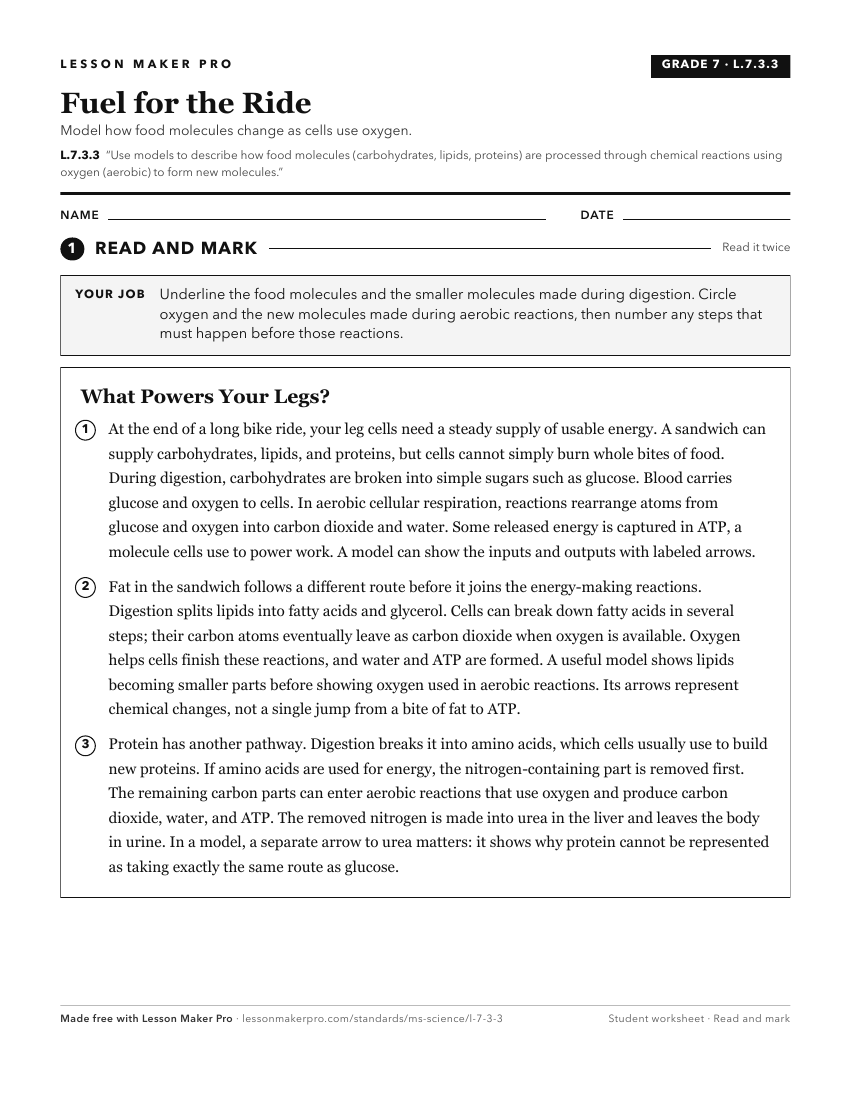
A ready-to-print activity worksheet aligned to L.7.3.3, with an answer key for the teacher on its own page. No account needed.
PDF, US Letter, prints cleanly in black and white.
Download the worksheetKeep exploring
Related Standards
- BIO.4.1
Use models to differentiate between organic and chemical evolution, illustrating the steps leading to aerobic heterotrophs and photosynthetic autotrophs.
- BIO.2.2
Develop models of the major reactants and products of photosynthesis to demonstrate the transformation of light energy into stored chemical energy in cells. Emp...
- BIO.2.3
Develop models of the major reactants and products of cellular respiration (aerobic and anaerobic) to demonstrate the transformation of the chemical energy stor...
- FB.6.2
Use models to analyze the cycling of matter in an ecosystem (e.g., water, carbon dioxide/oxygen, nitrogen).
Turn this exact standard into a lesson
Grade, subject, topic, and the complete standard are prefilled. Create one free, no account needed.
Also for this standard:Make a WorksheetMake a QuizMake a Sub Lesson