Mississippi Science BIO.2.3
The Standard
- BIO.2
- Students will explain that cells transform energy through the processes of photosynthesis and cellular respiration to drive cellular functions.
Develop models of the major reactants and products of cellular respiration (aerobic and anaerobic) to demonstrate the transformation of the chemical energy stored in food to the available energy of ATP. Emphasize the chemical processes in which bonds are broken, and energy is released, and new bonds are formed, and energy is stored.
2026 Mississippi College- and Career-Readiness Standards for Science · Energy Transfer
Teacher's field guide
What This Standard Means
What Students Need to Do
- Students draw models showing what enters and leaves yeast cells with and without oxygen. They trace how rearranging bonds releases energy and how cells store some of it by making ATP from ADP and phosphate.
What Mastery Looks Like
- With oxygen, students show glucose and oxygen becoming carbon dioxide and water. Without oxygen, they show yeast making ethanol and carbon dioxide, with less ATP made than in the oxygen pathway.
Common Misconceptions
- Students often put oxygen into both pathways or think cells make no ATP without oxygen. Some say breaking a bond alone releases energy, rather than looking at the energy change when bonds break and new bonds form.
How to Assess It
- Ask students to draw two arrow models for yeast using glucose with and without oxygen. Have them label the products, show ADP becoming ATP, and circle the path that makes more ATP.
Lesson moves
Ways to Teach It
Give pairs paper atoms to rearrange one glucose and six oxygen molecules into six carbon dioxide and six water molecules, plus ATP tokens.
Ask: Why can yeast still make ATP without oxygen, and why does it make less than it does with oxygen?
Have students sort glucose, oxygen, carbon dioxide, water, ethanol, and ATP cards into aerobic yeast respiration, yeast fermentation, or both.
Show a photo of rising bread dough and ask students to identify the yeast product that makes the bubbles.
Free download
Printable BIO.2.3 Worksheet
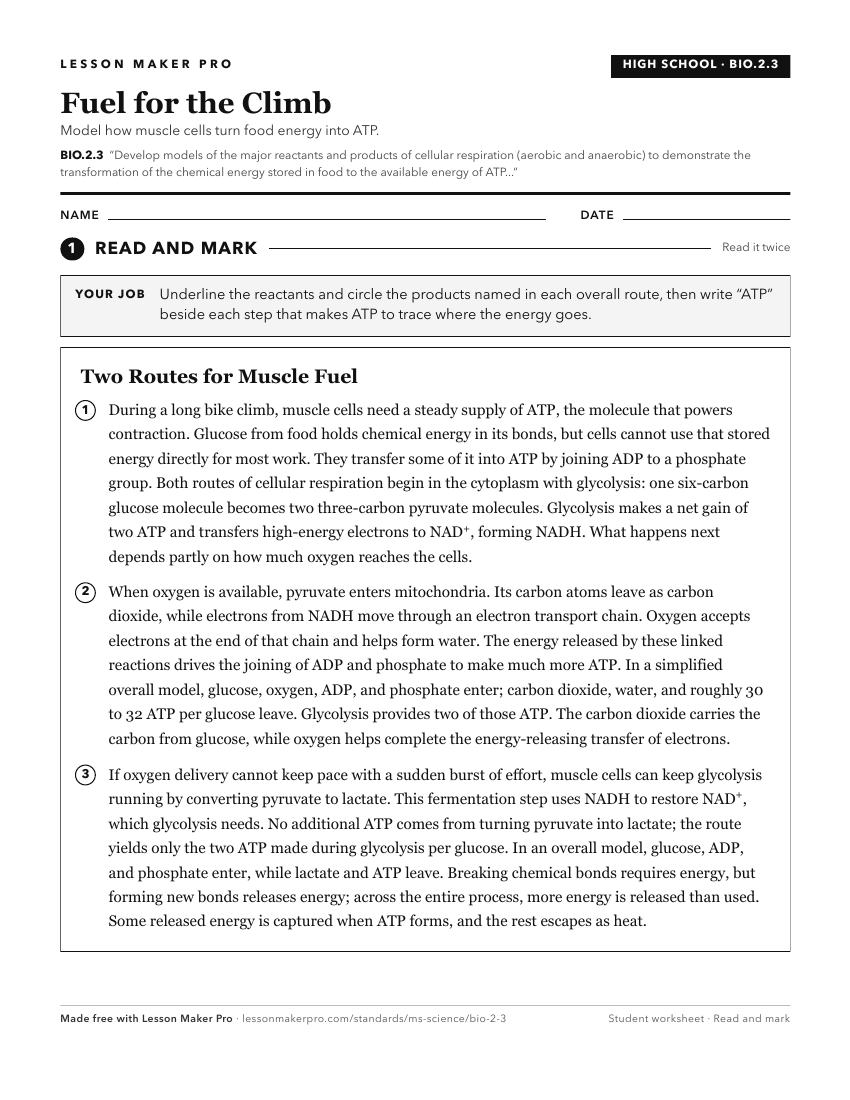
A ready-to-print activity worksheet aligned to BIO.2.3, with an answer key for the teacher on its own page. No account needed.
PDF, US Letter, prints cleanly in black and white.
Download the worksheetKeep exploring
Related Standards
- FB.3.5
Use models to explain how ADP and ATP cycle to store and release chemical energy using inorganic phosphate.
- BIO.2.2
Develop models of the major reactants and products of photosynthesis to demonstrate the transformation of light energy into stored chemical energy in cells. Emp...
- P.7.5D.4
Build a model to explain that chemical reactions can store (formation of bonds) or release energy (breaking of bonds).
- L.7.3.3
Use models to describe how food molecules (carbohydrates, lipids, proteins) are processed through chemical reactions using oxygen (aerobic) to form new molecule...
Turn this exact standard into a lesson
Grade, subject, topic, and the complete standard are prefilled. Create one free, no account needed.
Also for this standard:Make a WorksheetMake a QuizMake a Sub Lesson