Mississippi Science BIO.1A
Standard Cluster
Students will demonstrate an understanding of the characteristics of life and biological organization. Develop criteria to differentiate between living and non-living things. Describe the tenets of cell theory and the contributions of Schwann, Hooke, Schleiden, and Virchow. Using specific examples, explain how cells can be organized into complex tissues, organs, and organ systems in multicellular organisms. Use evidence from current scientific literature to support whether a virus is living or non-living
2026 Mississippi College- and Career-Readiness Standards for Science · Cells as a System
Cluster contents
Standards in This Cluster
BIO.1A is a cluster heading. These are the individual standards under it.
- BIO.1A.1
Develop criteria to differentiate between living and non-living things.
- BIO.1A.2
Describe the tenets of cell theory and the contributions of Schwann, Hooke, Schleiden, and Virchow.
- BIO.1A.3
Using specific examples, explain how cells can be organized into complex tissues, organs, and organ systems in multicellular organisms.
- BIO.1A.4
Use evidence from current scientific literature to support whether a virus is living or non-living
Teacher's field guide
What This Cluster Means
What Students Need to Do
- Students set criteria for living things and apply them to seeds, fire, and viruses. They explain how Hooke, Schleiden, Schwann, and Virchow shaped cell theory. They trace cells through tissues, organs, and organ systems and use recent research to defend a claim about viruses.
What Mastery Looks Like
- A student uses clear criteria to explain why a seed is alive and fire is not. They cite a recent study to defend a virus claim and explain that organisms consist of cells that come from existing cells. They trace heart muscle cells through tissue, the heart, and the circulatory system.
Common Misconceptions
- Students may call fire alive because it grows and uses fuel, or call a dormant seed dead because it does not visibly grow. They may think viruses are cells that reproduce on their own. Some confuse Hooke’s cork observation with later findings about plants, animals, and new cells.
How to Assess It
- Exit ticket: Give students an excerpt from a recent study of viral replication and ask, “Is this virus alive by our criteria? Cite one finding.” Ask them to trace a heart muscle cell to its organ system.
Lesson moves
Ways to Teach It
Set out dry beans, sprouted beans, rocks, and windup toys; have pairs sort them and defend each choice using written criteria for life.
Give pairs a recent research abstract on viral replication; ask, “Does reproduction inside host cells make viruses alive? Cite one result.”
Play a card match: link Hooke to cork, Schleiden to plants, Schwann to animals, and Virchow to cells from existing cells.
Use a heart attack diagram to trace how damaged heart muscle cells affect heart tissue, heart pumping, and blood flow.
Free download
Printable BIO.1A Worksheet
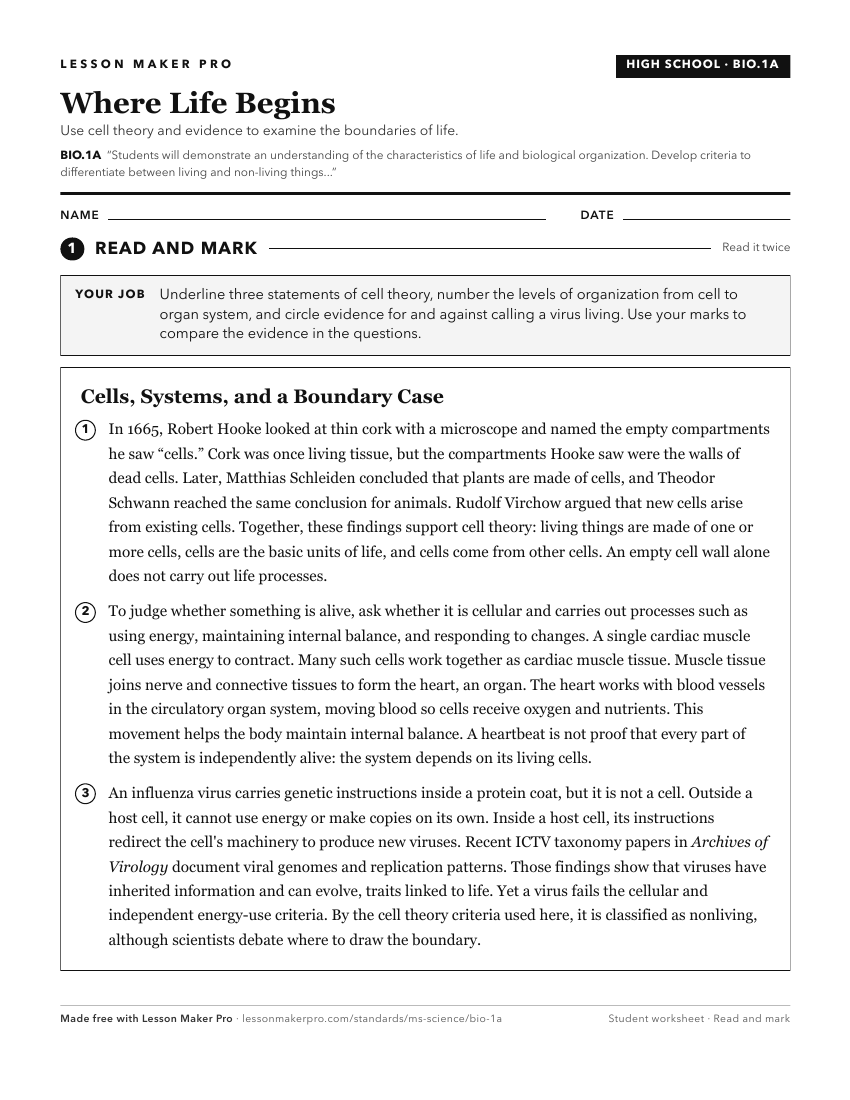
A ready-to-print activity worksheet aligned to BIO.1A, with an answer key for the teacher on its own page. No account needed.
PDF, US Letter, prints cleanly in black and white.
Download the worksheetKeep exploring
Related Standards
- FB.3
Students will demonstrate an understanding of how the structure of living organisms supports the essential functions of life.
- L.K.1A
Students will demonstrate an understanding of living and non-living things.
- FB.2
Students will demonstrate an understanding of the structure and interactions of matter and how the organization of matter supports living organisms.
- L.2.3B
Students will demonstrate an understanding of the interdependence of living things.
Turn this cluster into a lesson
Grade, subject, topic, and the complete cluster are prefilled. Create one free, no account needed.
Also for this cluster:Make a WorksheetMake a QuizMake a Sub Lesson