Mississippi Science BIO.1A.2
The Standard
- BIO.1A
- Students will demonstrate an understanding of the characteristics of life and biological organization.
Describe the tenets of cell theory and the contributions of Schwann, Hooke, Schleiden, and Virchow.
2026 Mississippi College- and Career-Readiness Standards for Science · Cells as a System
Teacher's field guide
What This Standard Means
What Students Need to Do
- Students explain that living things are made of cells, cells are the basic units of life, and new cells come from existing cells. They connect Hooke, Schleiden, Schwann, and Virchow to the observations behind those ideas.
What Mastery Looks Like
- A student can state all three claims and give an example of each. They can match Hooke to cork, Schleiden to plants, Schwann to animals, and Virchow to cells coming from cells.
Common Misconceptions
- Students may think Hooke saw living cells in cork, but he saw the walls of dead cells. They may also think cells appear from nonliving material or that only animals are made of cells.
How to Assess It
- On an exit ticket, ask students to write the three claims of cell theory and match Hooke, Schleiden, Schwann, and Virchow to cork, plants, animals, and cells coming from cells.
Lesson moves
Ways to Teach It
Have students examine onion skin and prepared animal tissue slides under a microscope, then sketch and label the cells they find.
Ask students to write two sentences explaining what Hooke could learn from cork and what cork could not tell him.
Give pairs four scientist cards and four finding cards; have them match the cards and explain each match aloud.
Show a sequence of wound-healing photos and ask which cell theory claim explains where the new skin cells came from.
Free download
Printable BIO.1A.2 Worksheet
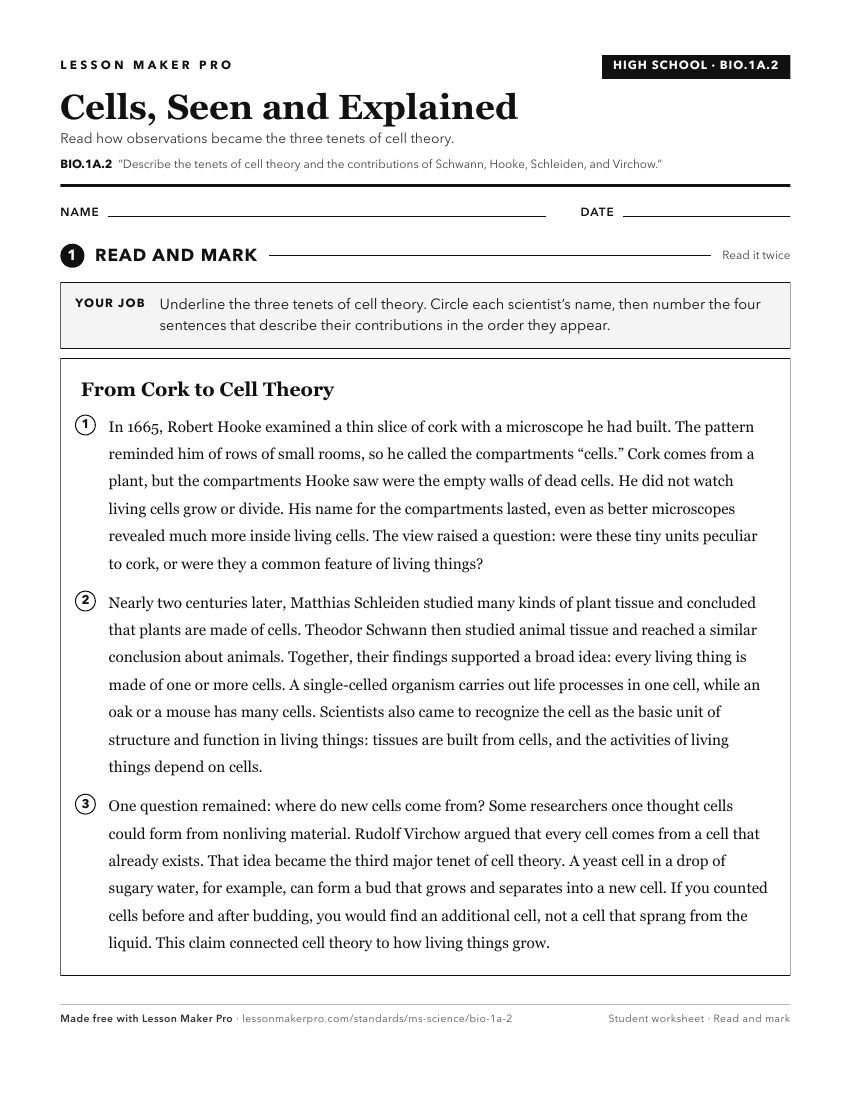
A ready-to-print activity worksheet aligned to BIO.1A.2, with an answer key for the teacher on its own page. No account needed.
PDF, US Letter, prints cleanly in black and white.
Download the worksheetKeep exploring
Related Standards
- L.6.1.2
Obtain and communicate evidence to support the cell theory.
- FB.5.1
Investigate through research the contributions of scientists to the theory of evolution and evolutionary processes (e.g., Needham, Spallanzani, Redi, Pasteur, L...
- BIO.1E.1
Construct models to explain how the processes of cell division and cell differentiation produce and maintain complex multicellular organisms.
- FB.1.1
Identify and communicate the contributions of famous scientists and their experiments that formed fundamental scientific principles (e.g., Robert Hooke, Schleid...
Turn this exact standard into a lesson
Grade, subject, topic, and the complete standard are prefilled. Create one free, no account needed.
Also for this standard:Make a WorksheetMake a QuizMake a Sub Lesson