Mississippi Science FB.1.1
The Standard
- FB.1
- Students will relate the importance of significant historical biological experiments and their impact of these on research, development, and society.
Identify and communicate the contributions of famous scientists and their experiments that formed fundamental scientific principles (e.g., Robert Hooke, Schleiden/ Schwann/Virchow, Griffith, Avery/MacLeod/McCarty, Hershey/Chase, Rosalind Franklin, Gregor Mendel, Watson/Crick, Pasteur, and Charles Darwin).
2026 Mississippi College- and Career-Readiness Standards for Science · History of Biology and Impacts on Society
Teacher's field guide
What This Standard Means
What Students Need to Do
- Students link scientists to the observations or experiments they used and the biology ideas those findings support. They explain how later work built on earlier results.
What Mastery Looks Like
- A student can explain how Pasteur's flasks challenged spontaneous generation and how Avery's team identified DNA as the transforming material. They can distinguish Franklin's X-ray evidence from Watson and Crick's DNA model.
Common Misconceptions
- Students may say Griffith proved DNA was the transforming material, or that Watson and Crick took Franklin's X-ray image. They may think Darwin meant individual organisms choose to change during their lifetimes.
How to Assess It
- Exit ticket: Explain what happened in Pasteur's intact swan-neck flask and after the broth touched trapped dust. State what the results showed about microbes.
Lesson moves
Ways to Teach It
Build paper models of Pasteur's straight-neck and swan-neck flasks, then draw where dust settles and where microbes can reach broth.
Ask: How did Franklin's X-ray data support Watson and Crick's DNA model? Write two sentences separating evidence from model.
Play a three-card match with name, evidence, and idea cards for Hooke, Schleiden, Schwann, Virchow, Mendel, Griffith, Avery's team, and Hershey and Chase.
Read a paragraph about antibiotic-resistant bacteria, then underline evidence of survival and reproduction that supports Darwin's natural selection.
Free download
Printable FB.1.1 Worksheet
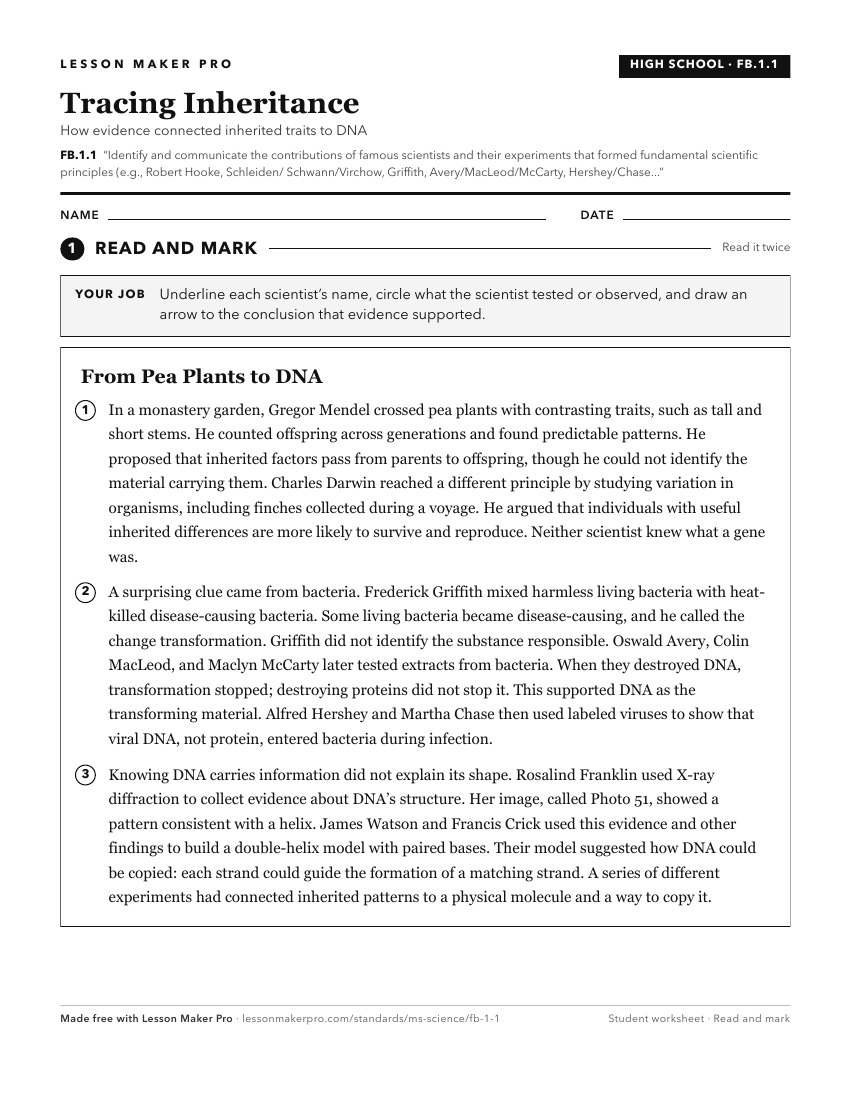
A ready-to-print activity worksheet aligned to FB.1.1, with an answer key for the teacher on its own page. No account needed.
PDF, US Letter, prints cleanly in black and white.
Download the worksheetKeep exploring
Related Standards
- L.1.1.5
With teacher support, gain an understanding that scientists are humans who use observations and experiments to learn about the natural world. Obtain information...
- FB.5.1
Investigate through research the contributions of scientists to the theory of evolution and evolutionary processes (e.g., Needham, Spallanzani, Redi, Pasteur, L...
- BIO.1A.2
Describe the tenets of cell theory and the contributions of Schwann, Hooke, Schleiden, and Virchow.
- FB.1.2
Trace and model the historical development of scientific ideas and theories (e.g., creation of the microscope, discovery of cells/cell theory, discovery of DNA/...
Turn this exact standard into a lesson
Grade, subject, topic, and the complete standard are prefilled. Create one free, no account needed.
Also for this standard:Make a WorksheetMake a QuizMake a Sub Lesson