Mississippi Science FB.2
Standard Cluster
Students will demonstrate an understanding of the structure and interactions of matter and how the organization of matter supports living organisms. Develop and use simple atomic models to describe the components of elements (e.g., relative position, charges of protons, neutrons, and electrons). Obtain and use information about elements (e.g., chemical symbol, atomic number, atomic mass, and group or family) to describe the organization of the periodic table. Relate chemical reactivity to an element’s position on the periodic table. Use this information to determine what type of bond will form between elements (ionic, covalent, hydrogen). Analyze and interpret data to classify common solutions such as acids, bases, or neutral. Communicate the importance of pH in living systems. Investigate how the properties of water (e.g., cohesion, adhesion, heat capacity, solvent properties) contribute to the maintenance of living cells and organisms. Explain the role of the major biomolecules (carbohydrates, proteins -including enzymes, lipids, and nucleic acids) to the survival of living organisms. Enrichment: Explore the structure of biomolecules using molecular models. Relate the structure of biomolecules to their function in living things (discuss types bonding, importance of the strength and weakness of the bond in function, energy in bonds, enzyme function).
2026 Mississippi College- and Career-Readiness Standards for Science · The Chemistry of Life
Cluster contents
Standards in This Cluster
FB.2 is a cluster heading. These are the individual standards under it.
- FB.2.1
Develop and use simple atomic models to describe the components of elements (e.g., relative position, charges of protons, neutrons, and electrons).
- FB.2.2
Obtain and use information about elements (e.g., chemical symbol, atomic number, atomic mass, and group or family) to describe the organization of the periodic ...
- FB.2.3
Relate chemical reactivity to an element’s position on the periodic table. Use this information to determine what type of bond will form between elements (ionic...
- FB.2.4
Analyze and interpret data to classify common solutions such as acids, bases, or neutral. Communicate the importance of pH in living systems.
- FB.2.5
Investigate how the properties of water (e.g., cohesion, adhesion, heat capacity, solvent properties) contribute to the maintenance of living cells and organism...
- FB.2.6
Explain the role of the major biomolecules (carbohydrates, proteins -including enzymes, lipids, and nucleic acids) to the survival of living organisms.
- FB.2.7
Enrichment: Explore the structure of biomolecules using molecular models. Relate the structure of biomolecules to their function in living things (discuss types...
Teacher's field guide
What This Cluster Means
What Students Need to Do
- Build atom models with protons and neutrons in the nucleus and electrons outside it. Use symbols, atomic numbers, masses, and groups to compare elements and predict ionic or covalent bonds. Use pH readings and water tests to explain conditions cells need, then describe the jobs of major biomolecules.
What Mastery Looks Like
- Students draw atoms with labeled particle charges and use periodic table groups to explain why elements react. They connect hydrogen bonds to water's cohesion and adhesion, and explain how its heat capacity and solvent action help organisms. They classify pH readings and match carbohydrates, proteins, lipids, and nucleic acids to their jobs.
Common Misconceptions
- Students may put electrons in the nucleus or confuse atomic number with atomic mass. Some think any bond involving hydrogen is a hydrogen bond. Others assume a neutral pH means a solution is safe or that enzymes work equally well at every pH.
How to Assess It
- Exit ticket: Draw sodium and chlorine atoms with labeled particle charges, predict their bond using the periodic table, and classify solutions with pH values of 2, 7, and 10.
Lesson moves
Ways to Teach It
Drop water on wax paper, wick it up paper towels, and dissolve salt; record evidence of cohesion, adhesion, and solvent action.
Give students pH readings of 7.4 and 6.8; ask what a drop in blood pH might do to an enzyme.
Hand out sodium, chlorine, carbon, and oxygen element cards; pairs use periodic table groups to sort likely ionic and covalent pairs.
Put cups of water and sand under a lamp, record temperatures after ten minutes, and connect water's slower warming to lake habitats.
Free download
Printable FB.2 Worksheet
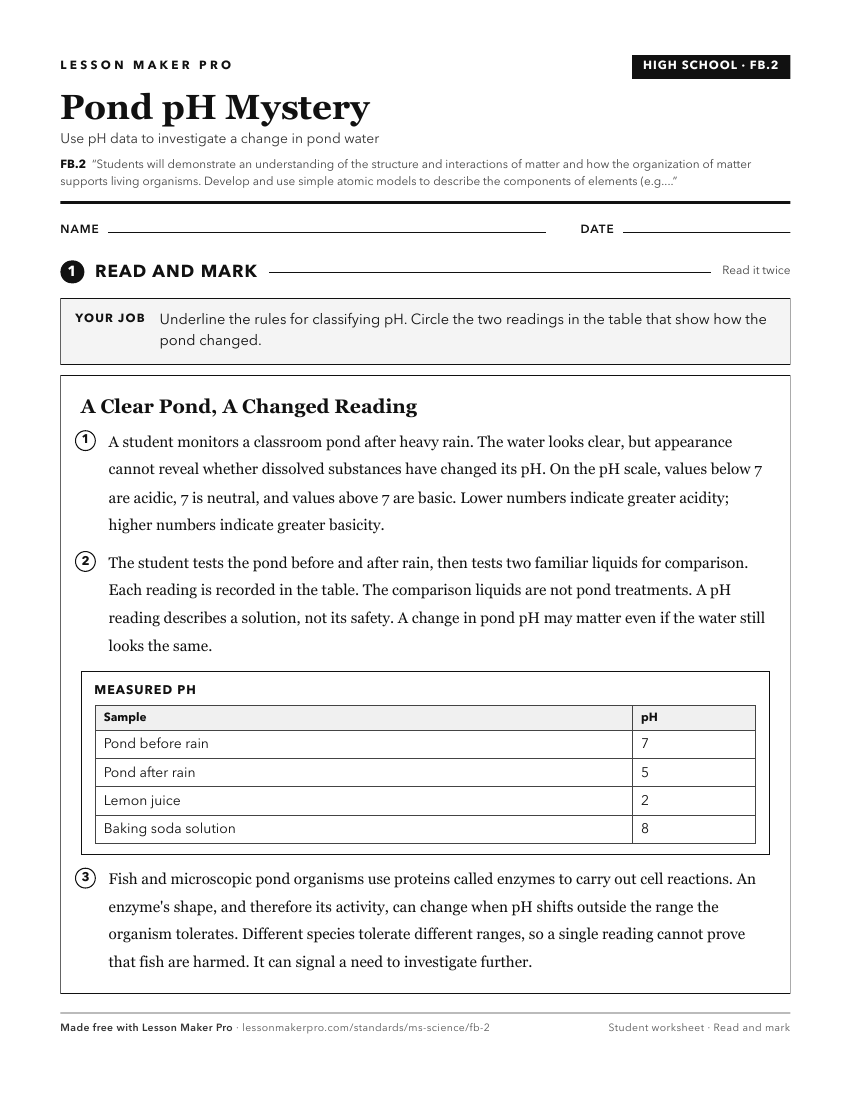
A ready-to-print activity worksheet aligned to FB.2, with an answer key for the teacher on its own page. No account needed.
PDF, US Letter, prints cleanly in black and white.
Download the worksheetKeep exploring
Related Standards
- PHS.1
Students will demonstrate an understanding of the nature of matter.
- FB.3
Students will demonstrate an understanding of how the structure of living organisms supports the essential functions of life.
- BIO.1A
Students will demonstrate an understanding of the characteristics of life and biological organization.
- P.2.5
Students will demonstrate an understanding of the properties of matter.
Turn this cluster into a lesson
Grade, subject, topic, and the complete cluster are prefilled. Create one free, no account needed.
Also for this cluster:Make a WorksheetMake a QuizMake a Sub Lesson