Mississippi Science P.2.5
Standard Cluster
Students will demonstrate an understanding of the properties of matter. Conduct a structured investigation to collect, represent, and analyze categorical data to classify matter as solid, liquid, or gas. Report findings and describe a variety of materials according to observable physical properties (e.g., size, color, texture, opacity, solubility). Compare and measure the length of solid objects using technology and mathematical representations. Analyze and communicate findings. Compare the weight of solid objects and the volume of liquid objects. Analyze and communicate findings. Construct scientific arguments to support claims that some changes to matter caused by heating can be reversed, and some changes cannot be reversed.
2026 Mississippi College- and Career-Readiness Standards for Science · Organization of Matter and Chemical Interactions
Cluster contents
Standards in This Cluster
P.2.5 is a cluster heading. These are the individual standards under it.
- P.2.5.1
Conduct a structured investigation to collect, represent, and analyze categorical data to classify matter as solid, liquid, or gas. Report findings and describe...
- P.2.5.2
Compare and measure the length of solid objects using technology and mathematical representations. Analyze and communicate findings.
- P.2.5.3
Compare the weight of solid objects and the volume of liquid objects. Analyze and communicate findings.
- P.2.5.4
Construct scientific arguments to support claims that some changes to matter caused by heating can be reversed, and some changes cannot be reversed.
Teacher's field guide
What This Cluster Means
What Students Need to Do
- Students sort solids, liquids, and gases and record their findings in a chart. They describe materials by what they observe, then measure lengths and compare weights and liquid volumes. They use evidence to explain which changes from heating can be reversed.
What Mastery Looks Like
- A student sorts a rock, water, and air in a balloon and explains each choice. They measure a block with a ruler, compare two weights and two liquid volumes, and describe properties such as texture or whether something dissolves. They explain that melted ice can freeze again, but a cooked egg cannot become raw again.
Common Misconceptions
- Some students say air is nothing because they cannot see it. They may start measuring at the 1 on a ruler or assume a bigger object always weighs more. They may think cooling can undo any change caused by heat.
How to Assess It
- Show students a rock, a clear cup of water, and an inflated balloon. On an exit slip, ask them to name each state, record one observable property of each, and explain how they know air is inside the balloon.
Lesson moves
Ways to Teach It
Give pairs a rock, water, and an inflated balloon to sort by state, then tally their choices on a class chart.
Ask, 'Why can melted ice freeze again, but a cooked egg cannot turn raw again?' Have students cite what they observed.
Race to record two blocks' lengths with a ruler, their weights with a balance, and water volumes from two marked cups.
Bring a clear drink bottle and a cardboard milk carton; check which lets light through, then stir sugar into water to test dissolving.
Free download
Printable P.2.5 Worksheet
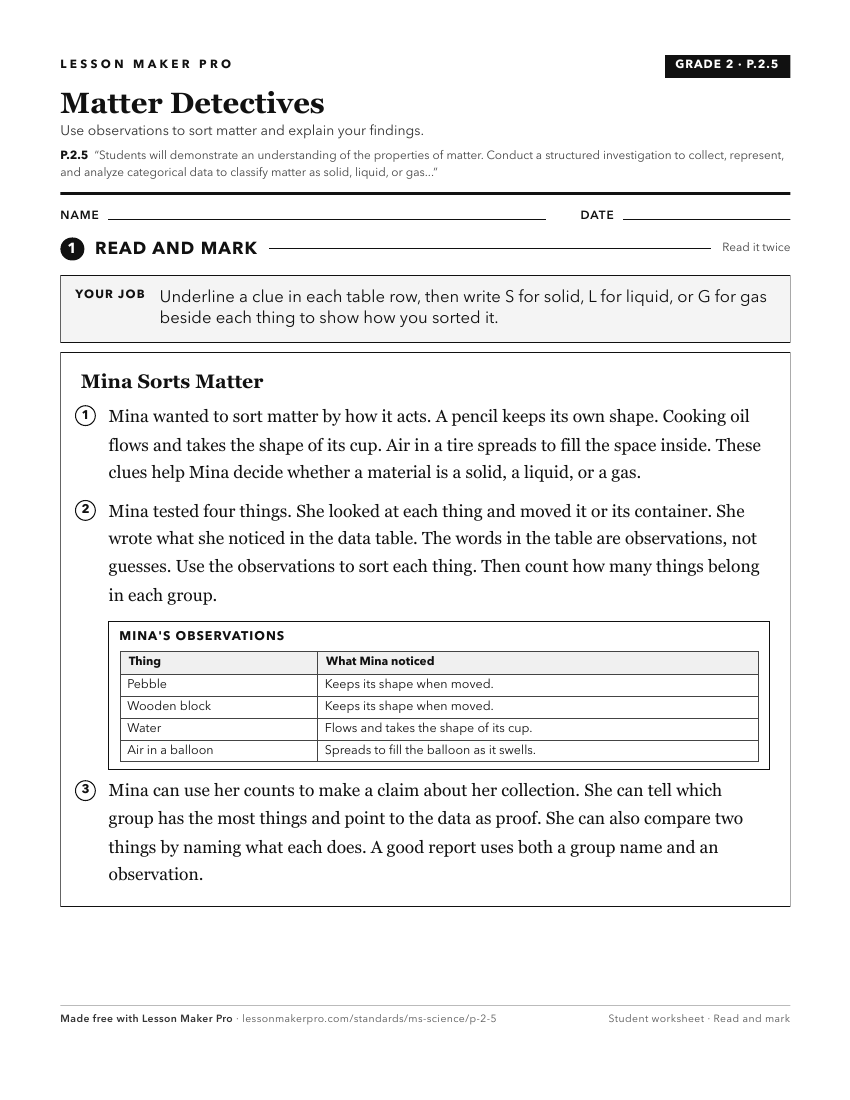
A ready-to-print activity worksheet aligned to P.2.5, with an answer key for the teacher on its own page. No account needed.
PDF, US Letter, prints cleanly in black and white.
Download the worksheetKeep exploring
Related Standards
- PHS.1
Students will demonstrate an understanding of the nature of matter.
- P.K.5A
Students will demonstrate an understanding of the solid and liquid states of matter.
- P.7.5A
Students will demonstrate an understanding of the physical and chemical properties of matter.
- P.5.5A
Students will demonstrate an understanding of the physical properties of matter.
Turn this cluster into a lesson
Grade, subject, topic, and the complete cluster are prefilled. Create one free, no account needed.
Also for this cluster:Make a WorksheetMake a QuizMake a Sub Lesson