Mississippi Science PHS.1
Standard Cluster
Students will demonstrate an understanding of the nature of matter. Use contextual evidence to describe particle theory of matter. Examine the particle properties of solids, liquids, and gases. Use scientific research to generate models to compare physical and chemical properties of elements, compounds, and mixtures. Conduct an investigation to determine the identity of unknown substances by comparing properties to known substances. Design and conduct investigations to explore techniques in measurements of mass, volume, length, and temperature. Design and conduct an investigation using graphical analysis (e.g., line graph) to determine the density of liquids and/or solids. Use mathematical and computational analysis to solve density problems. Manipulate the density formula to determine density, volume, or mass or use dimensional analysis to solve problems.
2026 Mississippi College- and Career-Readiness Standards for Science · Nature of Matter
Cluster contents
Standards in This Cluster
PHS.1 is a cluster heading. These are the individual standards under it.
- PHS.1.1
Use contextual evidence to describe particle theory of matter. Examine the particle properties of solids, liquids, and gases.
- PHS.1.2
Use scientific research to generate models to compare physical and chemical properties of elements, compounds, and mixtures.
- PHS.1.3
Conduct an investigation to determine the identity of unknown substances by comparing properties to known substances.
- PHS.1.4
Design and conduct investigations to explore techniques in measurements of mass, volume, length, and temperature.
- PHS.1.5
Design and conduct an investigation using graphical analysis (e.g., line graph) to determine the density of liquids and/or solids.
- PHS.1.6
Use mathematical and computational analysis to solve density problems. Manipulate the density formula to determine density, volume, or mass or use dimensional a...
Teacher's field guide
What This Cluster Means
What Students Need to Do
- Students use evidence to explain how particles are arranged and move in solids, liquids, and gases. They use models and property data to tell elements, compounds, and mixtures apart and identify unknown substances. They measure mass, volume, length, and temperature, then graph and calculate density.
What Mastery Looks Like
- Students explain why gases compress but solids keep their shape using particle spacing and motion. They use researched particle models and physical and chemical properties to classify samples and identify an unknown. They find density from the slope of a mass-versus-volume graph and solve for mass or volume with correct units.
Common Misconceptions
- Students may think particles in solids do not move or that gases have no mass. They may call salt water a compound because it looks uniform, or treat dissolving as a chemical change. They may divide volume by mass when finding density or mistake a graph's starting point for its slope.
How to Assess It
- Give students mass and volume data for one unknown solid: 10 cm³ and 27 g, 20 cm³ and 54 g, 30 cm³ and 81 g. Ask them to graph the data, find the density from the slope, and choose between aluminum at 2.7 g/cm³ and zinc at 7.1 g/cm³.
Lesson moves
Ways to Teach It
Give pairs a balance, ruler, thermometer, and graduated cylinder to measure a metal block's mass, length, temperature, and water-displacement volume.
Show a sealed syringe before and after compression, then ask students to sketch its gas particles and explain the volume change.
Run a four-card relay where teams solve for a missing mass, volume, or density and check the units.
Have students use a shipping label's mass and package dimensions to estimate density, then decide whether the package could contain steel or foam.
Free download
Printable PHS.1 Worksheet
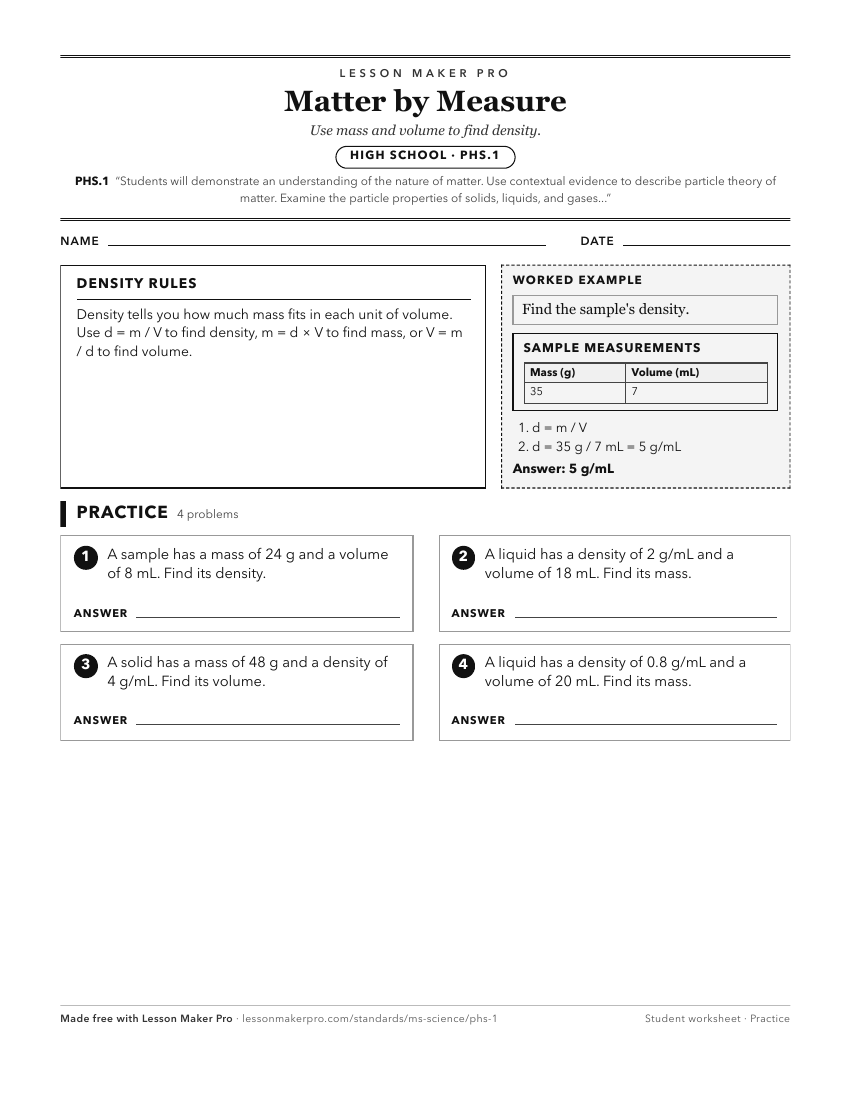
A ready-to-print activity worksheet aligned to PHS.1, with an answer key for the teacher on its own page. No account needed.
PDF, US Letter, prints cleanly in black and white.
Download the worksheetKeep exploring
Related Standards
- P.K.5A
Students will demonstrate an understanding of the solid and liquid states of matter.
- P.7.5A
Students will demonstrate an understanding of the physical and chemical properties of matter.
- P.5.5A
Students will demonstrate an understanding of the physical properties of matter.
- P.2.5
Students will demonstrate an understanding of the properties of matter.
Turn this cluster into a lesson
Grade, subject, topic, and the complete cluster are prefilled. Create one free, no account needed.
Also for this cluster:Make a WorksheetMake a QuizMake a Sub Lesson