Mississippi Science PHS.1.5
The Standard
- PHS.1
- Students will demonstrate an understanding of the nature of matter.
Design and conduct an investigation using graphical analysis (e.g., line graph) to determine the density of liquids and/or solids.
2026 Mississippi College- and Career-Readiness Standards for Science · Nature of Matter
Teacher's field guide
What This Standard Means
What Students Need to Do
- Students plan how to measure the mass and volume of several samples of one material. They graph mass against volume and use the slope to find its density.
What Mastery Looks Like
- A student tares the container, puts volume on the horizontal axis, and plots the measurements accurately. They calculate the line's slope, give its units, and explain why a larger sample has the same density.
Common Misconceptions
- Students may include the container's mass or divide volume by mass instead of mass by volume. Some think a larger piece of the same material is denser.
How to Assess It
- Exit ticket: A liquid has masses of 10 g, 20 g, and 30 g at volumes of 5 mL, 10 mL, and 15 mL. Sketch a mass-versus-volume graph and find its density from the slope, with units.
Lesson moves
Ways to Teach It
Groups choose three water volumes, measure each with a graduated cylinder, weigh each in a tared cup, then graph mass versus volume.
Show two mass-versus-volume graphs with different slopes; ask, 'Which material is denser, and what on the graph tells you?'
Give pairs cards with two mass and volume measurements; they calculate each slope and match the cards to density labels.
Use a scrap yard's mass and volume records for metal offcuts; graph the data and identify the metal with a density chart.
Free download
Printable PHS.1.5 Worksheet
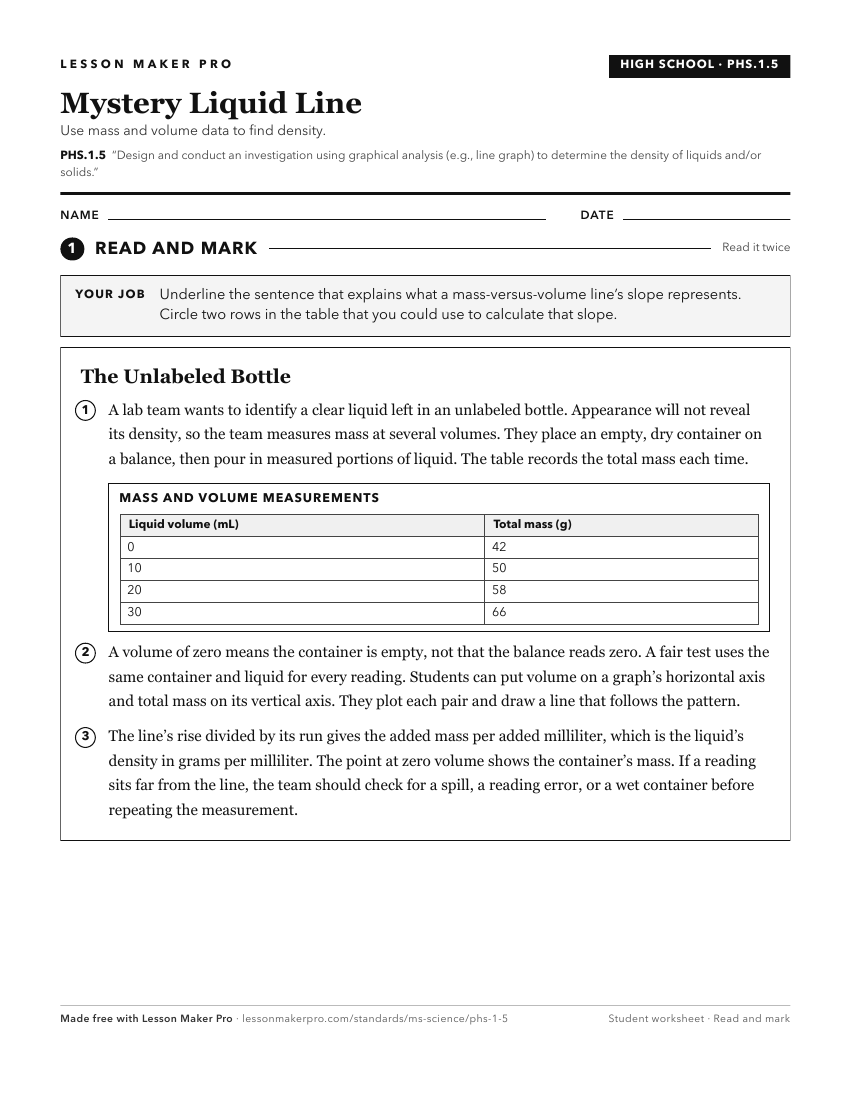
A ready-to-print activity worksheet aligned to PHS.1.5, with an answer key for the teacher on its own page. No account needed.
PDF, US Letter, prints cleanly in black and white.
Download the worksheetKeep exploring
Related Standards
- P.5.5A.2
Collect, analyze, and interpret data from measurements of the physical properties of solids, liquids, and gases (e.g., volume, shape, movement, and spacing of p...
- PHS.1.4
Design and conduct investigations to explore techniques in measurements of mass, volume, length, and temperature.
- P.2.5.1
Conduct a structured investigation to collect, represent, and analyze categorical data to classify matter as solid, liquid, or gas. Report findings and describe...
- P.2.5.3
Compare the weight of solid objects and the volume of liquid objects. Analyze and communicate findings.
Turn this exact standard into a lesson
Grade, subject, topic, and the complete standard are prefilled. Create one free, no account needed.
Also for this standard:Make a WorksheetMake a QuizMake a Sub Lesson