Mississippi Science P.2.5.3
The Standard
- P.2.5
- Students will demonstrate an understanding of the properties of matter.
Compare the weight of solid objects and the volume of liquid objects. Analyze and communicate findings.
2026 Mississippi College- and Career-Readiness Standards for Science · Organization of Matter and Chemical Interactions
Teacher's field guide
What This Standard Means
What Students Need to Do
- Students use a balance to compare the weight of solid objects. They measure liquids in marked cups, compare the amounts, and explain what they found.
What Mastery Looks Like
- A student can use a balance to tell whether a rock or an eraser is heavier. They can measure two pours of water, name which has more, and point to the readings as evidence.
Common Misconceptions
- Students may think a larger solid must weigh more. They may think water that sits higher in a narrow cup is always a larger amount, or mistake cup size for the amount inside.
How to Assess It
- Show a picture of a balance with the rock side lower than the eraser side, alongside cups marked 40 mL and 60 mL. Ask, "Which solid weighs more? Which cup has more water? What evidence tells you?"
Lesson moves
Ways to Teach It
Have pairs use a pan balance to compare a rock and eraser, then a marked measuring cup to compare two pours of colored water.
Pour 100 mL of water into a tall cup and 100 mL into a wide cup, then ask, "Does either contain more water? How do you know?"
Give pairs cards showing tipped balances or marked cups; have them name the heavier solid or larger liquid amount, then check the backs.
At a pretend grocery stall, weigh two apples and measure two cups of water, then label the heavier apple and larger drink.
Free download
Printable P.2.5.3 Worksheet
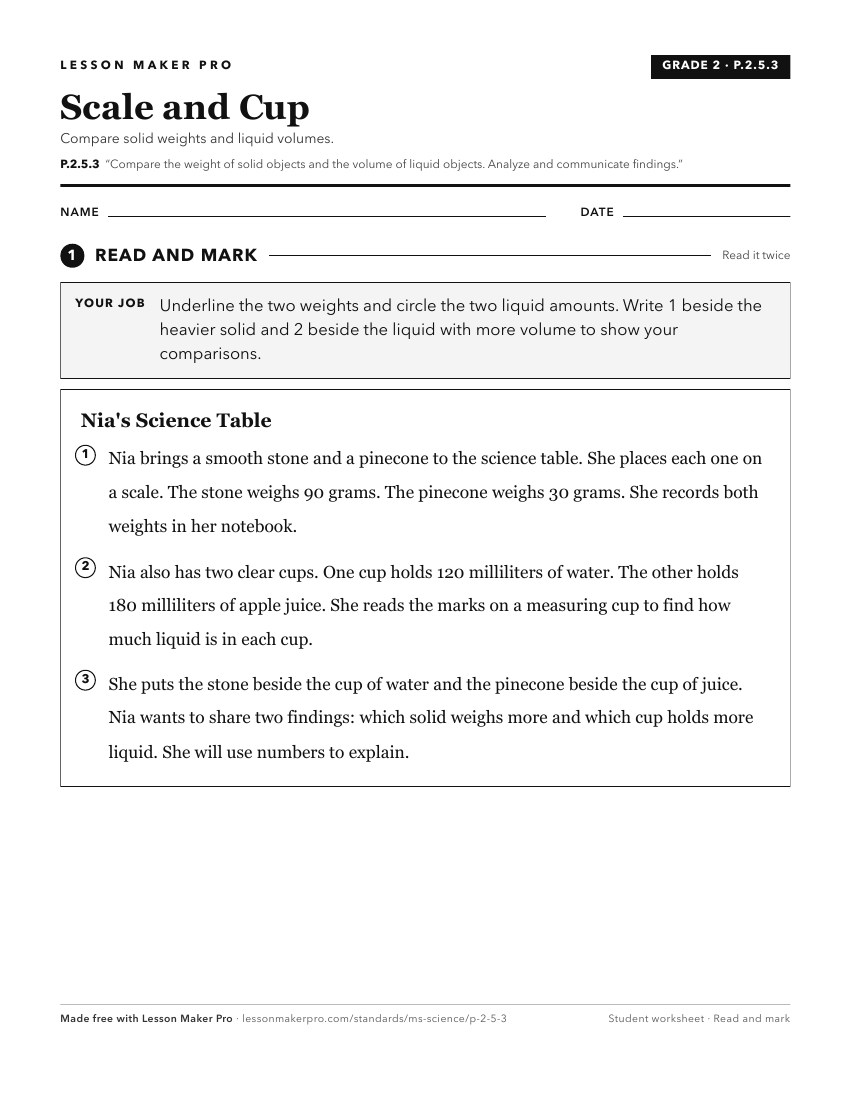
A ready-to-print activity worksheet aligned to P.2.5.3, with an answer key for the teacher on its own page. No account needed.
PDF, US Letter, prints cleanly in black and white.
Download the worksheetKeep exploring
Related Standards
- P.5.5A.2
Collect, analyze, and interpret data from measurements of the physical properties of solids, liquids, and gases (e.g., volume, shape, movement, and spacing of p...
- PHS.1.5
Design and conduct an investigation using graphical analysis (e.g., line graph) to determine the density of liquids and/or solids.
- P.K.5A.1
Generate questions and investigate the differences between liquids and solids and develop awareness that a liquid can become a solid and vice versa.
- P.2.5.2
Compare and measure the length of solid objects using technology and mathematical representations. Analyze and communicate findings.
Turn this exact standard into a lesson
Grade, subject, topic, and the complete standard are prefilled. Create one free, no account needed.
Also for this standard:Make a WorksheetMake a QuizMake a Sub Lesson