Mississippi Science P.2.5.2
The Standard
- P.2.5
- Students will demonstrate an understanding of the properties of matter.
Compare and measure the length of solid objects using technology and mathematical representations. Analyze and communicate findings.
2026 Mississippi College- and Career-Readiness Standards for Science · Organization of Matter and Chemical Interactions
Teacher's field guide
What This Standard Means
What Students Need to Do
- Students measure the length of solid objects with a ruler. They record the lengths in centimeters in a digital table or bar chart, then compare the objects using the numbers.
What Mastery Looks Like
- A student lines up one end of an object with 0 and reads the mark at the other end. They can use two recorded lengths to say which object is longer and by how many centimeters.
Common Misconceptions
- Some students start at the ruler's edge or the 1 mark instead of 0. Others count marks instead of centimeter spaces, or compare measurements made in different units.
How to Assess It
- Give each student a 9 cm and a 12 cm cardboard strip, a ruler, and a two-row digital table. Ask them to record both lengths and write which strip is longer and by how many centimeters.
Lesson moves
Ways to Teach It
Pairs measure a glue stick, pencil, and eraser with a centimeter ruler, then enter the lengths in a shared spreadsheet to make a bar chart.
Show the class bar chart and ask, 'Which object is longest, and how many centimeters longer is it than the shortest?'
Play measurement match: partners measure four craft sticks and match each one to a card showing its length in centimeters.
Measure the inside length of a pencil box and two pencils, then record the lengths in a tablet table to decide which pencils fit.
Free download
Printable P.2.5.2 Worksheet
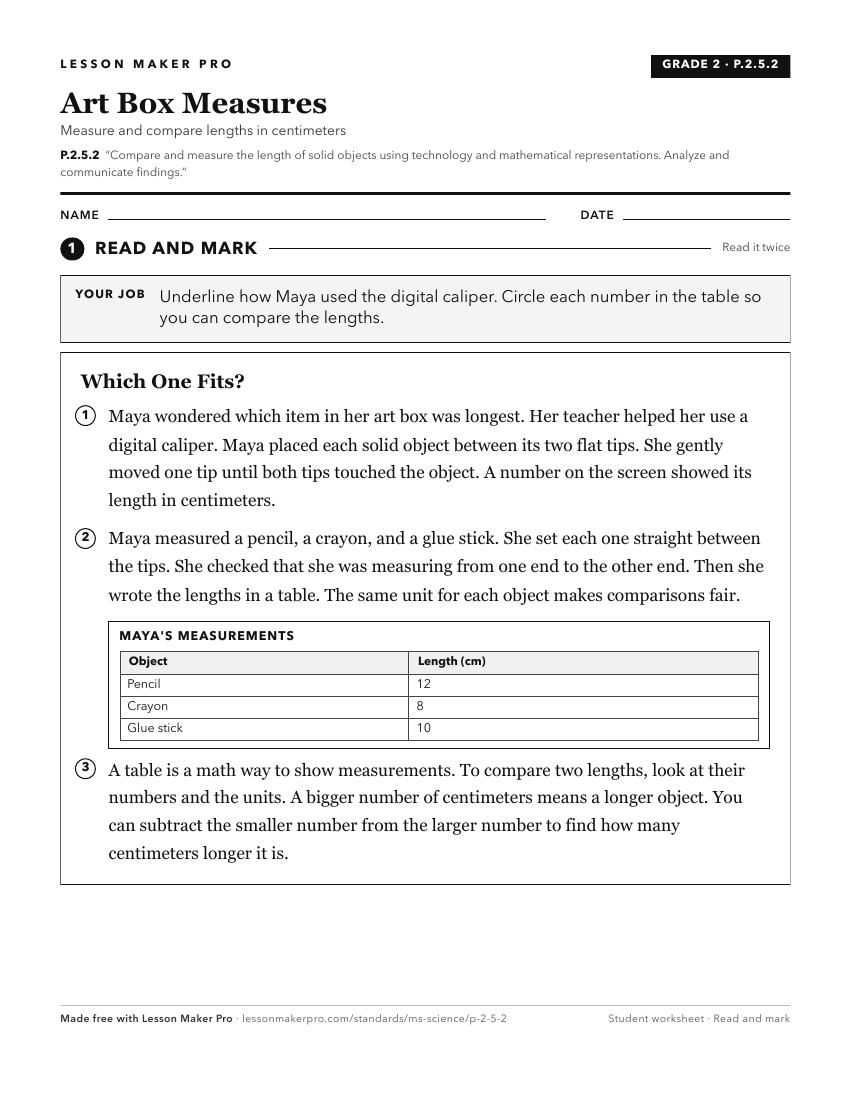
A ready-to-print activity worksheet aligned to P.2.5.2, with an answer key for the teacher on its own page. No account needed.
PDF, US Letter, prints cleanly in black and white.
Download the worksheetKeep exploring
Related Standards
- FSL.3A.4
Use mathematical and computational thinking to (1) use and manipulate appropriate metric units, (2) express relationships between variables for investigations, ...
- P.5.5A.2
Collect, analyze, and interpret data from measurements of the physical properties of solids, liquids, and gases (e.g., volume, shape, movement, and spacing of p...
- PHY.1.6
Design and mathematically/graphically analyze quantitative data to explore displacement, velocity, and acceleration of various objects. Use probe systems, video...
- P.2.5.3
Compare the weight of solid objects and the volume of liquid objects. Analyze and communicate findings.
Turn this exact standard into a lesson
Grade, subject, topic, and the complete standard are prefilled. Create one free, no account needed.
Also for this standard:Make a WorksheetMake a QuizMake a Sub Lesson