Mississippi Science FSL.3A.4
The Standard
- FSL.3A
- Students will apply science and engineering practices and skills to scientific investigations.
Use mathematical and computational thinking to (1) use and manipulate appropriate metric units, (2) express relationships between variables for investigations, and (3) compare or combine data from two or more simple data presentations (e.g., order or sum data from a table, categorize data from a table using a scale from another table).
2026 Mississippi College- and Career-Readiness Standards for Science · Nature of Science
Teacher's field guide
What This Standard Means
What Students Need to Do
- Students choose metric units, convert between them, and describe how one measured variable changes with another. They match or combine results from two tables to answer a question.
What Mastery Looks Like
- A student converts 30 mm of plant growth to 3 cm without changing the measurement. They match each plant to its water amount in a second table and describe the pattern the data shows.
Common Misconceptions
- Students may multiply when converting millimeters to centimeters instead of dividing. They may compare numbers before checking units, or pair rows from two tables without checking the labels.
How to Assess It
- Exit ticket: Table A lists Pot 1 at 10 mL of water and Pot 2 at 20 mL. Table B lists their growth as 15 mm and 30 mm; ask students to convert growth to centimeters and describe the relationship.
Lesson moves
Ways to Teach It
Roll toy cars from two ramp heights, measure travel in centimeters, then combine a partner's results with yours in a table.
Show a table of water added and seedling growth; ask, 'Which variable changes with water, and what pattern do you see?'
Give pairs two tables of race times in seconds and milliseconds; have them convert, rank, and add matching trials.
Use two nutrition labels to convert sodium from milligrams to grams, then total the sodium in a packed lunch.
Free download
Printable FSL.3A.4 Worksheet
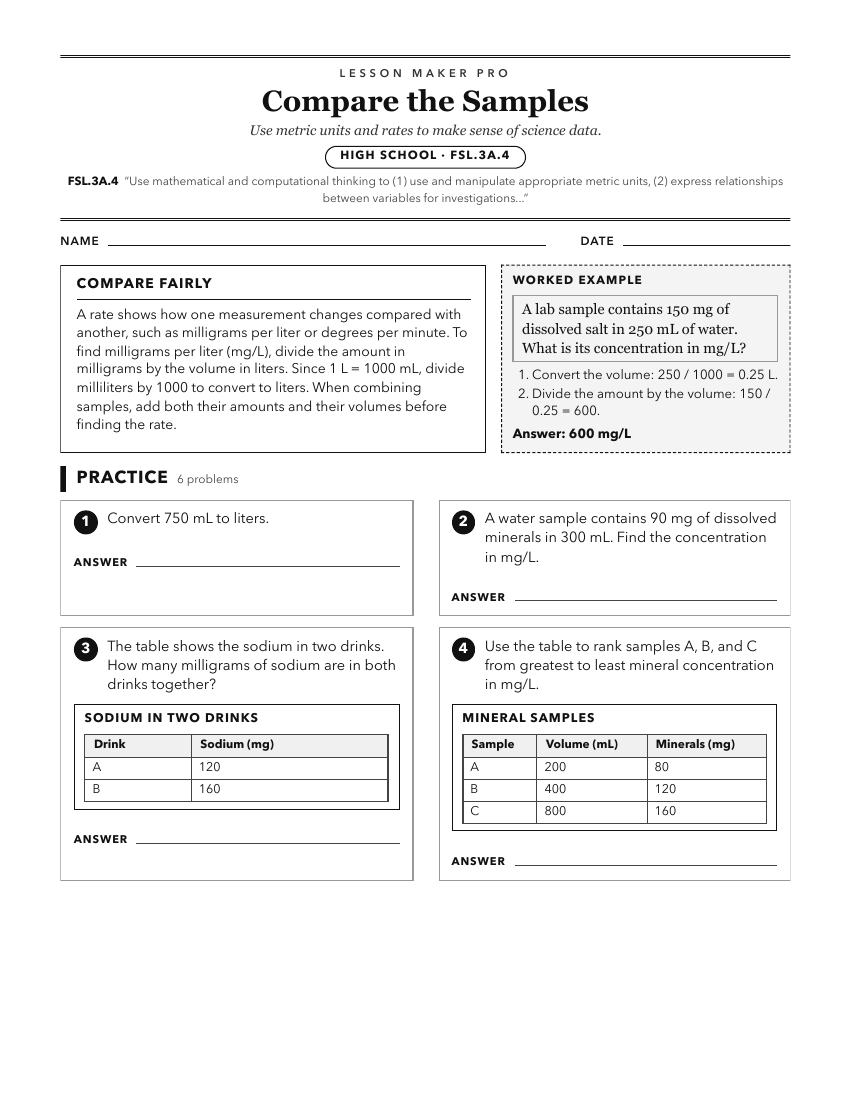
A ready-to-print activity worksheet aligned to FSL.3A.4, with an answer key for the teacher on its own page. No account needed.
PDF, US Letter, prints cleanly in black and white.
Download the worksheetKeep exploring
Related Standards
- P.2.5.2
Compare and measure the length of solid objects using technology and mathematical representations. Analyze and communicate findings.
- PHS.1.6
Use mathematical and computational analysis to solve density problems. Manipulate the density formula to determine density, volume, or mass or use dimensional a...
- FSL.3B.2
Compare or combine data from two or more simple data presentations (e.g., order or sum data from a table, categorize data from a table using a scale from anothe...
- FSL.3B.4
Perform a simple interpolation or simple extrapolation using data in a table or graph. Determine and/or use a simple (e.g., linear) mathematical relationship th...
Turn this exact standard into a lesson
Grade, subject, topic, and the complete standard are prefilled. Create one free, no account needed.
Also for this standard:Make a WorksheetMake a QuizMake a Sub Lesson