Mississippi Science PHS.1.6
The Standard
- PHS.1
- Students will demonstrate an understanding of the nature of matter.
Use mathematical and computational analysis to solve density problems. Manipulate the density formula to determine density, volume, or mass or use dimensional analysis to solve problems.
2026 Mississippi College- and Career-Readiness Standards for Science · Nature of Matter
Teacher's field guide
What This Standard Means
What Students Need to Do
- Students use mass and volume to calculate density. They rearrange the formula to find mass or volume, convert units when needed, and check their work with a calculator or spreadsheet.
What Mastery Looks Like
- Given 48 g and 12 cm³, a student finds a density of 4 g/cm³. Given that density and a mass of 48 g, they find a volume of 12 cm³ and explain the units.
Common Misconceptions
- Students may divide volume by mass when finding density, or multiply when finding volume. They may leave mass in kilograms while using a density in g/cm³. Some report density in grams instead of g/cm³.
How to Assess It
- Exit ticket: A metal sample has a mass of 54 g and a density of 6 g/cm³. Find its volume, show the calculation, and label the answer.
Lesson moves
Ways to Teach It
Have pairs weigh a rock, measure its displaced water in a graduated cylinder, and calculate its density in g/mL.
Show blocks labeled 10 g and 2 cm³, and 20 g and 10 cm³; ask which is denser and why.
Run a density relay with cards showing two known values; pairs calculate the missing density, mass, or volume before passing each card.
Give students a card stating that 750 mL of cooking oil weighs 690 g; ask them to calculate its density and predict whether it floats.
Free download
Printable PHS.1.6 Worksheet
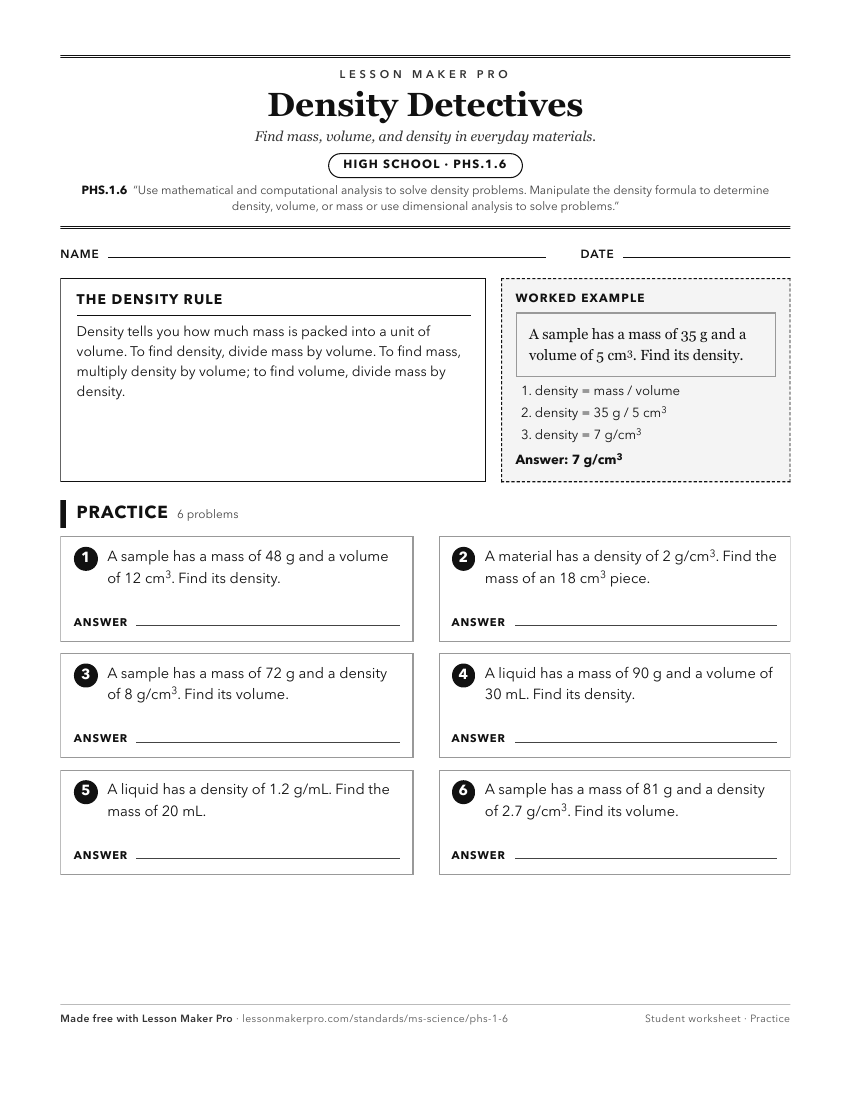
A ready-to-print activity worksheet aligned to PHS.1.6, with an answer key for the teacher on its own page. No account needed.
PDF, US Letter, prints cleanly in black and white.
Download the worksheetKeep exploring
Related Standards
- PHY.3.7
Enrichment: Use mathematical and computational analysis to analyze problems involving specific heat and heat capacity.
- PHY.1.3
Use mathematical and computational analysis to solve problems using kinematic equations.
- CHE.8.1
Use mathematical and computational analysis to quantitatively express the concentration of solutions using concepts such as molarity, percent by mass, and dilut...
- CHE.8.5
Use mathematical and computational analysis to analyze molarity, molality, dilution, and percentage dilution problems.
Turn this exact standard into a lesson
Grade, subject, topic, and the complete standard are prefilled. Create one free, no account needed.
Also for this standard:Make a WorksheetMake a QuizMake a Sub Lesson