Mississippi Science PHY.1.3
The Standard
- PHY.1
- Students will investigate and understand how to analyze and interpret data.
Use mathematical and computational analysis to solve problems using kinematic equations.
2026 Mississippi College- and Career-Readiness Standards for Science · One-Dimensional Motion
Teacher's field guide
What This Standard Means
What Students Need to Do
- Students use starting position, velocity, acceleration, and time to predict where an object will be or how fast it will move. They use equations and a spreadsheet or calculator to solve straight-line motion problems with constant acceleration.
What Mastery Looks Like
- Given starting speed, acceleration, and time, a student chooses an equation and calculates final speed or displacement with units. They set a positive direction, handle negative acceleration, and check a result with a spreadsheet.
Common Misconceptions
- Students may think negative acceleration means an object is moving backward, even when it is still moving forward. They may use distance = speed × time when speed is changing, or forget to square time in the displacement equation.
How to Assess It
- Exit ticket: A cart starts at 2 m/s and accelerates at 3 m/s² for 4 s. Find its displacement, show units, and check your answer with a spreadsheet formula.
Lesson moves
Ways to Teach It
Mark a ramp every 20 cm, film a rolling cart, and use video timestamps to compare measured positions with calculated positions.
Have students write two sentences explaining why a braking car has negative acceleration when forward is positive.
Give pairs three motion cards and have them check hand calculations for final speed or displacement with spreadsheet formulas.
A car travels at 12 m/s and accelerates at -3 m/s²; calculate whether it stops before a crosswalk 20 meters ahead.
Free download
Printable PHY.1.3 Worksheet
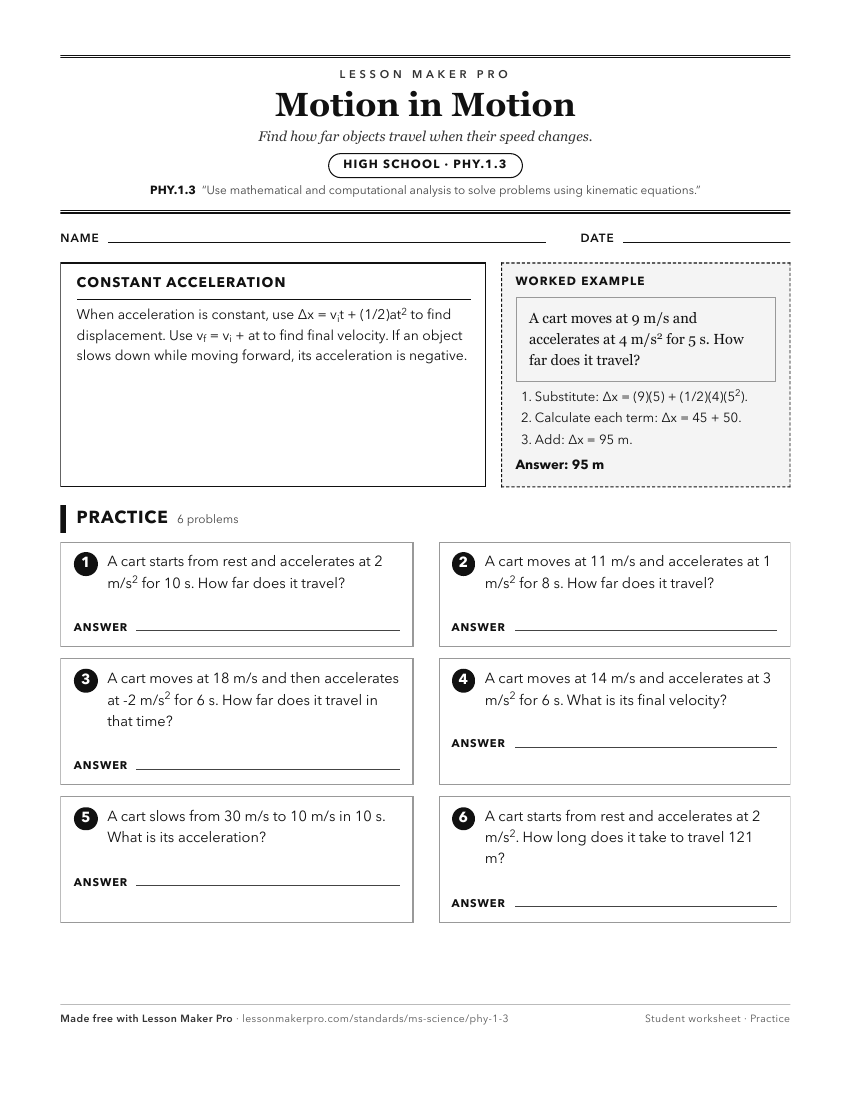
A ready-to-print activity worksheet aligned to PHY.1.3, with an answer key for the teacher on its own page. No account needed.
PDF, US Letter, prints cleanly in black and white.
Download the worksheetKeep exploring
Related Standards
- PHY.1.4
Use graphical analysis to derive kinematic equations.
- PHY.2.5
Use mathematical and computational analysis to derive simple equations of motion for various systems using Newton’s second law (e.g., net force equations).
- PHY.2.6
Use mathematical and computational analysis to explore forces (e.g., friction, force applied, normal, and tension).
- PHS.5.4
Use mathematical and computational analyses to show the relationships among force, mass, and acceleration (i.e., Newton’s second law).
Turn this exact standard into a lesson
Grade, subject, topic, and the complete standard are prefilled. Create one free, no account needed.
Also for this standard:Make a WorksheetMake a QuizMake a Sub Lesson