Mississippi Science PHY.2.5
The Standard
- PHY.2
- Students will develop an understanding of concepts related to Newtonian dynamics.
Use mathematical and computational analysis to derive simple equations of motion for various systems using Newton’s second law (e.g., net force equations).
2026 Mississippi College- and Career-Readiness Standards for Science · Newton’s Laws
Teacher's field guide
What This Standard Means
What Students Need to Do
- Students combine forces with signs, then divide net force by mass to find acceleration. They use that acceleration to derive velocity and position equations when the net force stays constant. They check predictions with a table or spreadsheet.
What Mastery Looks Like
- Students calculate signed net force from a force diagram. They derive v(t) = v0 + (Fnet/m)t and x(t) = x0 + v0t + (Fnet/2m)t² when the net force is constant. Their predictions for a given time have correct units and direction.
Common Misconceptions
- Students add forces in opposite directions instead of subtracting them. They use the applied force instead of net force, leaving out friction. Some think an object moving at constant speed must have a forward net force.
How to Assess It
- Give students a 2 kg cart at rest, pushed right by 6 N against 2 N of friction for 3 seconds. Ask for net force, acceleration, v(t), and x(t), with x(0) = 0.
Lesson moves
Ways to Teach It
Weigh a cart, measure friction by pulling at steady speed, then apply a measured pull and predict its distance from rest.
Ask: With the same 8 N net force, which travels farther in three seconds, a 2 kg cart or a 4 kg cart? Why?
Deal 8 N right, 3 N left, and 1 kg cart cards; pairs race to write v(t) and x(t) from rest.
Use a 70 kg rider, a 750 N elevator scale reading, and g = 10 m/s² to predict speed after two seconds from rest.
Free download
Printable PHY.2.5 Worksheet
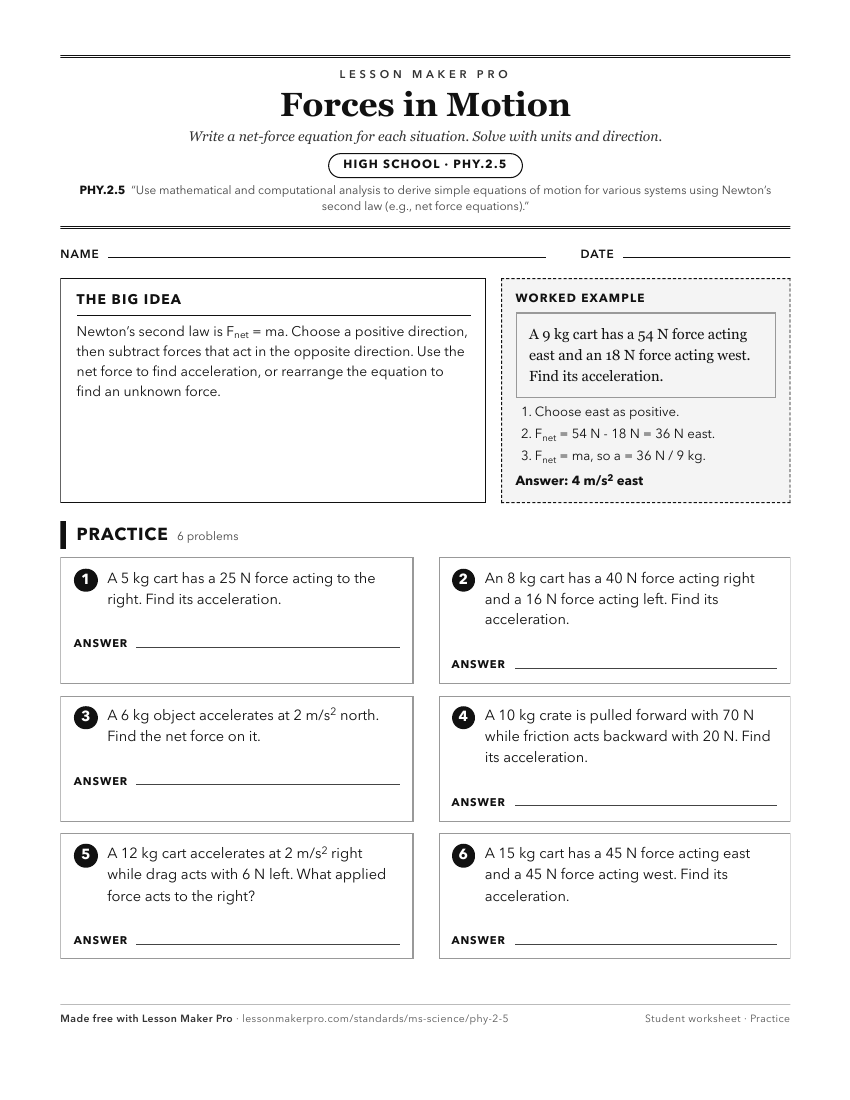
A ready-to-print activity worksheet aligned to PHY.2.5, with an answer key for the teacher on its own page. No account needed.
PDF, US Letter, prints cleanly in black and white.
Download the worksheetKeep exploring
Related Standards
- PHY.1.3
Use mathematical and computational analysis to solve problems using kinematic equations.
- PHY.2.1
Identify forces acting on a system by applying Newton’s laws mathematically and graphically (e.g., vector and scalar quantities).
- PHY.2.6
Use mathematical and computational analysis to explore forces (e.g., friction, force applied, normal, and tension).
- PHS.5.4
Use mathematical and computational analyses to show the relationships among force, mass, and acceleration (i.e., Newton’s second law).
Turn this exact standard into a lesson
Grade, subject, topic, and the complete standard are prefilled. Create one free, no account needed.
Also for this standard:Make a WorksheetMake a QuizMake a Sub Lesson