Mississippi Science PHY.1.4
The Standard
- PHY.1
- Students will investigate and understand how to analyze and interpret data.
Use graphical analysis to derive kinematic equations.
2026 Mississippi College- and Career-Readiness Standards for Science · One-Dimensional Motion
Teacher's field guide
What This Standard Means
What Students Need to Do
- Students find acceleration from the slope of a velocity-time graph and displacement from the signed area beneath it. They use those results to write equations for motion with steady acceleration.
What Mastery Looks Like
- A student can split the area under a sloping velocity-time line into a rectangle and triangle, then use their areas to write Δx = v₀t + ½at². They can combine that equation with v = v₀ + at to get an equation without time.
Common Misconceptions
- Students may read the height of a velocity-time graph as position rather than velocity. They may count only the triangle and miss the rectangle from the starting velocity. Some count area below the time axis as positive when finding displacement.
How to Assess It
- Draw a straight velocity-time line from (0 s, 2 m/s) to (4 s, 14 m/s). Ask students to find its slope, derive a displacement equation using a rectangle and triangle, and calculate the displacement.
Lesson moves
Ways to Teach It
On graph paper, cut out the area beneath a sloping velocity-time line and split it into a rectangle and triangle.
Ask students to write why the triangle's height is the change in velocity, not the final velocity.
Give pairs cards with velocity-time graphs, acceleration values, and displacement equations to match.
Sketch a bus slowing from 12 m/s to rest in 6 s, then use the graph to calculate its stopping distance.
Free download
Printable PHY.1.4 Worksheet
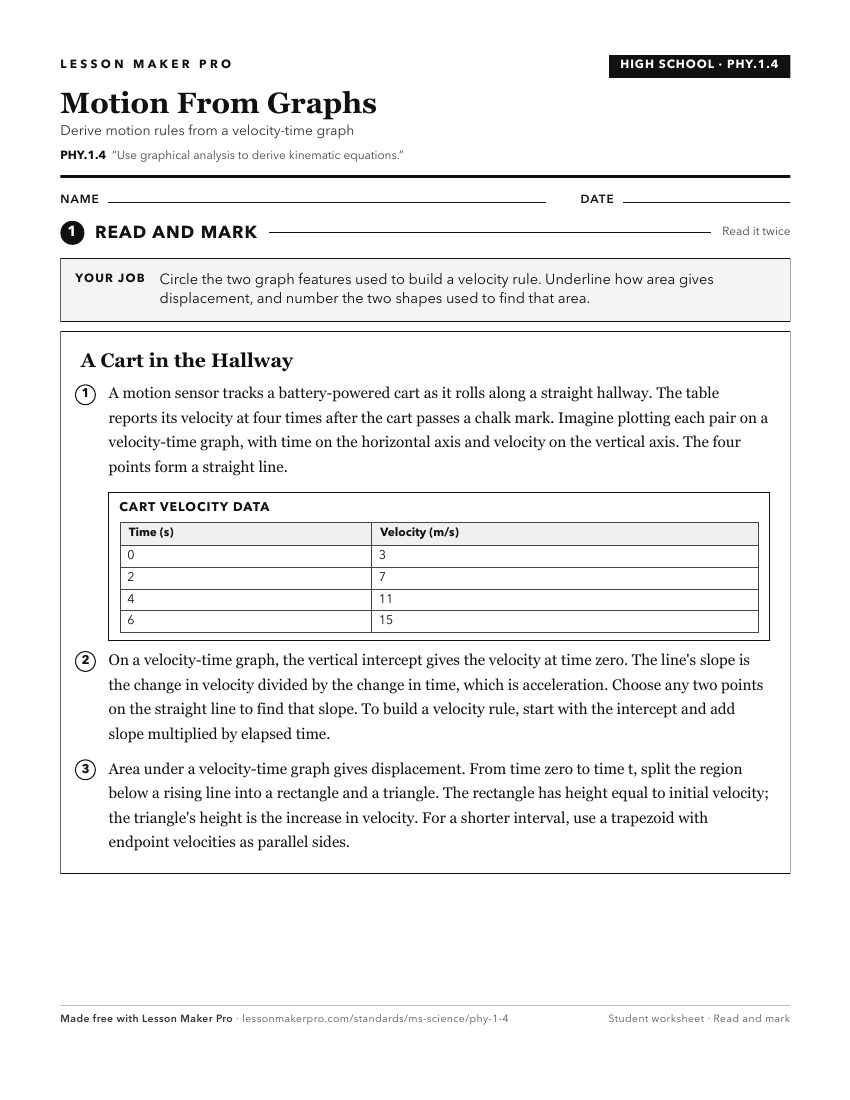
A ready-to-print activity worksheet aligned to PHY.1.4, with an answer key for the teacher on its own page. No account needed.
PDF, US Letter, prints cleanly in black and white.
Download the worksheetKeep exploring
Related Standards
- PHY.2.5
Use mathematical and computational analysis to derive simple equations of motion for various systems using Newton’s second law (e.g., net force equations).
- PHY.1.3
Use mathematical and computational analysis to solve problems using kinematic equations.
- PHY.2.4
Use vectors and mathematical analysis to explore the 2D motion of objects. (i.e., projectile and circular motion).
- PHS.5.4
Use mathematical and computational analyses to show the relationships among force, mass, and acceleration (i.e., Newton’s second law).
Turn this exact standard into a lesson
Grade, subject, topic, and the complete standard are prefilled. Create one free, no account needed.
Also for this standard:Make a WorksheetMake a QuizMake a Sub Lesson