Mississippi Science PHY.2.4
The Standard
- PHY.2
- Students will develop an understanding of concepts related to Newtonian dynamics.
Use vectors and mathematical analysis to explore the 2D motion of objects. (i.e., projectile and circular motion).
2026 Mississippi College- and Career-Readiness Standards for Science · Newton’s Laws
Teacher's field guide
What This Standard Means
What Students Need to Do
- Students split motion into horizontal and vertical parts to predict where a projectile will land. They use speed and radius to find the acceleration of an object moving in a circle.
What Mastery Looks Like
- Given a launch speed and angle, students find the horizontal and vertical speeds, flight time, and range. For circular motion, they calculate acceleration and draw it toward the center while velocity points along the path.
Common Misconceptions
- Students may think a projectile needs a forward force to keep moving, or that gravity slows its horizontal motion. They may draw circular acceleration in the direction of travel instead of toward the center.
How to Assess It
- Exit ticket: A ball leaves a 1.25 m table horizontally at 4.0 m/s. Find its landing distance, then calculate and draw the acceleration of a ball moving at 4.0 m/s around a circle with a 2.0 m radius. Use g = 10 m/s².
Lesson moves
Ways to Teach It
Roll a marble off a measured-height table, film its launch to find speed, and compare its predicted landing spot with the actual spot.
Ask: If one ball is dropped and another is launched horizontally from the same height, which lands first? Explain with vector diagrams.
Give pairs projectile and circular-motion cards; have them race to draw velocity and acceleration arrows, then check against an answer key.
Show a car rounding a curve; have students mark its velocity and acceleration, then predict its path if the tires lose grip.
Free download
Printable PHY.2.4 Worksheet
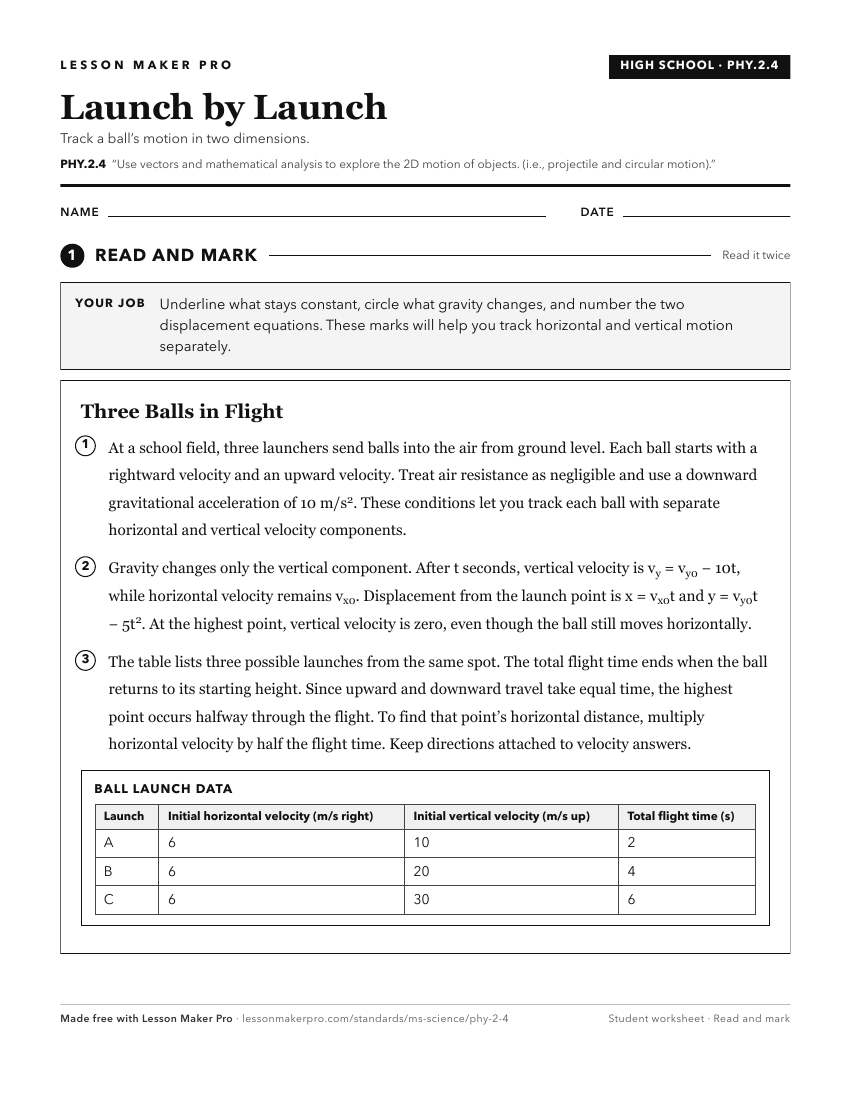
A ready-to-print activity worksheet aligned to PHY.2.4, with an answer key for the teacher on its own page. No account needed.
PDF, US Letter, prints cleanly in black and white.
Download the worksheetKeep exploring
Related Standards
- PHY.1.1
Investigate and analyze evidence gained through observation or experimental design regarding the one-dimensional (1-D) motion of objects. Design and conduct exp...
- PHY.1.3
Use mathematical and computational analysis to solve problems using kinematic equations.
- PHY.1.2
Interpret and predict 1-D motion based on displacement vs. time, velocity vs. time, or acceleration vs. time graphs (e.g., free-falling objects).
- PHY.2.2
Use models such as free-body diagrams to explain and predict the motion of an object according to Newton's law of motion, including circular motion.
Turn this exact standard into a lesson
Grade, subject, topic, and the complete standard are prefilled. Create one free, no account needed.
Also for this standard:Make a WorksheetMake a QuizMake a Sub Lesson