Mississippi Science PHY.2.2
The Standard
- PHY.2
- Students will develop an understanding of concepts related to Newtonian dynamics.
Use models such as free-body diagrams to explain and predict the motion of an object according to Newton's law of motion, including circular motion.
2026 Mississippi College- and Career-Readiness Standards for Science · Newton’s Laws
Teacher's field guide
What This Standard Means
What Students Need to Do
- Students draw force arrows on one object and use the net force to predict how it moves. They use the same method for straight paths and turns, where the net force points toward the center.
What Mastery Looks Like
- Given a car speeding up or turning, students label the forces on it and predict the direction of its acceleration. They explain why a car turning at steady speed still accelerates inward.
Common Misconceptions
- Students may add an outward force to the diagram of a turning object. They may think motion always needs a force in the direction of travel, or put action and reaction forces on the same object.
How to Assess It
- Exit ticket: A car turns left at steady speed on a flat road. Draw and label its forces, mark the net force direction, and name the force that makes it turn.
Lesson moves
Ways to Teach It
Tie a toy car to a string, pull it around a tabletop circle, and draw its weight, support force, and inward tension.
Ask: If a car turns left without changing speed, is it accelerating? Explain using the direction of its velocity.
Give students force diagrams for a sliding box, hanging weight, and turning car; have them match each to a motion prediction.
Show a photo of a car rounding a bend; have students identify how tire friction keeps it turning.
Free download
Printable PHY.2.2 Worksheet
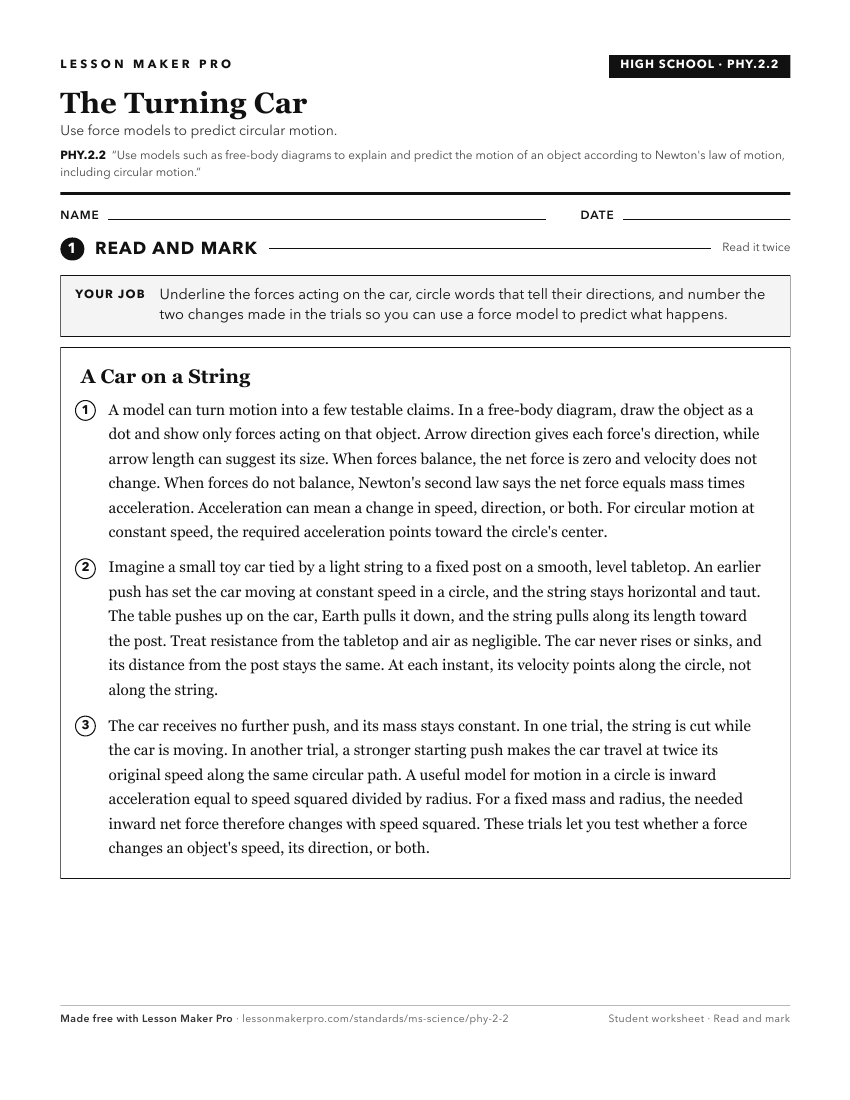
A ready-to-print activity worksheet aligned to PHY.2.2, with an answer key for the teacher on its own page. No account needed.
PDF, US Letter, prints cleanly in black and white.
Download the worksheetKeep exploring
Related Standards
- PHY.2.5
Use mathematical and computational analysis to derive simple equations of motion for various systems using Newton’s second law (e.g., net force equations).
- P.6.6
Students will demonstrate an understanding of Newton’s laws of motion using real world models and examples.
- PHY.2.7
Analyze real-world applications to draw conclusions about Newton’s three laws of motion using online simulations, probe systems, and/or laboratory experiences.
- P.5.6.3
Develop and use models to explain how the amount or type of force, both contact and non-contact, affects the motion of an object.
Turn this exact standard into a lesson
Grade, subject, topic, and the complete standard are prefilled. Create one free, no account needed.
Also for this standard:Make a WorksheetMake a QuizMake a Sub Lesson