Mississippi Science P.5.6.3
The Standard
- P.5.6
- Students will demonstrate an understanding of the factors that affect the motion of an object through a study of Newton's Laws of Motion.
Develop and use models to explain how the amount or type of force, both contact and non-contact, affects the motion of an object.
2026 Mississippi College- and Career-Readiness Standards for Science · Motions, Forces, and Energy
Teacher's field guide
What This Standard Means
What Students Need to Do
- Students draw models that show where a force acts, its direction, and its strength. They use the models to explain how pushes, pulls, and forces that act without touching can change motion.
What Mastery Looks Like
- A student draws a longer force arrow for a firm push than for a gentle push. They use their model to predict a bigger change in a toy car's motion and show a magnet pulling a paper clip without touching it.
Common Misconceptions
- Students may point a force arrow in the direction an object moves, even when the force acts against that motion. Some think a moving object always needs a push, or that a magnet must touch a paper clip to move it.
How to Assess It
- Exit ticket: Sketch a toy car pushed gently, then firmly, and a paper clip pulled by a nearby magnet. Label the force arrows, circle the force that acts without touching, and predict how the car's motion changes.
Lesson moves
Ways to Teach It
Push a toy car gently, then firmly, across a desk; move a paper clip with a magnet and sketch force arrows for each.
Have pairs explain whether a magnet can change a paper clip's motion without touching it, using force arrows in a sketch.
Play force match: pair picture cards of a kicked ball, braking bike, and attracted paper clip with matching force arrows and motion changes.
Show a photo of a cyclist braking; draw a force arrow against the bike's motion and explain why it slows.
Free download
Printable P.5.6.3 Worksheet
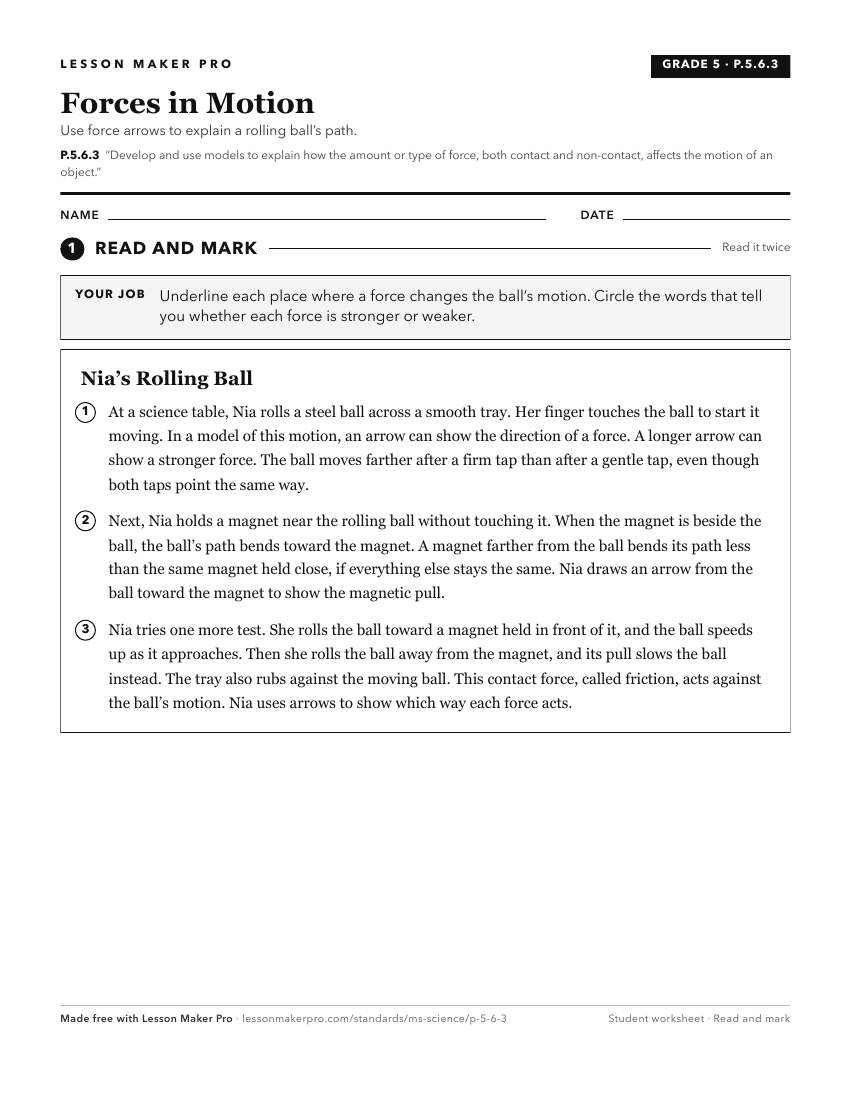
A ready-to-print activity worksheet aligned to P.5.6.3, with an answer key for the teacher on its own page. No account needed.
PDF, US Letter, prints cleanly in black and white.
Download the worksheetKeep exploring
Related Standards
- P.3.6.2
Plan an experiment to investigate the relationship between a force applied to an object (e.g., friction, gravity) and resulting motion of the object.
- PHY.2.6
Use mathematical and computational analysis to explore forces (e.g., friction, force applied, normal, and tension).
- P.5.6.5
Predict how a change of force, mass, and/or friction affects the motion of an object to convert potential energy into kinetic energy.
- PHY.2.2
Use models such as free-body diagrams to explain and predict the motion of an object according to Newton's law of motion, including circular motion.
Turn this exact standard into a lesson
Grade, subject, topic, and the complete standard are prefilled. Create one free, no account needed.
Also for this standard:Make a WorksheetMake a QuizMake a Sub Lesson