Mississippi Science P.5.6.5
The Standard
- P.5.6
- Students will demonstrate an understanding of the factors that affect the motion of an object through a study of Newton's Laws of Motion.
Predict how a change of force, mass, and/or friction affects the motion of an object to convert potential energy into kinetic energy.
2026 Mississippi College- and Career-Readiness Standards for Science · Motions, Forces, and Energy
Teacher's field guide
What This Standard Means
What Students Need to Do
- Students predict how a cart will move when the force, mass, or friction changes. They describe how energy stored at the top of a ramp becomes motion energy as the cart rolls down.
What Mastery Looks Like
- A student can explain why a cart speeds up as it rolls downhill and slows down on a rough surface. They can predict that the same push changes a heavy cart's speed less than a light cart's speed.
Common Misconceptions
- Students may think a heavier cart always rolls faster down the same ramp. They may also think friction adds speed or that energy disappears when the cart stops.
How to Assess It
- Show a drawing of a cart at the top of a ramp that ends on carpet. Ask students to label stored and motion energy, then predict what changes if the carpet is rougher or the cart gets a stronger push.
Lesson moves
Ways to Teach It
Roll a toy cart from the same ramp mark onto smooth paper and sandpaper, then measure how far it travels on each.
Ask: Why does a toy car speed up downhill but slow down on carpet? Have students name the forces and energy change.
Give pairs three cards: stronger push, heavier cart, rougher track. Have them predict each cart's motion and defend one choice.
Sketch a bike rolling downhill onto gravel, then mark where it gains speed and where friction slows it.
Free download
Printable P.5.6.5 Worksheet
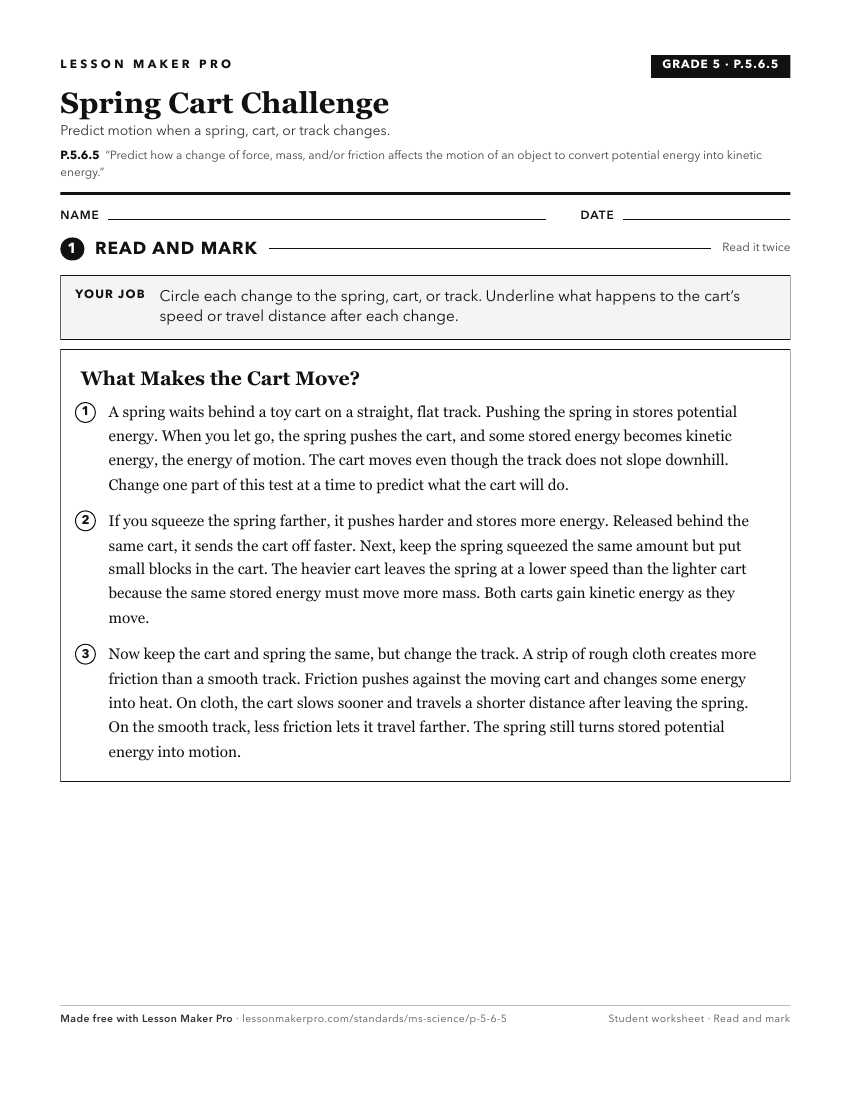
A ready-to-print activity worksheet aligned to P.5.6.5, with an answer key for the teacher on its own page. No account needed.
PDF, US Letter, prints cleanly in black and white.
Download the worksheetKeep exploring
Related Standards
- P.2.6.3
Develop a plan to change the force (push or pull) of friction to solve a human problem (e.g., improve the ride on a playground slide or make a toy car or truck ...
- P.3.6.2
Plan an experiment to investigate the relationship between a force applied to an object (e.g., friction, gravity) and resulting motion of the object.
- P.2.6.2
Generate and answer questions about the relationship between (1) friction and the motion of objects and (2) friction and the production of heat.
- P.5.6.3
Develop and use models to explain how the amount or type of force, both contact and non-contact, affects the motion of an object.
Turn this exact standard into a lesson
Grade, subject, topic, and the complete standard are prefilled. Create one free, no account needed.
Also for this standard:Make a WorksheetMake a QuizMake a Sub Lesson