Mississippi Science P.6.6
Standard Cluster
Students will demonstrate an understanding of Newton’s laws of motion using real world models and examples. Use an engineering design process to create or improve safety devices (e.g., seat belts, car seats, helmets) by applying Newton’s Laws of motion. Use an engineering design process to define the problem, design, construct, evaluate, and improve the safety device. * Use mathematical computation and diagrams to calculate the sum of forces acting on various objects. Investigate and communicate ways to manipulate applied/frictional forces to improve movement of objects on various surfaces (e.g., athletic shoes, wheels on cars). Compare and contrast magnetic, electric, frictional, and gravitational forces. Conduct investigations to predict and explain the motion of an object according to its position, direction, speed, and acceleration. Investigate forces (gravity, friction, drag, lift, thrust) acting on objects (e.g., airplane, bicycle helmets). Use data to explain the differences between the forces in various environments. Determine the relationships between the concepts of potential, kinetic, and thermal energy.
2026 Mississippi College- and Career-Readiness Standards for Science · Motions, Forces, and Energy
Cluster contents
Standards in This Cluster
P.6.6 is a cluster heading. These are the individual standards under it.
- P.6.6.1
Use an engineering design process to create or improve safety devices (e.g., seat belts, car seats, helmets) by applying Newton’s Laws of motion. Use an enginee...
- P.6.6.2
Use mathematical computation and diagrams to calculate the sum of forces acting on various objects.
- P.6.6.3
Investigate and communicate ways to manipulate applied/frictional forces to improve movement of objects on various surfaces (e.g., athletic shoes, wheels on car...
- P.6.6.4
Compare and contrast magnetic, electric, frictional, and gravitational forces.
- P.6.6.5
Conduct investigations to predict and explain the motion of an object according to its position, direction, speed, and acceleration.
- P.6.6.6
Investigate forces (gravity, friction, drag, lift, thrust) acting on objects (e.g., airplane, bicycle helmets). Use data to explain the differences between the ...
- P.6.6.7
Determine the relationships between the concepts of potential, kinetic, and thermal energy.
Teacher's field guide
What This Cluster Means
What Students Need to Do
- Students draw force arrows, find net force, and predict changes in motion. They test how forces affect movement on different surfaces and in flight. They build and improve a safety device, then trace potential energy into kinetic and thermal energy.
What Mastery Looks Like
- A student can calculate net force and use test data to explain changes in speed or direction. They can tell apart gravity, friction, magnetic, and electric forces, and explain how lift, drag, and thrust affect flight. They can revise a seat belt after a crash test and explain why the passenger keeps moving when the car stops.
Common Misconceptions
- Students may think a moving object needs a constant forward force, even when friction is low. They may add opposite forces as if both point the same way or draw an action and reaction force on the same object. They may think kinetic energy disappears when a rolling car stops, rather than becoming thermal energy.
How to Assess It
- Exit ticket: A toy car is pushed right with 6 N while friction acts left with 2 N. Draw force arrows, find the net force, and predict how its motion changes.
Lesson moves
Ways to Teach It
Make a tape seat belt for a clay passenger in a toy car; crash it into a block, measure the passenger's movement, and revise the belt.
Ask: Why does a bike keep rolling after you stop pedaling, and why does it eventually stop? Use inertia and friction in your answer.
Give pairs cards showing 5 N right and 3 N left; have them draw arrows, calculate net force, and predict a cart's acceleration.
Show a plane taking off; label thrust, drag, lift, and gravity, then predict how more drag would change its motion.
Free download
Printable P.6.6 Worksheet
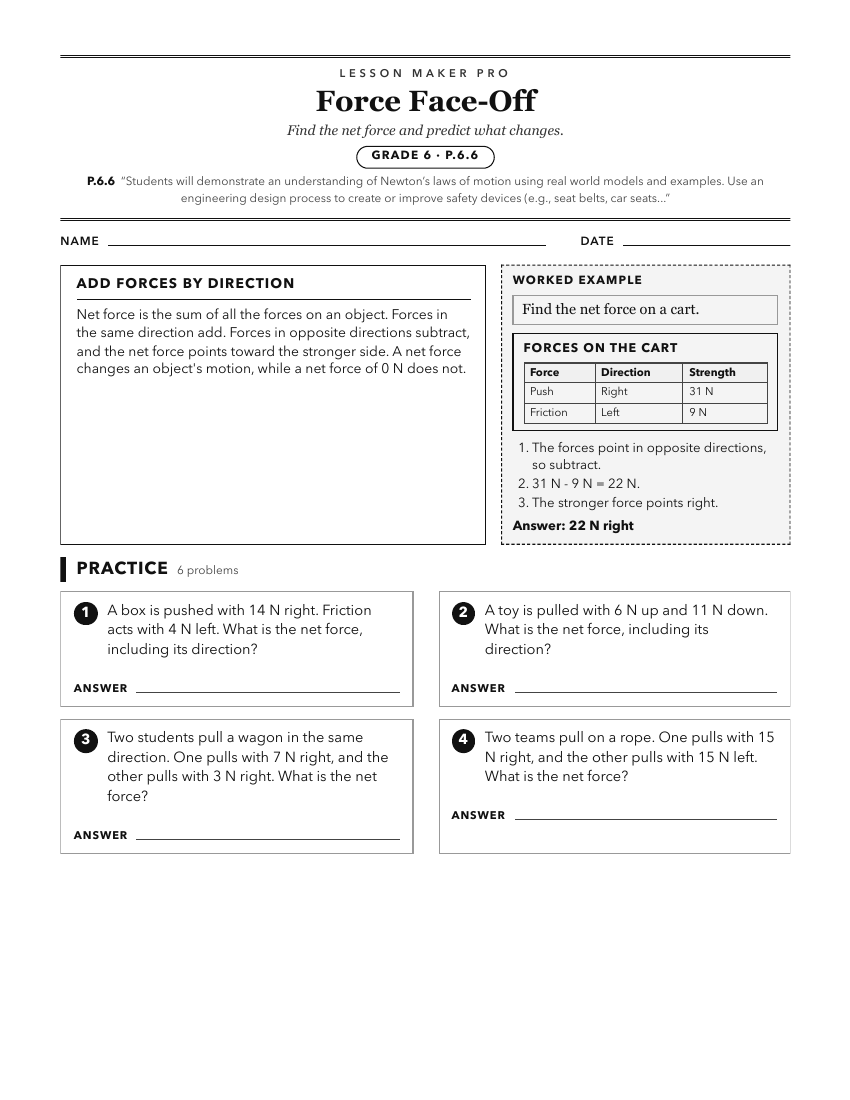
A ready-to-print activity worksheet aligned to P.6.6, with an answer key for the teacher on its own page. No account needed.
PDF, US Letter, prints cleanly in black and white.
Download the worksheetKeep exploring
Related Standards
- PHY.2
Students will develop an understanding of concepts related to Newtonian dynamics.
- PHS.5
Students will analyze the scientific principles of motion, force, and work.
- P.5.6
Students will demonstrate an understanding of the factors that affect the motion of an object through a study of Newton's Laws of Motion.
- PHY.2.7
Analyze real-world applications to draw conclusions about Newton’s three laws of motion using online simulations, probe systems, and/or laboratory experiences.
Turn this cluster into a lesson
Grade, subject, topic, and the complete cluster are prefilled. Create one free, no account needed.
Also for this cluster:Make a WorksheetMake a QuizMake a Sub Lesson