Mississippi Science P.6.6.5
The Standard
- P.6.6
- Students will demonstrate an understanding of Newton’s laws of motion using real world models and examples.
Conduct investigations to predict and explain the motion of an object according to its position, direction, speed, and acceleration.
2026 Mississippi College- and Career-Readiness Standards for Science · Motions, Forces, and Energy
Teacher's field guide
What This Standard Means
What Students Need to Do
- Students record an object's position at set times and note which way it moves. They use changes in distance and direction to describe its speed, tell when it accelerates, and predict where it will go next.
What Mastery Looks Like
- Given numbered positions one second apart, students use the gaps to tell whether an object moves at a steady speed, speeds up, or slows down. They notice a turn as a change in motion, even if the speed stays the same. They predict the next position and explain their choice using the recorded positions.
Common Misconceptions
- Students may call any fast motion acceleration, even when speed stays steady. They may think bigger gaps between equal-time marks mean more time passed. Some miss that slowing down or turning also counts as acceleration.
How to Assess It
- On an exit ticket, show a car 0, 1, 3, and 6 meters east of a cone at 0, 1, 2, and 3 seconds. Ask students where it will be at 4 seconds and how the positions support their prediction.
Lesson moves
Ways to Teach It
Roll a toy car down a ramp beside a meter stick, film it, and record its position at equal time intervals.
Show a ball moving right, then bouncing left; ask how its motion changes if its speed stays the same.
Give pairs position cards for each second; have them sort steady-speed, speeding-up, slowing-down, and direction-change motions.
Give students a printed bus route with positions marked each minute; ask them to find a turn and a stretch of increasing speed.
Free download
Printable P.6.6.5 Worksheet
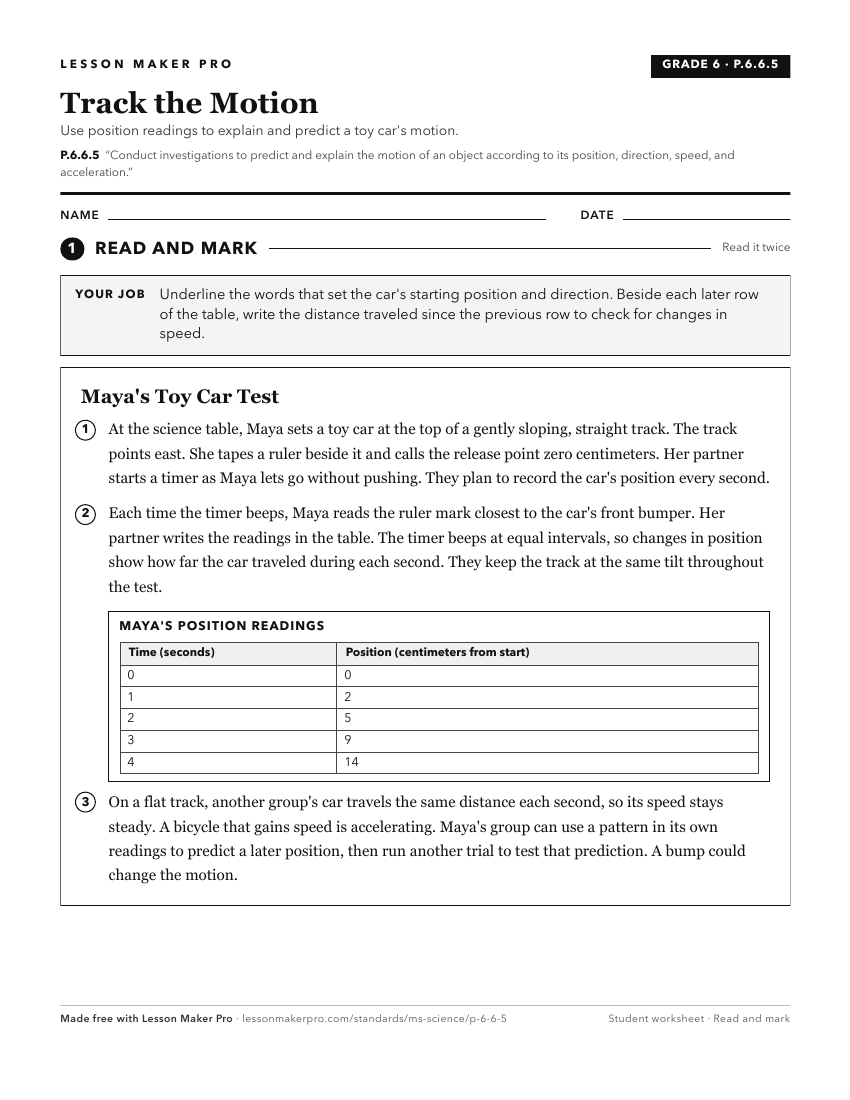
A ready-to-print activity worksheet aligned to P.6.6.5, with an answer key for the teacher on its own page. No account needed.
PDF, US Letter, prints cleanly in black and white.
Download the worksheetKeep exploring
Related Standards
- PHY.1.1
Investigate and analyze evidence gained through observation or experimental design regarding the one-dimensional (1-D) motion of objects. Design and conduct exp...
- PHS.5.2
Design and conduct an investigation to study the motion of an object using properties such as displacement, time of motion, velocity, and acceleration.
- P.5.6.2
Predict the future motion of various objects based on past observation and measurement of position, direction, and speed.
- P.5.6.4
Plan and conduct scientific investigations to test the effects of balanced and unbalanced forces on the speed and/or direction of objects in motion.
Turn this exact standard into a lesson
Grade, subject, topic, and the complete standard are prefilled. Create one free, no account needed.
Also for this standard:Make a WorksheetMake a QuizMake a Sub Lesson