Mississippi Science P.5.6.2
The Standard
- P.5.6
- Students will demonstrate an understanding of the factors that affect the motion of an object through a study of Newton's Laws of Motion.
Predict the future motion of various objects based on past observation and measurement of position, direction, and speed.
2026 Mississippi College- and Career-Readiness Standards for Science · Motions, Forces, and Energy
Teacher's field guide
What This Standard Means
What Students Need to Do
- Students record an object's position and direction at set times. They use the distance traveled each second to estimate its speed and predict where it will be next.
What Mastery Looks Like
- A student can find how far an object moves each second and say which way it is going. They can predict its next position if the pattern continues and revise that prediction if it slows down or turns.
Common Misconceptions
- Some students give the last recorded position as the next position or forget which way the object is moving. Others assume speed stays the same even when the distance traveled each second changes.
How to Assess It
- A car moves right and is at 10 cm after 1 second, 20 cm after 2 seconds, and 30 cm after 3 seconds. Where will it be after 4 seconds if it keeps moving the same way? Explain your answer.
Lesson moves
Ways to Teach It
Roll a toy car beside a taped ruler, film it, mark its position each second, and predict its next position.
Show positions of 10, 20, and 30 cm at one-second intervals; ask students to write where the car goes next and why.
Play Motion Detective: give pairs three timed positions and a direction arrow, then have them predict a fourth position before revealing it.
Time a classmate walking past floor tiles toward the door, then predict when they will reach it from their pace and distance.
Free download
Printable P.5.6.2 Worksheet
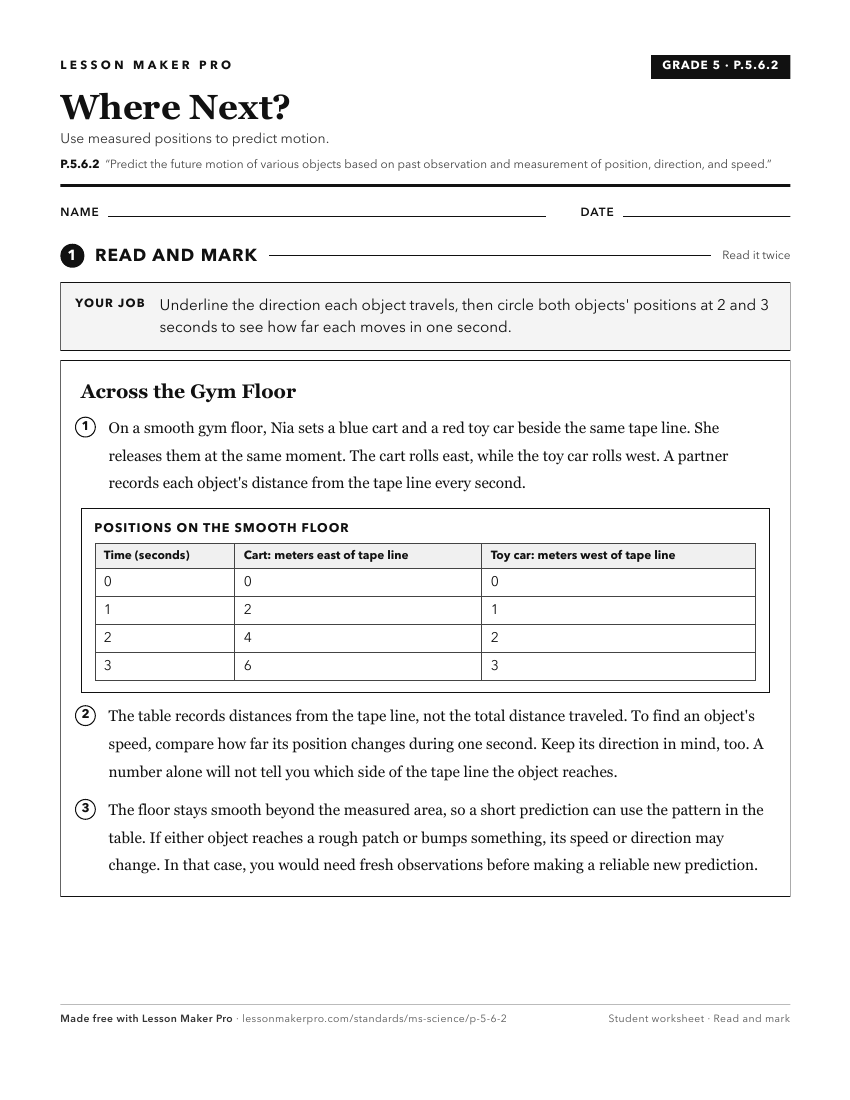
A ready-to-print activity worksheet aligned to P.5.6.2, with an answer key for the teacher on its own page. No account needed.
PDF, US Letter, prints cleanly in black and white.
Download the worksheetKeep exploring
Related Standards
- PHS.5.2
Design and conduct an investigation to study the motion of an object using properties such as displacement, time of motion, velocity, and acceleration.
- P.6.6.5
Conduct investigations to predict and explain the motion of an object according to its position, direction, speed, and acceleration.
- PHY.1.2
Interpret and predict 1-D motion based on displacement vs. time, velocity vs. time, or acceleration vs. time graphs (e.g., free-falling objects).
- PHY.2.2
Use models such as free-body diagrams to explain and predict the motion of an object according to Newton's law of motion, including circular motion.
Turn this exact standard into a lesson
Grade, subject, topic, and the complete standard are prefilled. Create one free, no account needed.
Also for this standard:Make a WorksheetMake a QuizMake a Sub Lesson