Mississippi Science PHS.5.2
The Standard
- PHS.5
- Students will analyze the scientific principles of motion, force, and work.
Design and conduct an investigation to study the motion of an object using properties such as displacement, time of motion, velocity, and acceleration.
2026 Mississippi College- and Career-Readiness Standards for Science · Newton’s Laws of Motion
Teacher's field guide
What This Standard Means
What Students Need to Do
- Students choose where and when to measure a moving object, then record its position and time. They use the measurements to find displacement, velocity, and acceleration.
What Mastery Looks Like
- A student records positions and times in a table and calculates displacement and velocity for each time interval. They use changes in velocity to calculate acceleration and explain what the numbers show about the motion.
Common Misconceptions
- Students may use total distance instead of displacement when an object changes direction. Some think acceleration means only speeding up, not slowing down or changing direction.
How to Assess It
- In pairs, have students mark three equally spaced points on a ramp, film a rolling toy car, and record when it crosses each point. Ask them to calculate the velocity for each interval and explain whether the car accelerated.
Lesson moves
Ways to Teach It
Tape a meter stick beside a ramp, film a rolling toy car, and use video timestamps to make a position-time table.
Ask: A cart moves 2 meters forward, then 1 meter back. What are its distance and displacement?
Give pairs position-time cards for toy cars; have them calculate interval velocities and sort the cards by how the cars move.
Compare two car ads with different 0-to-60-mph times; calculate which car has greater average acceleration.
Free download
Printable PHS.5.2 Worksheet
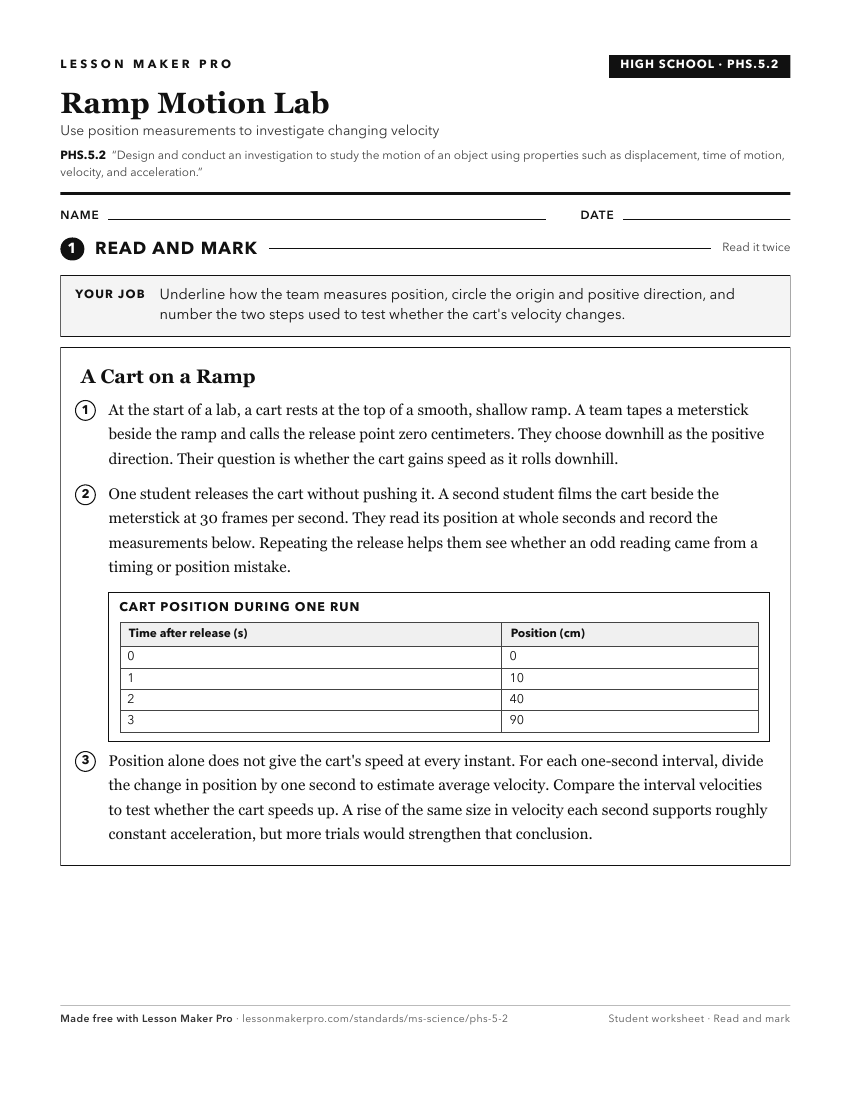
A ready-to-print activity worksheet aligned to PHS.5.2, with an answer key for the teacher on its own page. No account needed.
PDF, US Letter, prints cleanly in black and white.
Download the worksheetKeep exploring
Related Standards
- PHY.1.1
Investigate and analyze evidence gained through observation or experimental design regarding the one-dimensional (1-D) motion of objects. Design and conduct exp...
- P.6.6.5
Conduct investigations to predict and explain the motion of an object according to its position, direction, speed, and acceleration.
- PHY.1.6
Design and mathematically/graphically analyze quantitative data to explore displacement, velocity, and acceleration of various objects. Use probe systems, video...
- P.5.6.4
Plan and conduct scientific investigations to test the effects of balanced and unbalanced forces on the speed and/or direction of objects in motion.
Turn this exact standard into a lesson
Grade, subject, topic, and the complete standard are prefilled. Create one free, no account needed.
Also for this standard:Make a WorksheetMake a QuizMake a Sub Lesson