Mississippi Science PHY.1.2
The Standard
- PHY.1
- Students will investigate and understand how to analyze and interpret data.
Interpret and predict 1-D motion based on displacement vs. time, velocity vs. time, or acceleration vs. time graphs (e.g., free-falling objects).
2026 Mississippi College- and Career-Readiness Standards for Science · One-Dimensional Motion
Teacher's field guide
What This Standard Means
What Students Need to Do
- Students read position, velocity, and acceleration from graphs over time. They use the graphs to predict direction, speed changes, and when an object turns around.
What Mastery Looks Like
- Students use graph slopes to find velocity or acceleration. They use signed areas to find displacement or change in velocity. For a ball tossed upward, they show velocity changing sign while acceleration stays downward.
Common Misconceptions
- Students may read the height of a position-time graph as speed instead of using its slope. They may think negative velocity always means slowing down. Some draw acceleration changing direction when a tossed ball turns around.
How to Assess It
- Give students a velocity-time line from (0 s, 20 m/s) to (3 s, -10 m/s), with upward positive. Ask when the ball turns, its acceleration, and its displacement over 3 seconds.
Lesson moves
Ways to Teach It
Lay a five-meter tape on the floor, film a student walking out and back, and plot position each second.
Show one velocity-time line above zero sloping down and another below zero sloping down; ask which object slows down.
Hand out velocity-time cards with flat, rising, falling, and crossing-zero lines; have pairs match each to a motion description.
Show an elevator floor-display video; have students sketch velocity and acceleration during departure, steady travel, and arrival.
Free download
Printable PHY.1.2 Worksheet
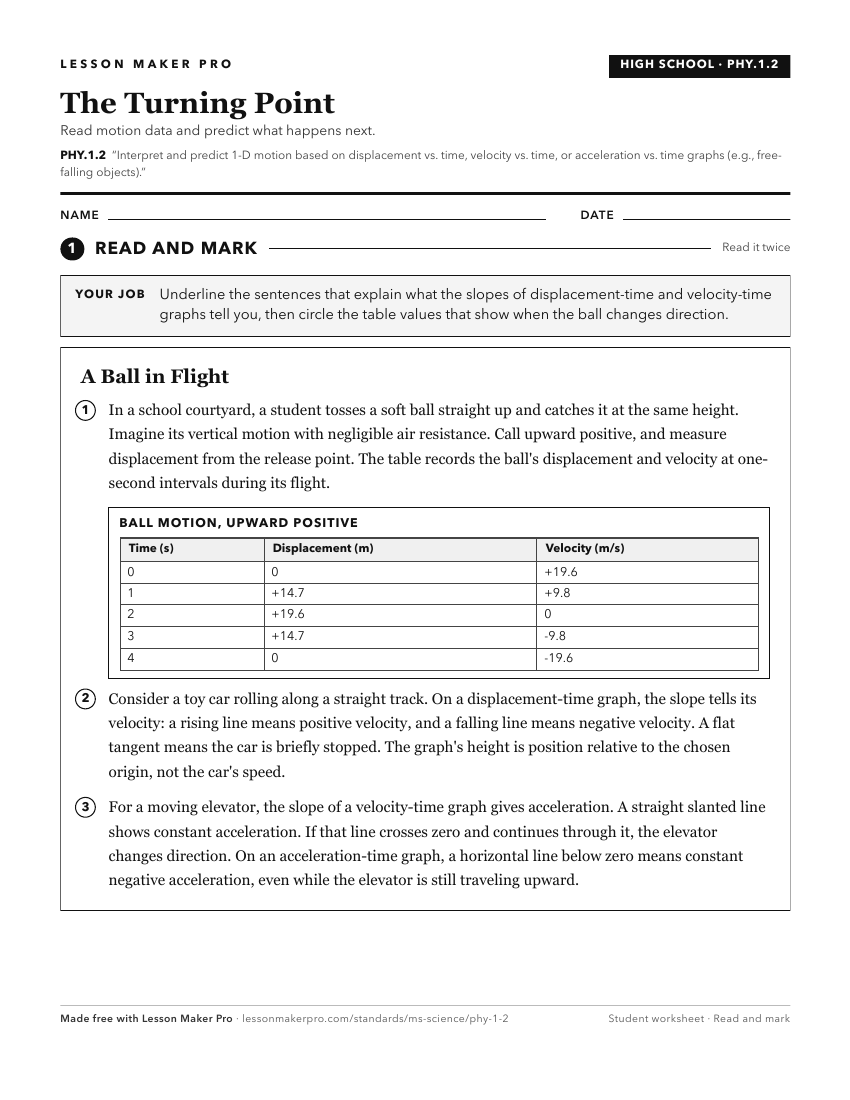
A ready-to-print activity worksheet aligned to PHY.1.2, with an answer key for the teacher on its own page. No account needed.
PDF, US Letter, prints cleanly in black and white.
Download the worksheetKeep exploring
Related Standards
- PHY.1.1
Investigate and analyze evidence gained through observation or experimental design regarding the one-dimensional (1-D) motion of objects. Design and conduct exp...
- PHS.5.2
Design and conduct an investigation to study the motion of an object using properties such as displacement, time of motion, velocity, and acceleration.
- P.6.6.5
Conduct investigations to predict and explain the motion of an object according to its position, direction, speed, and acceleration.
- PHY.1.7
Design different scenarios, and predict graph shapes for distance/time, velocity/time, and acceleration/time graphs.
Turn this exact standard into a lesson
Grade, subject, topic, and the complete standard are prefilled. Create one free, no account needed.
Also for this standard:Make a WorksheetMake a QuizMake a Sub Lesson