Mississippi Science PHY.1.7
The Standard
- PHY.1
- Students will investigate and understand how to analyze and interpret data.
Design different scenarios, and predict graph shapes for distance/time, velocity/time, and acceleration/time graphs.
2026 Mississippi College- and Career-Readiness Standards for Science · One-Dimensional Motion
Teacher's field guide
What This Standard Means
What Students Need to Do
- Students make up motions, such as walking away, stopping, and walking back. They predict how distance traveled, velocity, and acceleration change over time, then sketch a graph for each.
What Mastery Looks Like
- Students can sketch three graphs for a new motion and line up the same events on each time axis. Their distance graph stays flat at rest and rises during the return, while velocity changes sign and acceleration shows changes in velocity.
Common Misconceptions
- Students sometimes draw a picture of the path instead of showing change over time. They may make total distance fall on the return trip or show acceleration during steady-speed motion.
How to Assess It
- Exit ticket: A walker moves away, slows to a stop, waits, then walks back. Sketch distance traveled, velocity, and acceleration versus time, and label each part of the trip.
Lesson moves
Ways to Teach It
Tape a line on the floor; pairs walk away, pause, and return while a partner records their position each second for graphing.
Ask students to write two sentences explaining why total distance rises on the return trip while velocity becomes negative.
Give groups cards marked “speed up forward,” “stop,” and “move backward steadily”; have them order the cards and sketch matching graphs.
Describe a bus driving, braking for a light, waiting, and pulling away; have students sketch its three graphs.
Free download
Printable PHY.1.7 Worksheet
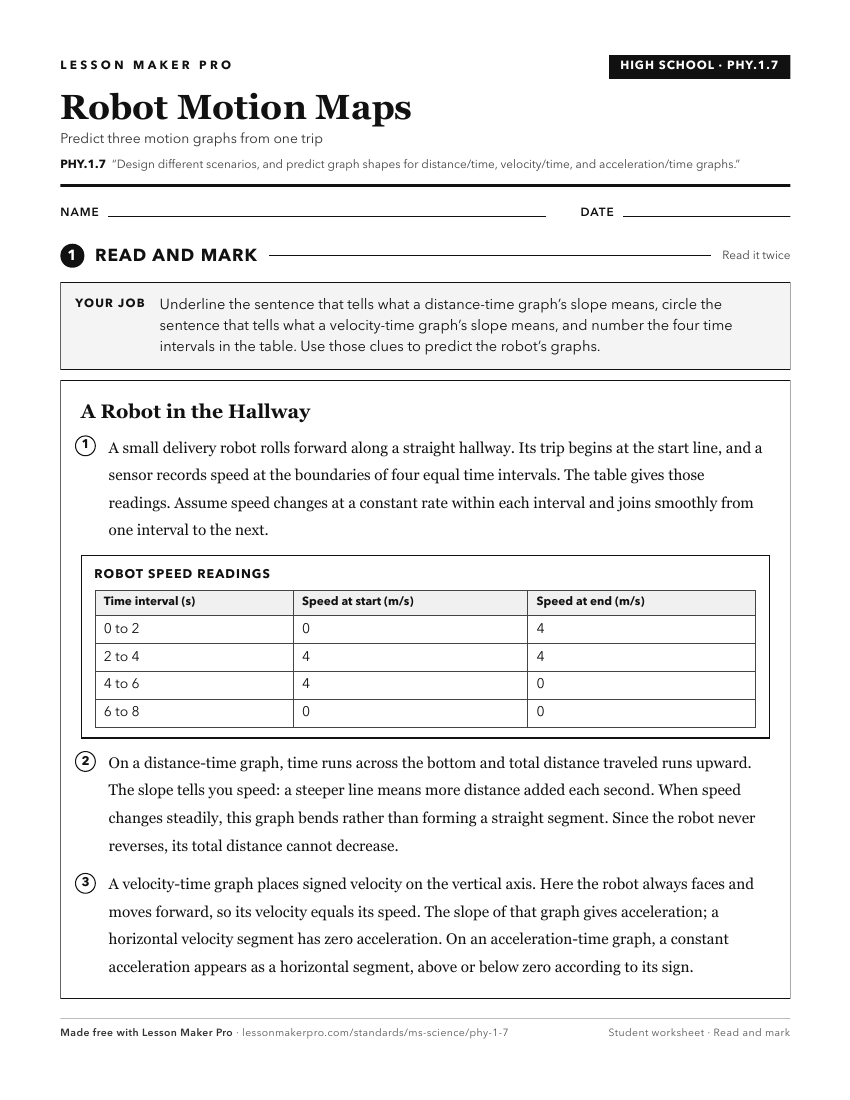
A ready-to-print activity worksheet aligned to PHY.1.7, with an answer key for the teacher on its own page. No account needed.
PDF, US Letter, prints cleanly in black and white.
Download the worksheetKeep exploring
Related Standards
- PHY.1.1
Investigate and analyze evidence gained through observation or experimental design regarding the one-dimensional (1-D) motion of objects. Design and conduct exp...
- PHS.5.2
Design and conduct an investigation to study the motion of an object using properties such as displacement, time of motion, velocity, and acceleration.
- PHY.1.2
Interpret and predict 1-D motion based on displacement vs. time, velocity vs. time, or acceleration vs. time graphs (e.g., free-falling objects).
- PHY.1.6
Design and mathematically/graphically analyze quantitative data to explore displacement, velocity, and acceleration of various objects. Use probe systems, video...
Turn this exact standard into a lesson
Grade, subject, topic, and the complete standard are prefilled. Create one free, no account needed.
Also for this standard:Make a WorksheetMake a QuizMake a Sub Lesson