Mississippi Science P.6.6.6
The Standard
- P.6.6
- Students will demonstrate an understanding of Newton’s laws of motion using real world models and examples.
Investigate forces (gravity, friction, drag, lift, thrust) acting on objects (e.g., airplane, bicycle helmets). Use data to explain the differences between the forces in various environments.
2026 Mississippi College- and Career-Readiness Standards for Science · Motions, Forces, and Energy
Teacher's field guide
What This Standard Means
What Students Need to Do
- Students identify gravity, friction, drag, lift, and thrust on moving objects. They use measurements from different surfaces or air conditions to explain changes in motion.
What Mastery Looks Like
- A student draws force arrows on an airplane or bicycle and explains what each arrow means. They use measured distances to explain why a toy car stops sooner on carpet than on tile.
Common Misconceptions
- Students often call any force that slows an object friction, even when air or water causes drag. They may think a plane needs thrust to stay up but overlook lift, or think gravity stops acting once an object rises.
How to Assess It
- Exit ticket: A toy car rolls 90 cm on tile, 35 cm on carpet, and 20 cm through shallow water after identical ramp releases. Name the main force slowing it in each setting and use the distances as evidence.
Lesson moves
Ways to Teach It
Release the same toy car down a ramp onto tile and carpet, then measure and record stopping distances for three trials each.
Give students paper airplane flight distances from still air and a headwind; ask them to explain the difference using drag.
Hand out airplane and bicycle picture cards; partners add force arrows that apply, then compare and correct their diagrams.
Give students a cyclist's speed log from calm and windy rides at the same pedaling effort; ask how drag affects speed.
Free download
Printable P.6.6.6 Worksheet
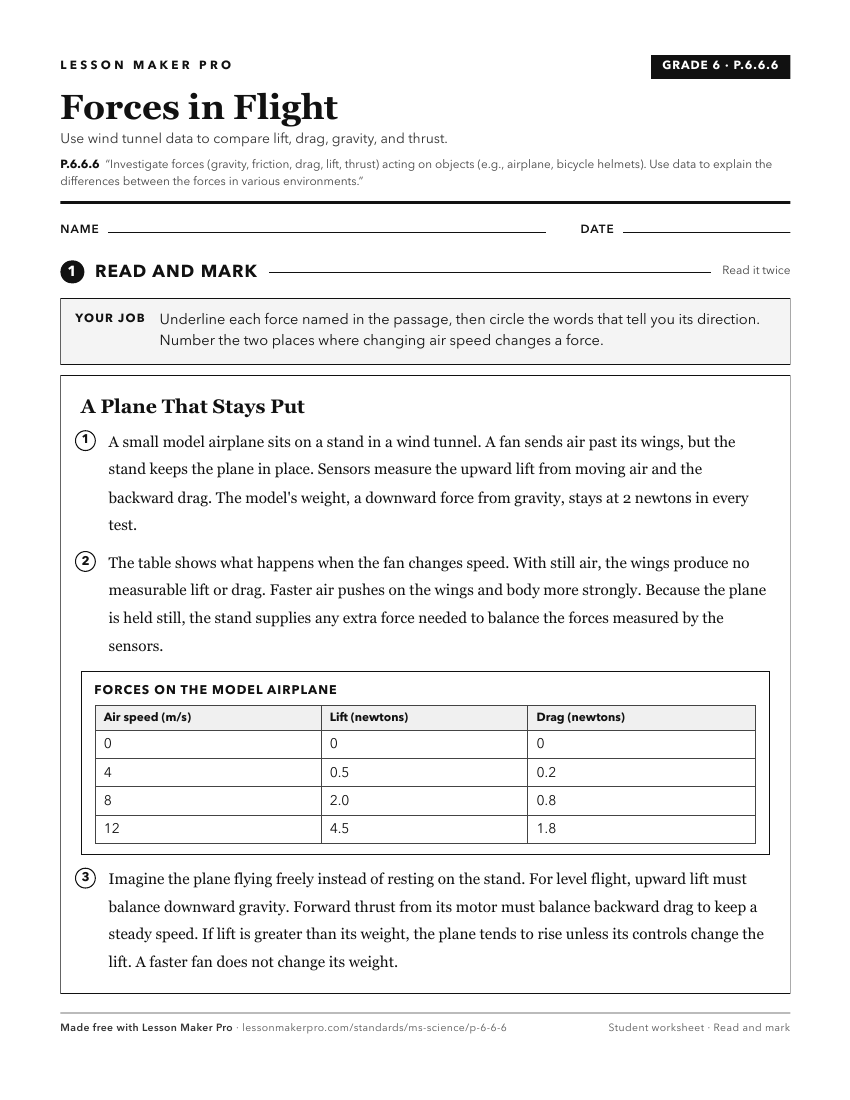
A ready-to-print activity worksheet aligned to P.6.6.6, with an answer key for the teacher on its own page. No account needed.
PDF, US Letter, prints cleanly in black and white.
Download the worksheetKeep exploring
Related Standards
- P.3.6.2
Plan an experiment to investigate the relationship between a force applied to an object (e.g., friction, gravity) and resulting motion of the object.
- P.6.6.3
Investigate and communicate ways to manipulate applied/frictional forces to improve movement of objects on various surfaces (e.g., athletic shoes, wheels on car...
- PHY.2.6
Use mathematical and computational analysis to explore forces (e.g., friction, force applied, normal, and tension).
- P.5.6.4
Plan and conduct scientific investigations to test the effects of balanced and unbalanced forces on the speed and/or direction of objects in motion.
Turn this exact standard into a lesson
Grade, subject, topic, and the complete standard are prefilled. Create one free, no account needed.
Also for this standard:Make a WorksheetMake a QuizMake a Sub Lesson