Mississippi Science P.6.6.3
The Standard
- P.6.6
- Students will demonstrate an understanding of Newton’s laws of motion using real world models and examples.
Investigate and communicate ways to manipulate applied/frictional forces to improve movement of objects on various surfaces (e.g., athletic shoes, wheels on cars).
2026 Mississippi College- and Career-Readiness Standards for Science · Motions, Forces, and Energy
Teacher's field guide
What This Standard Means
What Students Need to Do
- Students test how a push or a contact surface changes an object's movement. They measure how far it travels and explain when friction slows movement or provides useful grip.
What Mastery Looks Like
- A student can keep the push the same while comparing surfaces. They use measurements to explain why a sled needs less friction to slide, while a runner needs grip to push off.
Common Misconceptions
- Students may think friction always makes movement worse, forgetting that shoes need grip. They may call friction the force that starts an object moving. They may change both the push and the surface, then credit the surface for the result.
How to Assess It
- Exit ticket: A box gets the same push on tile and carpet. Predict where it slides farther, then name one change that would help it slide farther on carpet and explain why.
Lesson moves
Ways to Teach It
Release the same toy car from one ramp mark onto wax paper and sandpaper, then measure how far it rolls on each.
Ask: Why do cleats help a runner push off grass while sandpaper slows a sliding block? Write two sentences about friction.
Deal object cards (sled, shoe, cart) and surface cards (ice, grass, carpet); partners choose a material change and predict its effect.
Inspect sneaker and cleat soles, then choose one for grass and one for a gym floor, explaining how grip helps.
Free download
Printable P.6.6.3 Worksheet
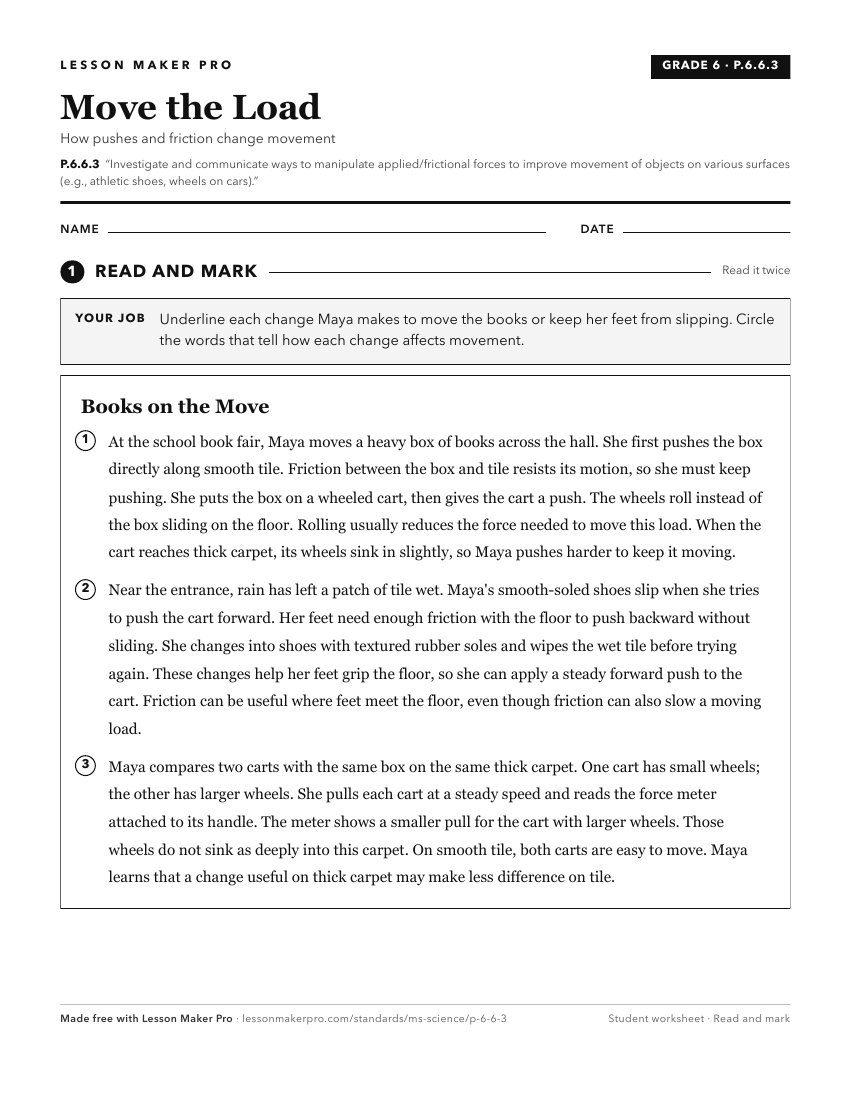
A ready-to-print activity worksheet aligned to P.6.6.3, with an answer key for the teacher on its own page. No account needed.
PDF, US Letter, prints cleanly in black and white.
Download the worksheetKeep exploring
Related Standards
- P.6.6.6
Investigate forces (gravity, friction, drag, lift, thrust) acting on objects (e.g., airplane, bicycle helmets). Use data to explain the differences between the ...
- P.2.6.3
Develop a plan to change the force (push or pull) of friction to solve a human problem (e.g., improve the ride on a playground slide or make a toy car or truck ...
- PHY.2.6
Use mathematical and computational analysis to explore forces (e.g., friction, force applied, normal, and tension).
- P.5.6.6
Design a system to increase the effects of friction on the motion of an object (e.g., non-slip surfaces or vehicle braking systems or flaps on aircraft wings). ...
Turn this exact standard into a lesson
Grade, subject, topic, and the complete standard are prefilled. Create one free, no account needed.
Also for this standard:Make a WorksheetMake a QuizMake a Sub Lesson