Mississippi Science P.6.6.1
The Standard
- P.6.6
- Students will demonstrate an understanding of Newton’s laws of motion using real world models and examples.
Use an engineering design process to create or improve safety devices (e.g., seat belts, car seats, helmets) by applying Newton’s Laws of motion. Use an engineering design process to define the problem, design, construct, evaluate, and improve the safety device. *
2026 Mississippi College- and Career-Readiness Standards for Science · Motions, Forces, and Energy
Teacher's field guide
What This Standard Means
What Students Need to Do
- Students identify what a safety device needs to protect and what materials they can use. They build a model, test it in a crash, and use the results to improve it. They explain how forces change the passenger's motion.
What Mastery Looks Like
- A student builds a restraint that keeps a clay rider in a toy car during a ramp crash. They test from the same height, record how far the rider moves, and improve the design based on results. They explain why the rider keeps moving when the car stops and how padding can make the stop less sudden.
Common Misconceptions
- Students may think the rider stops as soon as the car stops. Some think a seat belt pushes the rider forward. They may change the ramp height between tests and still treat the results as a fair comparison.
How to Assess It
- Show a sketch of a toy car hitting a block while its clay rider moves forward. Ask students to sketch a restraint, explain why the rider moves, and describe a fair test and one change they would make if the rider still fell out.
Lesson moves
Ways to Teach It
Build paper-and-tape restraints for clay riders in toy cars, crash them from one ramp height, record rider travel, then revise and retest.
Ask students to write why a clay rider keeps moving when its car stops and which part of their restraint changes that motion.
Give teams three crash cards with different rider travel distances; have them rank the designs and name one change to test next.
Show a helmet liner and ask students to point out where padding helps slow a head during a fall.
Free download
Printable P.6.6.1 Worksheet
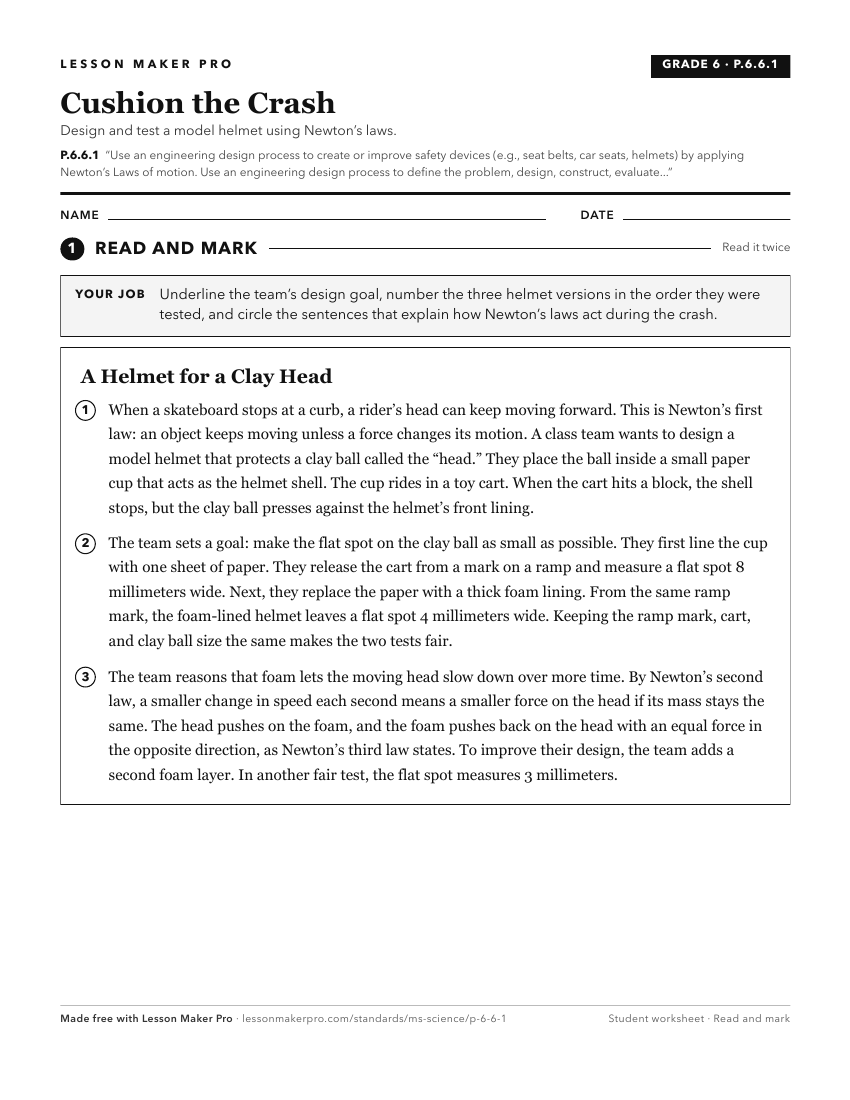
A ready-to-print activity worksheet aligned to P.6.6.1, with an answer key for the teacher on its own page. No account needed.
PDF, US Letter, prints cleanly in black and white.
Download the worksheetKeep exploring
Related Standards
- E.K.10.3
Create a product from reused materials that will meet a human need (e.g., pencil holder, musical instrument, bird feeder). Use an engineering design process to ...
- ENV.4.5
Enrichment: Use an engineering design process to define a problem, design, construct, evaluate, and improve a device or method to reduce or prevent human impact...
- PHS.5.6
Use an engineering design process and mathematical analysis to design and construct models to demonstrate the law of conservation of momentum (e.g., roller coas...
- P.5.6.6
Design a system to increase the effects of friction on the motion of an object (e.g., non-slip surfaces or vehicle braking systems or flaps on aircraft wings). ...
Turn this exact standard into a lesson
Grade, subject, topic, and the complete standard are prefilled. Create one free, no account needed.
Also for this standard:Make a WorksheetMake a QuizMake a Sub Lesson