Mississippi Science P.6.6.4
The Standard
- P.6.6
- Students will demonstrate an understanding of Newton’s laws of motion using real world models and examples.
Compare and contrast magnetic, electric, frictional, and gravitational forces.
2026 Mississippi College- and Career-Readiness Standards for Science · Motions, Forces, and Energy
Teacher's field guide
What This Standard Means
What Students Need to Do
- Students identify the force acting in a familiar situation. They compare which forces need objects to touch and which can act across a gap. They describe when a force pulls, pushes, or slows motion.
What Mastery Looks Like
- Given a dropped ball, a magnet pulling a clip, a rubbed balloon attracting paper, and a sliding book, students name the force in each case. They explain that friction needs touching, while the other three can act across a gap.
Common Misconceptions
- Students may think magnets attract every metal, including aluminum. They may mistake a rubbed balloon's pull on paper for magnetism. They may think friction only stops motion, rather than also giving shoes grip.
How to Assess It
- Exit ticket: Name the force in each case: a dropped ball, a magnet pulling a clip, a rubbed balloon attracting paper, and a book slowing on a desk. Circle the force that requires touching.
Lesson moves
Ways to Teach It
Have pairs test a magnet with clips, a balloon rubbed on a sleeve near paper bits, a block on sandpaper, and a dropped ball.
Ask students to explain why a paper clip falls to the floor but can also move toward a nearby magnet.
Give pairs cards of a sliding shoe, falling apple, charged balloon attracting paper, and repelling magnets; race to label force and contact.
Show a fridge magnet on a vertical door; ask which force pulls it down, which holds it against the door, and which prevents sliding.
Free download
Printable P.6.6.4 Worksheet
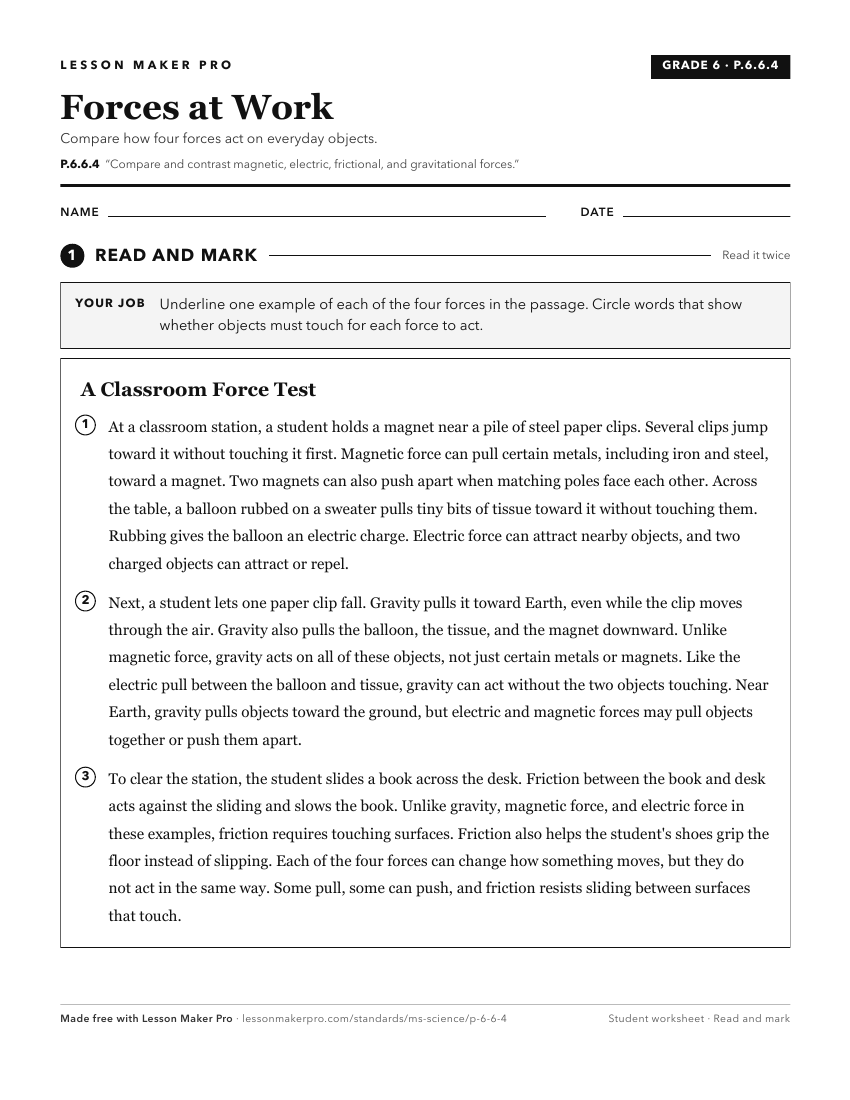
A ready-to-print activity worksheet aligned to P.6.6.4, with an answer key for the teacher on its own page. No account needed.
PDF, US Letter, prints cleanly in black and white.
Download the worksheetKeep exploring
Related Standards
- P.6.6.6
Investigate forces (gravity, friction, drag, lift, thrust) acting on objects (e.g., airplane, bicycle helmets). Use data to explain the differences between the ...
- P.3.6
Students will demonstrate an understanding of magnets and the effects of pushes, pulls, and friction on the motion of objects.
- P.3.6.1
Compare and contrast the effects of different strengths and directions of forces on the motion of an object (e.g., gravity, polarity, attraction, repulsion, or ...
- PHY.2.6
Use mathematical and computational analysis to explore forces (e.g., friction, force applied, normal, and tension).
Turn this exact standard into a lesson
Grade, subject, topic, and the complete standard are prefilled. Create one free, no account needed.
Also for this standard:Make a WorksheetMake a QuizMake a Sub Lesson