Mississippi Science P.3.6.1
The Standard
- P.3.6
- Students will demonstrate an understanding of magnets and the effects of pushes, pulls, and friction on the motion of objects.
Compare and contrast the effects of different strengths and directions of forces on the motion of an object (e.g., gravity, polarity, attraction, repulsion, or strength).
2026 Mississippi College- and Career-Readiness Standards for Science · Motion, Forces, and Energy
Teacher's field guide
What This Standard Means
What Students Need to Do
- Students compare how the same object moves after gentle and firm pushes in different directions. They describe how gravity pulls objects down and how magnets can pull together or push apart.
What Mastery Looks Like
- Students use measured distances to compare how far a toy car rolls after two different pushes. They can predict whether a push will speed up, slow down, or turn a moving car. They can predict whether two magnets will attract or repel.
Common Misconceptions
- Students may think a stronger push always changes an object's direction, rather than how quickly it moves. They may think magnets only attract or that gravity acts only when something is falling.
How to Assess It
- Draw a car rolling right. Ask, "Which changes its motion more, a gentle push right or a firm push right? What could a push left do?"
Lesson moves
Ways to Teach It
Tape a start line on the floor; give the same toy car a gentle push and a firm push, then measure each travel distance.
Draw two pairs of magnets, N facing N and N facing S; ask students to write which pair pushes apart and which pulls together.
Give pairs a picture of a car rolling right and force-arrow cards; have them match each arrow to speeding up, slowing down, or turning.
Show a playground slide photo with a ball on it; ask why the ball rolls down and what an uphill push could do.
Free download
Printable P.3.6.1 Worksheet
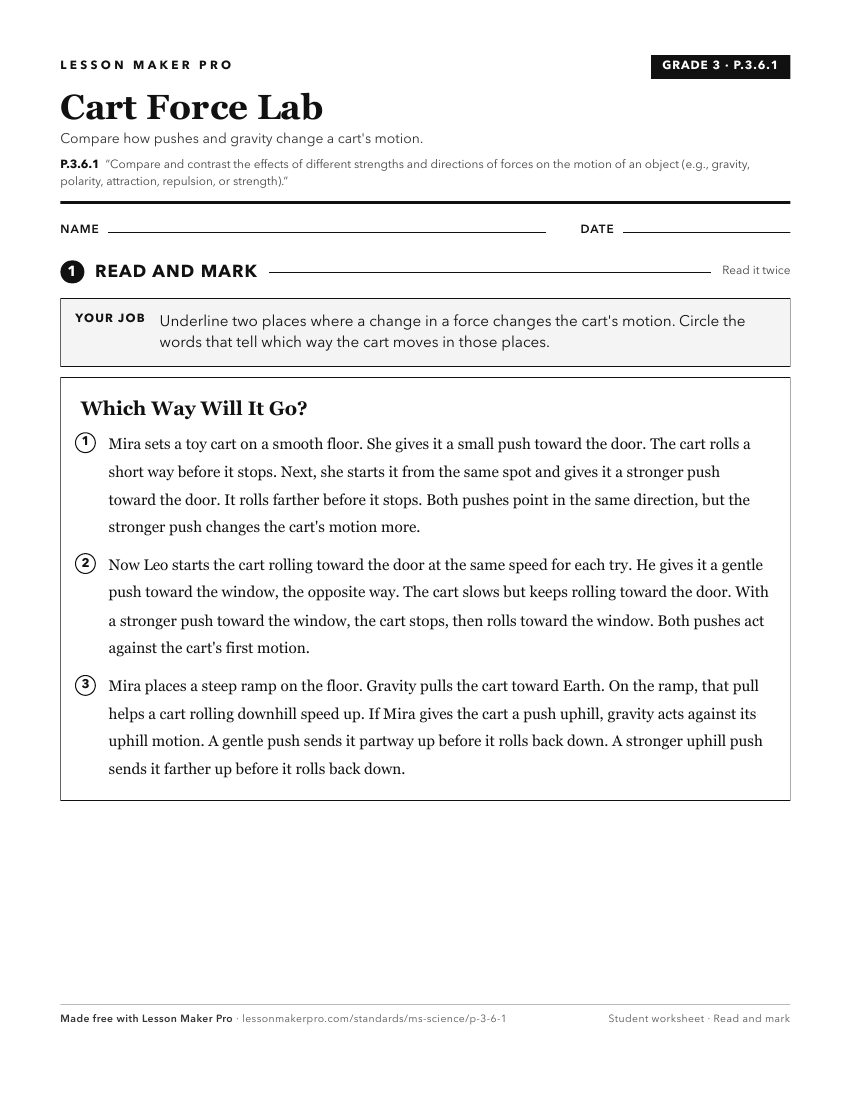
A ready-to-print activity worksheet aligned to P.3.6.1, with an answer key for the teacher on its own page. No account needed.
PDF, US Letter, prints cleanly in black and white.
Download the worksheetKeep exploring
Related Standards
- P.6.6.6
Investigate forces (gravity, friction, drag, lift, thrust) acting on objects (e.g., airplane, bicycle helmets). Use data to explain the differences between the ...
- P.6.6.4
Compare and contrast magnetic, electric, frictional, and gravitational forces.
- P.3.6.2
Plan an experiment to investigate the relationship between a force applied to an object (e.g., friction, gravity) and resulting motion of the object.
- P.5.6.3
Develop and use models to explain how the amount or type of force, both contact and non-contact, affects the motion of an object.
Turn this exact standard into a lesson
Grade, subject, topic, and the complete standard are prefilled. Create one free, no account needed.
Also for this standard:Make a WorksheetMake a QuizMake a Sub Lesson