Mississippi Science P.3.6
Standard Cluster
Students will demonstrate an understanding of magnets and the effects of pushes, pulls, and friction on the motion of objects. Compare and contrast the effects of different strengths and directions of forces on the motion of an object (e.g., gravity, polarity, attraction, repulsion, or strength). Plan an experiment to investigate the relationship between a force applied to an object (e.g., friction, gravity) and resulting motion of the object. Research and communicate information to explain how magnets are used in everyday life.
2026 Mississippi College- and Career-Readiness Standards for Science · Motion, Forces, and Energy
Cluster contents
Standards in This Cluster
P.3.6 is a cluster heading. These are the individual standards under it.
- P.3.6.1
Compare and contrast the effects of different strengths and directions of forces on the motion of an object (e.g., gravity, polarity, attraction, repulsion, or ...
- P.3.6.2
Plan an experiment to investigate the relationship between a force applied to an object (e.g., friction, gravity) and resulting motion of the object.
- P.3.6.3
Research and communicate information to explain how magnets are used in everyday life.
Teacher's field guide
What This Cluster Means
What Students Need to Do
- Students test how pushes, pulls, friction, gravity, and magnets change an object's motion. They plan a fair test, record what happens, and explain an everyday use for a magnet.
What Mastery Looks Like
- Students can predict how a harder push, a rougher surface, or a sloped ramp will change a toy car's motion. They can change one condition, measure how far the car travels, and explain the result. They can show when magnets attract or repel and explain how a magnetic cabinet latch works.
Common Misconceptions
- Students may think magnets attract every metal and that any two magnet ends stick together. They may think friction acts only when an object stops, not while it slows down. They may change both ramp height and surface in a test, then claim one caused the result.
How to Assess It
- Exit ticket: A toy car rolls from the same ramp onto tile and onto a towel. Ask students where it will travel farther, why, and how they would measure the difference fairly.
Lesson moves
Ways to Teach It
Release a toy car from the same ramp height onto tile and a towel, then measure how far it rolls on each.
Ask students to write what happens when a rolling ball gets a gentle push from behind versus a hard push from the side.
Play magnet match: pairs predict whether labeled magnet ends will attract or repel, then test each pairing and tally correct predictions.
Give students a short fact sheet about magnetic cabinet latches, then have them draw and label how one keeps a door shut.
Free download
Printable P.3.6 Worksheet
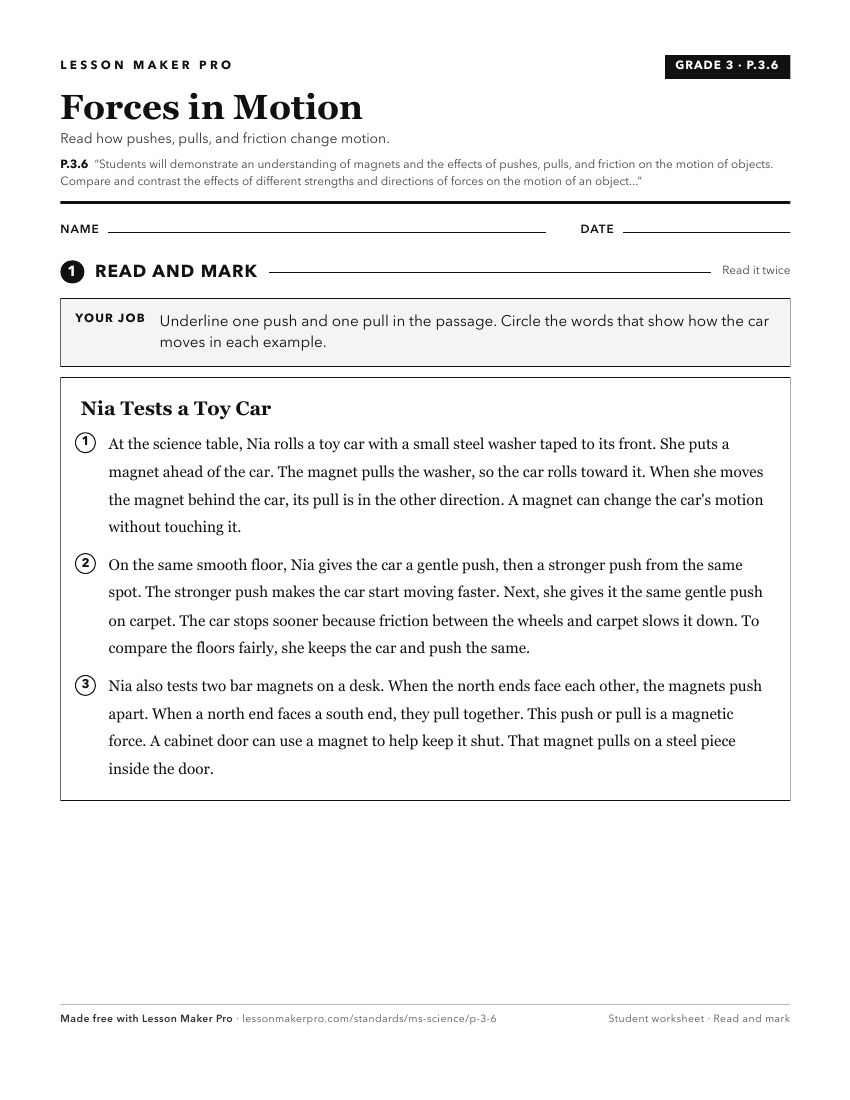
A ready-to-print activity worksheet aligned to P.3.6, with an answer key for the teacher on its own page. No account needed.
PDF, US Letter, prints cleanly in black and white.
Download the worksheetKeep exploring
Related Standards
- P.2.6
Students will demonstrate an understanding of how the motion of objects is affected by pushes, pulls, and friction on an object.
- PHS.5
Students will analyze the scientific principles of motion, force, and work.
- P.5.6
Students will demonstrate an understanding of the factors that affect the motion of an object through a study of Newton's Laws of Motion.
- P.5.5A
Students will demonstrate an understanding of the physical properties of matter.
Turn this cluster into a lesson
Grade, subject, topic, and the complete cluster are prefilled. Create one free, no account needed.
Also for this cluster:Make a WorksheetMake a QuizMake a Sub Lesson