Mississippi Science P.5.5A
Standard Cluster
Students will demonstrate an understanding of the physical properties of matter. Obtain and evaluate scientific information to describe basic physical properties of atoms and molecules. Collect, analyze, and interpret data from measurements of the physical properties of solids, liquids, and gases (e.g., volume, shape, movement, and spacing of particles). Analyze matter through observations and measurements to classify materials (e.g., powders, metals, minerals, or liquids) based on their properties (e.g., color, hardness, reflectivity, electrical conductivity, thermal conductivity, response to magnetic forces, solubility, or density). Make and test predictions about how the density of an object affects whether the object sinks or floats when placed in a liquid. Design a vessel that can safely transport a dense substance (e.g., syrup, coins, marbles) through water at various distances and under variable conditions. Use an engineering design process to define the problem, design, construct, evaluate, and improve the vessel. *
2026 Mississippi College- and Career-Readiness Standards for Science · Organization of Matter and Chemical Interactions
Cluster contents
Standards in This Cluster
P.5.5A is a cluster heading. These are the individual standards under it.
- P.5.5A.1
Obtain and evaluate scientific information to describe basic physical properties of atoms and molecules.
- P.5.5A.2
Collect, analyze, and interpret data from measurements of the physical properties of solids, liquids, and gases (e.g., volume, shape, movement, and spacing of p...
- P.5.5A.3
Analyze matter through observations and measurements to classify materials (e.g., powders, metals, minerals, or liquids) based on their properties (e.g., color,...
- P.5.5A.4
Make and test predictions about how the density of an object affects whether the object sinks or floats when placed in a liquid.
- P.5.5A.5
Design a vessel that can safely transport a dense substance (e.g., syrup, coins, marbles) through water at various distances and under variable conditions. Use ...
Teacher's field guide
What This Cluster Means
What Students Need to Do
- Students use simple sources to describe atoms and molecules. They measure and compare solids, liquids, and gases, then sort materials by properties they can test. They predict what will float and build a vessel to carry a heavy load across water.
What Mastery Looks Like
- A student can use measurements to sort unknown materials and explain how particles move in solids, liquids, and gases. They can use mass and volume to predict whether an object will float in water. They can test a loaded vessel, spot why it failed, and improve it.
Common Misconceptions
- Students may think a heavy object must sink, even if its shape traps air. Some think particles in a solid do not move at all. Others assume two materials with the same color must have the same properties.
How to Assess It
- Exit ticket: Water has a density of 1 g/mL. A 30 g block takes up 20 mL, and a 10 g block takes up 20 mL. Which block floats, and how do you know?
Lesson moves
Ways to Teach It
Give groups foil, tape, and ten coins to build boats; test each in a tub, add waves, then revise the design.
Ask students to draw particles in ice, water, and steam, then explain what changes and what stays the same.
Set out salt, sand, foil, and paper clips; have teams sort them using a magnet and small cups of water.
Show a photo of a cargo ship, then ask students why its steel hull floats while a steel bolt sinks.
Free download
Printable P.5.5A Worksheet
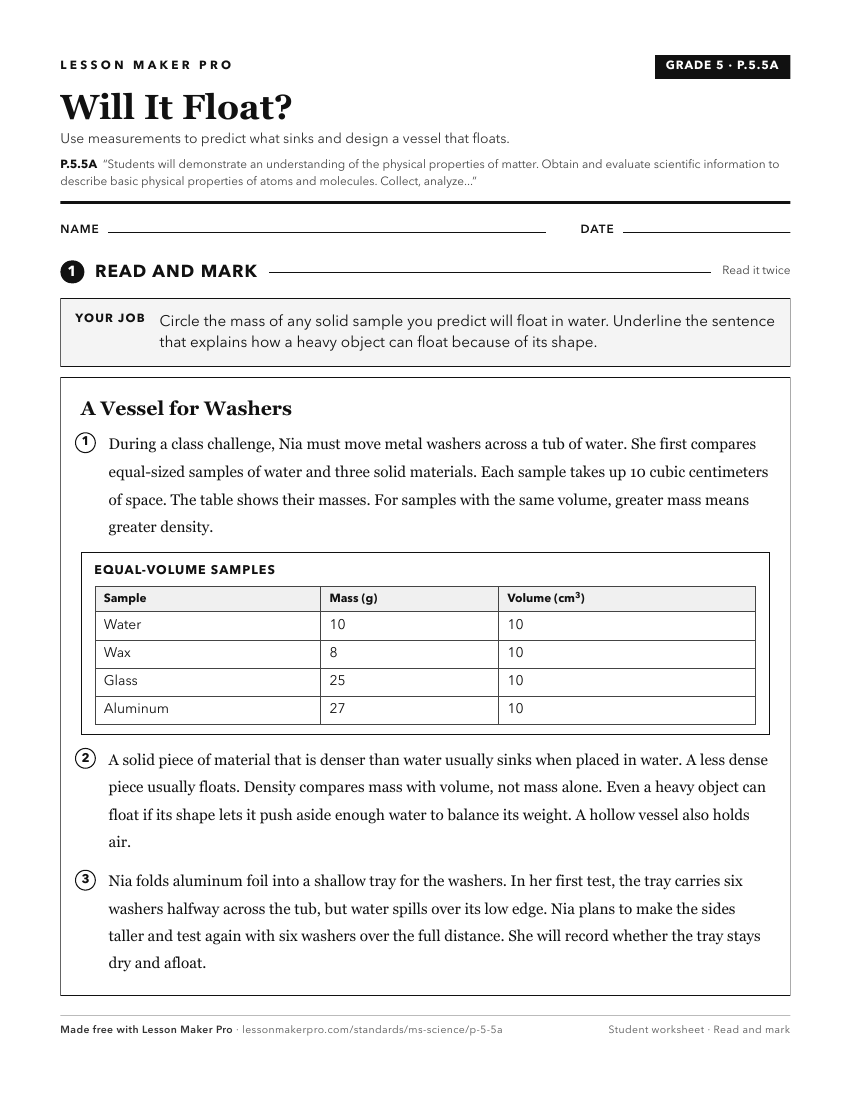
A ready-to-print activity worksheet aligned to P.5.5A, with an answer key for the teacher on its own page. No account needed.
PDF, US Letter, prints cleanly in black and white.
Download the worksheetKeep exploring
Related Standards
- PHS.1
Students will demonstrate an understanding of the nature of matter.
- P.K.5A
Students will demonstrate an understanding of the solid and liquid states of matter.
- P.7.5A
Students will demonstrate an understanding of the physical and chemical properties of matter.
- P.2.5
Students will demonstrate an understanding of the properties of matter.
Turn this cluster into a lesson
Grade, subject, topic, and the complete cluster are prefilled. Create one free, no account needed.
Also for this cluster:Make a WorksheetMake a QuizMake a Sub Lesson