Mississippi Science P.7.5A
Standard Cluster
Students will demonstrate an understanding of the physical and chemical properties of matter. Collect and evaluate qualitative data to describe substances using physical properties (state, boiling/melting point, density, heat/electrical conductivity, color, and magnetic properties). Analyze and interpret qualitative data to describe substances using chemical properties (the ability to burn or rust). Compare and contrast chemical and physical properties (e.g., combustion, oxidation, pH, solubility, reaction with water).
2026 Mississippi College- and Career-Readiness Standards for Science · Organization of Matter and Chemical Interactions
Cluster contents
Standards in This Cluster
P.7.5A is a cluster heading. These are the individual standards under it.
- P.7.5A.1
Collect and evaluate qualitative data to describe substances using physical properties (state, boiling/melting point, density, heat/electrical conductivity, col...
- P.7.5A.2
Analyze and interpret qualitative data to describe substances using chemical properties (the ability to burn or rust).
- P.7.5A.3
Compare and contrast chemical and physical properties (e.g., combustion, oxidation, pH, solubility, reaction with water).
Teacher's field guide
What This Cluster Means
What Students Need to Do
- Students describe materials using color, state, magnetism, density, solubility, and melting or boiling points. They check how materials carry heat or electricity. They use pH results and evidence of burning, rusting, or reacting with water to describe chemical properties.
What Mastery Looks Like
- Given a table of materials, a student can identify an unknown using observations such as color, magnetism, and solubility. They can explain why the ability to rust is a chemical property, while the ability to dissolve is a physical property.
Common Misconceptions
- Students often call dissolving a chemical change because the solid seems to disappear. They may think any color change proves a reaction. Some confuse boiling with burning because both involve heat.
How to Assess It
- Exit ticket: Sort these as physical or chemical properties, then explain two choices: an iron nail sticks to a magnet, salt dissolves in water, iron can rust, and paper can burn.
Lesson moves
Ways to Teach It
Give pairs a magnet, salt, an iron nail, and cups of water; have them record color, magnetism, and whether each solid dissolves.
Ask students to write why salt dissolving in water is a physical change while iron rusting is a chemical change.
Give pairs cards labeled boiling point, solubility, electrical conductivity, ability to burn, and ability to rust; have them sort the cards by property type.
Show a rusty bike chain and a plastic chain guard; ask why only one can rust after rainy rides.
Free download
Printable P.7.5A Worksheet
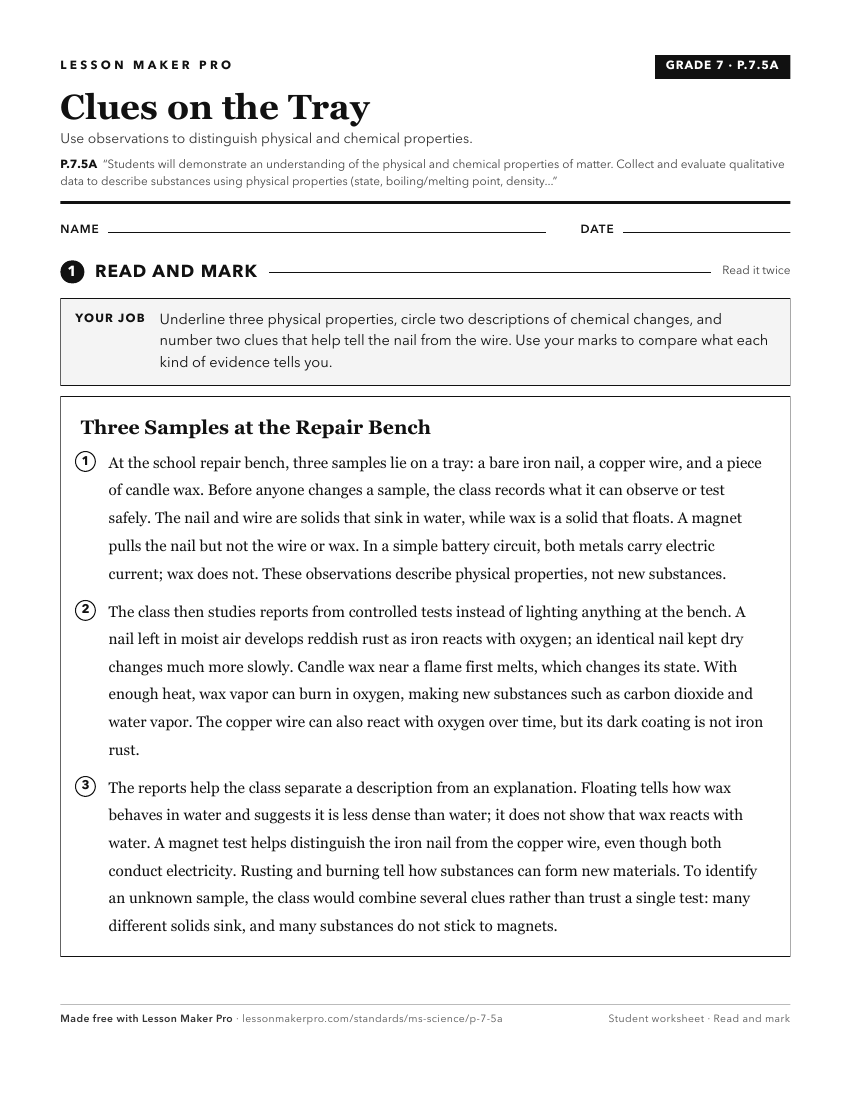
A ready-to-print activity worksheet aligned to P.7.5A, with an answer key for the teacher on its own page. No account needed.
PDF, US Letter, prints cleanly in black and white.
Download the worksheetKeep exploring
Related Standards
- PHS.1
Students will demonstrate an understanding of the nature of matter.
- P.K.5A
Students will demonstrate an understanding of the solid and liquid states of matter.
- P.5.5A
Students will demonstrate an understanding of the physical properties of matter.
- P.2.5
Students will demonstrate an understanding of the properties of matter.
Turn this cluster into a lesson
Grade, subject, topic, and the complete cluster are prefilled. Create one free, no account needed.
Also for this cluster:Make a WorksheetMake a QuizMake a Sub Lesson