Mississippi Science P.K.5A
Standard Cluster
Students will demonstrate an understanding of the solid and liquid states of matter. Generate questions and investigate the differences between liquids and solids and develop awareness that a liquid can become a solid and vice versa. Describe and compare the properties of different materials (e.g., wood, plastic, metal, cloth, paper) and classify these materials by their observable characteristics (visual, aural, or natural textual) and by their physical properties (weight, volume, solid or liquid, and sink or float).
2026 Mississippi College- and Career-Readiness Standards for Science · Organization of Matter and Chemical Interactions
Cluster contents
Standards in This Cluster
P.K.5A is a cluster heading. These are the individual standards under it.
- P.K.5A.1
Generate questions and investigate the differences between liquids and solids and develop awareness that a liquid can become a solid and vice versa.
- P.K.5A.2
Describe and compare the properties of different materials (e.g., wood, plastic, metal, cloth, paper) and classify these materials by their observable character...
Teacher's field guide
What This Cluster Means
What Students Need to Do
- Students ask questions and test how solids and liquids behave. They watch ice melt and water freeze. They sort materials by how they look, sound, and feel, how heavy they are, how much space they take up, and whether they sink or float.
What Mastery Looks Like
- A student shows that an ice cube keeps its shape while water takes the shape of its cup. They explain that ice melts into water and water freezes into ice. They sort objects by a property they observed or tested.
Common Misconceptions
- Some children think ice becomes a different material when it melts. They may think a liquid takes up no space because it changes shape, or that every heavy object sinks.
How to Assess It
- Show an ice cube, a cup of water, a wood block, and a metal spoon. Ask students to name the solid and liquid items, explain how ice and water change into each other, and choose one way to sort the block and spoon.
Lesson moves
Ways to Teach It
Give pairs ice cubes, water, and two clear cups to compare shapes as the ice melts and the water is poured.
Ask, 'How could we test whether a wooden block and a metal spoon both float?'
Play a sorting game with wood, plastic, metal, cloth, and paper samples: group them by sound when tapped, then by weight.
Show ice in a drink at snack time and ask what happens to it and how to turn the water back into ice.
Free download
Printable P.K.5A Worksheet
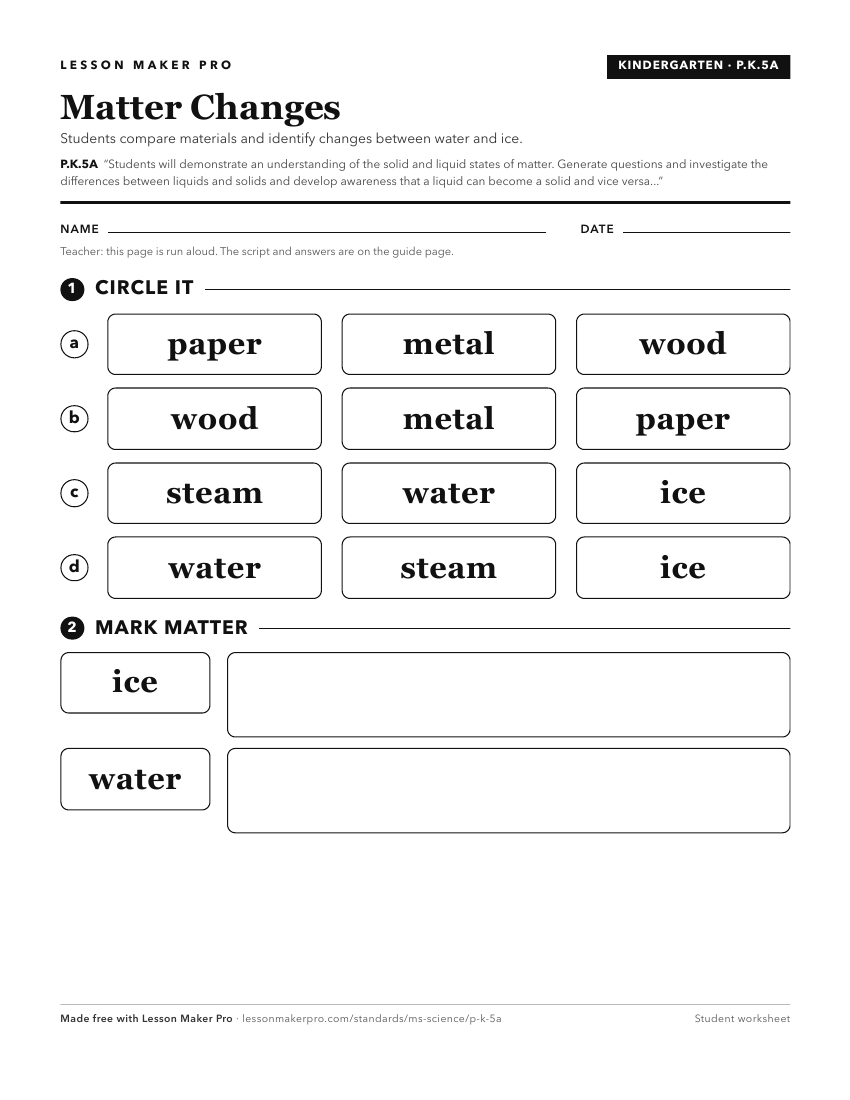
A ready-to-print activity worksheet aligned to P.K.5A, with an answer key for the teacher on its own page. No account needed.
PDF, US Letter, prints cleanly in black and white.
Download the worksheetKeep exploring
Related Standards
- PHS.1
Students will demonstrate an understanding of the nature of matter.
- P.7.5A
Students will demonstrate an understanding of the physical and chemical properties of matter.
- P.5.5A
Students will demonstrate an understanding of the physical properties of matter.
- P.2.5
Students will demonstrate an understanding of the properties of matter.
Turn this cluster into a lesson
Grade, subject, topic, and the complete cluster are prefilled. Create one free, no account needed.
Also for this cluster:Make a WorksheetMake a QuizMake a Sub Lesson