Mississippi Science P.5.5A.4
The Standard
- P.5.5A
- Students will demonstrate an understanding of the physical properties of matter.
Make and test predictions about how the density of an object affects whether the object sinks or floats when placed in a liquid.
2026 Mississippi College- and Career-Readiness Standards for Science · Organization of Matter and Chemical Interactions
Teacher's field guide
What This Standard Means
What Students Need to Do
- Students predict whether an object will sink or float in a liquid. They test it, record what happens, and compare the object's density with the liquid's.
What Mastery Looks Like
- A student predicts that a cork will float and a glass marble will sink in water. They test both and explain that the cork is less dense than water, while the marble is more dense.
Common Misconceptions
- Students may think heavy objects always sink and small objects always float. They may also think an object will behave the same way in every liquid, without comparing its density with the liquid's.
How to Assess It
- Put a cork and a glass marble beside a cup of water. Have students predict what each will do, test both, and write a density-based explanation for each result.
Lesson moves
Ways to Teach It
Have pairs predict whether a cork, a glass marble, and a steel spoon will float in water, then test each in a clear tub.
Ask students to write why a large wooden log floats while a small coin sinks, using density compared with water.
Teams race to sort density cards for cork (0.2), ice (0.9), glass (2.5), and steel (7.8) into float or sink in water (1.0).
Show a cargo ship photo and have students label its air-filled hull, then explain why the whole ship floats despite its steel parts.
Free download
Printable P.5.5A.4 Worksheet
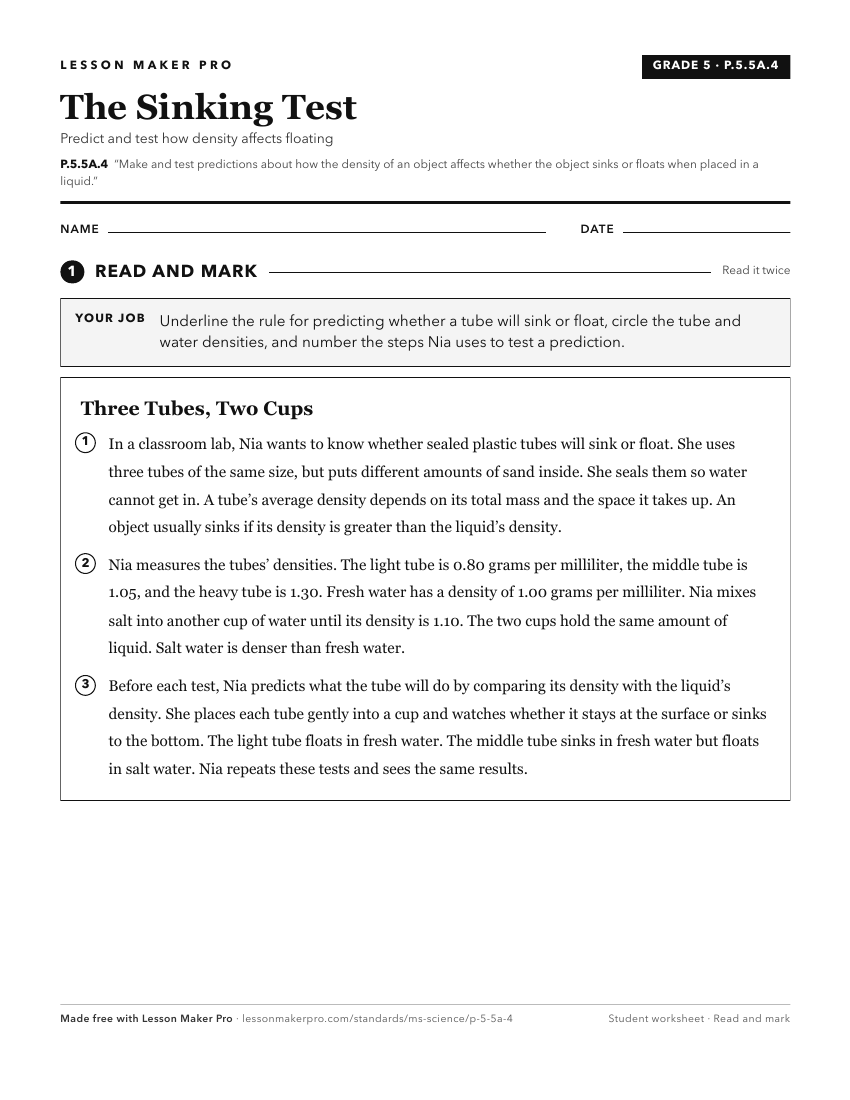
A ready-to-print activity worksheet aligned to P.5.5A.4, with an answer key for the teacher on its own page. No account needed.
PDF, US Letter, prints cleanly in black and white.
Download the worksheetKeep exploring
Related Standards
- PHS.1.5
Design and conduct an investigation using graphical analysis (e.g., line graph) to determine the density of liquids and/or solids.
- P.K.5A.1
Generate questions and investigate the differences between liquids and solids and develop awareness that a liquid can become a solid and vice versa.
- ZOO.7.8
Enrichment: Use an engineering design process to design a “balloon fish” that has neutral buoyancy (i.e., does not sink or float). Report which materials were u...
- P.2.5.3
Compare the weight of solid objects and the volume of liquid objects. Analyze and communicate findings.
Turn this exact standard into a lesson
Grade, subject, topic, and the complete standard are prefilled. Create one free, no account needed.
Also for this standard:Make a WorksheetMake a QuizMake a Sub Lesson